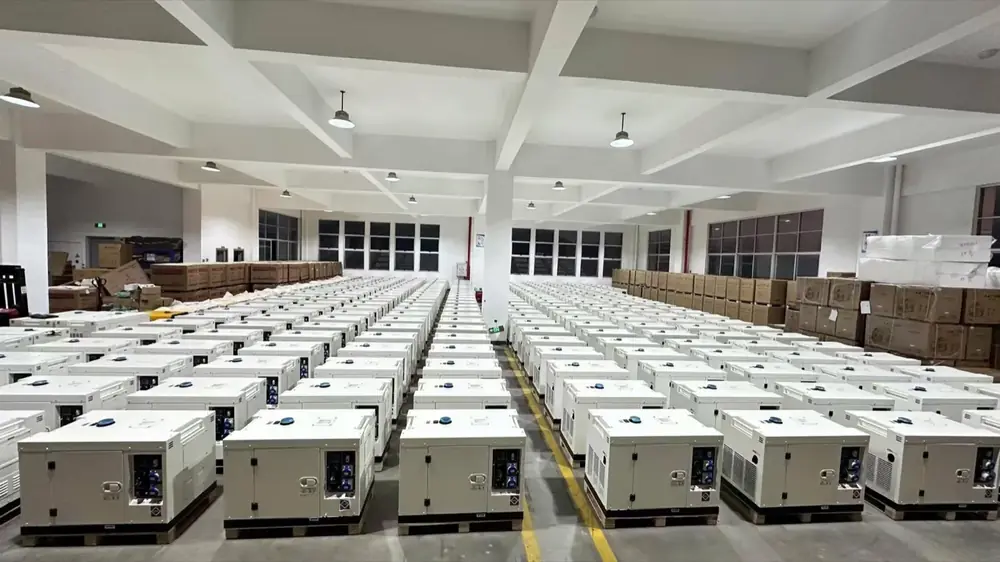
An event centre is sized on its worst minute, not its average hour. If the load list does not say which equipment can be running at the same moment, the sizing has not started yet.
Why an event centre is easy to size wrongly
A generator is usually sized on a load list, and an event centre produces an unusual one. The site is quiet for hours, then demands everything at once when the doors close and the programme starts.
Anyone sizing the set from a monthly electricity bill will understate it badly. The bill describes consumption, which is energy over time. The set has to answer for demand, which is what is being drawn at one instant.
The practical consequence is that an event centre quotation should be built from equipment, not from a single kVA label. Ask for the load list to be written into the offer so the assumptions are visible.
Lighting, sound and cooling as three separate loads
Treat the venue as three load families and keep them apart on the list. They behave differently on startup, and mixing them into one total hides the part that matters.
Stage lighting is largely resistive, so it draws close to its nameplate figure while it is on. The size of the rig matters less than how much of it is switched on at the same time. Dimming systems and moving heads add their own behaviour, and the lighting designer is the person who knows the real figure.
Sound is the smallest of the three in raw power and the least predictable. Amplifiers draw in bursts that follow the music, and large systems can pull far above their idle demand on transients. A sound engineer who knows the rig is a more useful source than a catalogue.
Air conditioning is the family most often underestimated. When a hall fills with people and the doors open, the cooling load climbs and the compressors start in sequence. Compressor starting is the classic reason a set trips on a load that looked comfortable on paper.
Which loads actually run at the same time
This is the single most valuable line in an event centre enquiry. A list that adds every item together will be oversized and expensive; a list that assumes everything is staggered will trip at the worst possible moment.
Write the site as a short timeline instead of a total. Doors open, house lights on, cooling running. Programme starts, stage lighting and sound up together. Interval, catering equipment on. Close, cleaning lights and cooling on while the rest comes down.
Mark the moment with the highest simultaneous demand and the equipment involved. That moment, not the sum of the whole list, is what the set has to carry.
Noise is a planning input, not a preference
In a venue, the enclosure decision is driven by where the set can physically stand. A set close to the hall, or to a neighbouring property, needs acoustic treatment that a set behind a wall does not.
An open set is the cheaper machine and the louder one. A silent canopy enclosure costs more and reduces what the audience and the neighbours hear. Neither is automatically correct; the site layout decides.
Two details are worth settling before the quotation is issued. First, where the exhaust will discharge, because the exhaust note and the flue direction affect what people hear and smell. Second, whether the set will be tested at the site before the first event, so the noise level is confirmed rather than assumed.
Transfer time and what the audience notices
The length of the interruption is a venue decision, not a technical one. A few seconds of darkness between acts is survivable. A blackout during a wedding speech is not.
A changeover panel restores supply automatically once the mains fails and the set is running, so the interruption is short. A manual changeover depends on somebody being present and knowing the procedure.
Ask the supplier to state how the changeover works, what the set has to do before it accepts load, and whether the arrangement is tested before the event. For a venue with a programme that cannot be interrupted, the discussion moves on to a second set rather than a faster panel.
Continuous supply and the case for a second set
Some event centre loads cannot be dropped at all: refrigeration for catering, security systems, and the lighting needed to evacuate a hall safely. Those loads are usually small, and they are the argument for splitting the supply.
The usual arrangement is a smaller set that carries the essential circuits continuously and a larger set that runs the show. The two do not have to run together, and they give the venue a fallback if either needs service.
Where the programme itself cannot be interrupted, the question becomes whether two sets can share the load or whether one stands by for the other. Either way it should be written into the quotation, because load sharing, synchronising and changeover between two sets are scope items, not accessories.
The service side matters as much as the machines. A set that cannot be maintained between events will fail during one. Ask what consumables and spare parts should be kept on site.
What to send for a checked event centre quotation
Send the equipment, not just a rating. Lighting rig and its control, sound system, air conditioning tonnage and type, catering equipment, lifts or hoists, and the essential circuits that must never drop.
Add the site facts: where the set can stand, the distance to the nearest neighbour, whether there is a fuel store, and who operates the changeover. Add the commercial facts: the delivery term, the destination, and whether installation is expected.
Two other site types are planned from the same starting point, a load list: a mixed farm and an industrial plant.
Request an event centre generator quotation
Send the equipment list and the site facts and ask for the load list to be written into the offer, so the sizing assumptions can be checked before anything is ordered.
Get a written quotation
Three fields. We reply with the rating, the engine option and the delivery basis.
Event centre generator questions
How do I size a generator for an event centre?
Build the list from equipment rather than from a bill, keep lighting, sound and cooling separate, then identify the moment when the highest number of those loads run together. Size the set on that moment and state the enclosure from where the set has to stand.
Is a silent generator necessary for an event centre?
It depends on the layout. A set installed away from the hall and away from neighbours may not need acoustic treatment. A set that has to stand close to the audience or a boundary usually does, so the distance is the deciding fact.
What transfer time should an event centre plan for?
That is a venue decision. A changeover panel restores supply automatically and shortens the interruption; a manual changeover depends on an operator being present. For a programme that cannot be interrupted at all, the answer is usually a second set rather than a faster panel.
Can one generator run the whole event centre?
It can, and many venues do run a single set. The reason to consider two is not total capacity but the loads that must never drop, such as catering refrigeration and evacuation lighting, which are usually small enough to carry separately.
Why did a generator trip when the air conditioning started?
Compressor and motor starting draws far more current than running does, and if several compressors start together the surge can exceed what the set can supply momentarily. That is why the starting method and the sequence matter as much as the total load.
What should an event centre generator quotation include?
The rating with its duty basis, the engine and alternator identified by model, the enclosure type and acoustic treatment, the changeover arrangement, the electrical scope, the fuel arrangement and the delivery term. Installation and site work should be stated separately unless they are included.
