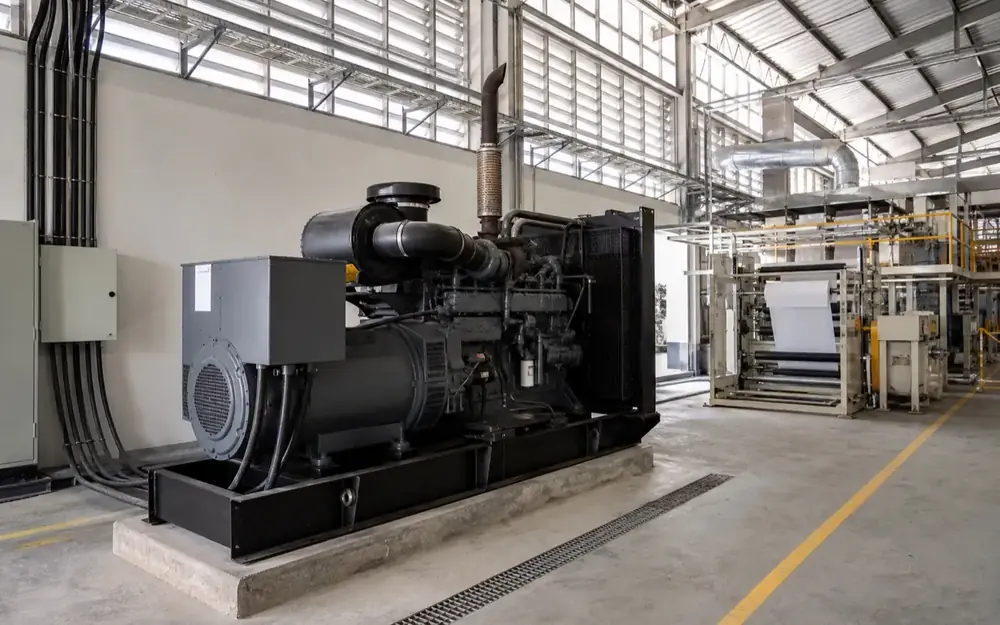
An industrial set is defined by what it is asked to do continuously, not by the size of its label. Two sets with the same kVA can differ completely in duty rating, starting capability and protection, and only one of them may suit a plant.
What makes a set industrial rather than commercial
The word industrial describes the duty the set is bought for, and the duty changes almost every other decision. A commercial set usually covers a defined building load and runs occasionally. An industrial set often carries a production load, may run for long blocks of hours or continuously, and may be one of several sources feeding the same plant.
That difference shows up in four places. In the rating basis, because a prime or continuous rating is not the same commitment as a standby rating. In the cooling and ventilation design, because the set has to reject heat for hours rather than minutes. In the protection and breaker scope, because a fault on a plant has a different consequence. And in the service plan, because maintenance intervals arrive far more often on a set that runs every day.
It also changes the specification conversation. An industrial buyer usually has an electrical drawing, a motor list and a plant engineer, and the useful work is in reconciling the supplier's offer with those, rather than in comparing headline figures.
The industrial bands this site describes
This site organises its larger sets into bands rather than single ratings, because the engineering question changes as the band rises. A 100-300kVA band is usually about a project or a mid-size plant; a 300-500kVA band about a heavier industrial load with several large motors; and a 500-2000kVA band about heavy project work where a single set may not be the answer at all.
What changes across those bands is not just capacity. Loading sequence becomes a design question rather than an operational detail, ventilation and acoustic treatment become structural, and transport and offloading start to constrain the specification as much as the electrical requirement does.
The band pages exist so that a buyer can see the same decisions applied consistently at each level. The 100-300kVA band, the 300-500kVA band and the 500-2000kVA band follow the same structure, and the product directory lists the ratings described on this site.
Why motor starting decides the specification
A plant load list is mostly motors, and motors draw a multiple of their running current when they start. The multiplier depends on the starting method rather than on the motor alone.
Direct-on-line starting draws a multiple that industry references describe as roughly six to eight times the running current. Star-delta reduces that, to something like two to two and a half times running current, at the cost of a transition step. A soft starter reduces it again, to roughly three times running current, and a variable frequency drive ramps the motor so the starting current approaches the running current rather than multiplying it.
Because an industrial plant usually has several motors, the sizing question is not only about the largest one. It is about which motors can start at the same moment, and what else is already running when they do. Two plants with identical motor lists can need different sets if one starts its loads in sequence and the other starts them together.
The starting methods and their effect on generator sizing are explained in more detail in the three-phase motor sizing page and in the motor starting methods guide.
The selection order that avoids re-quoting
Most industrial enquiries that go through several rounds of re-quoting do so because the questions were asked in the wrong order. Capacity is the easiest item to name and the most expensive one to get wrong, so it belongs near the end of the conversation, not at the start.
The table below is the order that produces a specification a supplier can price once. It also produces something more useful than a price: it tells you which numbers are assumptions and which are measurements.
| Order | Question | What it fixes |
|---|---|---|
| 1 | Duty and running hours | Whether the offer should be built on a prime or standby basis. |
| 2 | Load list and largest motor | The starting demand the set has to absorb. |
| 3 | Simultaneous starting | Whether a smaller set is possible with sequenced starting. |
| 4 | Voltage, phase and frequency | The electrical configuration the plant actually uses. |
| 5 | Protection and changeover | The breaker, protection and transfer scope required. |
| 6 | Enclosure, cooling and position | Attenuation, ventilation and placement constraints. |
| 7 | Transport and offloading | Crate dimensions, mass and the delivery arrangement. |
| 8 | Candidate rating and platform | The comparison of engine options at the resulting band. |
Voltage, phase and the plant connection
Nigerian industrial sites normally distribute at 415 V three-phase and 50 Hz, with 230 V available for single-phase circuits. Those are the figures an offer should be written against, because a set configured for a different voltage or frequency cannot simply be adjusted on arrival.
Frequency is worth stating explicitly. A set built for 50 Hz will not serve a site that runs 60 Hz equipment, and the difference is a factory configuration rather than a setting. The same applies to single-phase and three-phase output: a plant with three-phase motors needs a three-phase source, and the phase arrangement belongs in the first message rather than in the last.
The connection point matters too. Ask where the set will be tied into the plant, whether there is an existing changeover arrangement, and whether the set has to run in parallel with another source at any point. Parallel operation is a design decision, not an accessory, and it changes the controller and protection scope.
The unit conversions behind these figures are set out in the kW, kVA and kWh guide, and a factory-level view of what can be recorded before shipment is in the factory acceptance test page.
How the rating is arrived at in the first place is set out in the sizing guide, and where these sizes sit against the smaller bands in the 50kVA page.
Request an industrial generator quotation
Send the duty and running hours, the load list with the largest motor and its starting method, whether the plant starts loads together or in sequence, the voltage, phase and frequency, and the protection and changeover scope required.
Get a written quotation
Three fields. We reply with the rating, the engine option and the delivery basis.
Industrial generator selection questions
What kVA range counts as industrial?
This site treats the bands from 100kVA upwards as project and industrial territory, with 300-500kVA describing heavier industrial loads and 500-2000kVA describing heavy project work. What makes a set industrial is the duty and the starting demand, not the label alone.
How much starting current does a motor draw?
Industry references describe direct-on-line starting as drawing roughly six to eight times running current, star-delta as reducing that to about two to two and a half times, a soft starter to roughly three times, and a variable frequency drive to near running current.
Do I need a larger set if several motors start together?
That depends on the plant's practice. If loads can be sequenced, a smaller set may be sufficient. If they start together, the set has to absorb the combined starting demand, so the size follows the operating practice rather than the motor list.
What voltage and frequency should an industrial set be built for in Nigeria?
Nigerian industrial sites normally distribute at 415 V three-phase and 50 Hz, with 230 V for single-phase circuits. Both the voltage and the frequency are factory configurations, so state them at the enquiry stage.
Do you claim to be an authorised distributor of any engine brand?
No. No authorised distributorship of any engine brand is claimed by this website or by a quotation from it. Engine options are offered subject to written quotation and model availability, and the offered model can be verified from the nameplate evidence.
Is a single large set always better than several smaller ones?
Not always. Several smaller sets can offer redundancy and easier transport, while a single large set can simplify control, protection and maintenance. The right answer depends on the plant's duty, its transport constraints and how much downtime it can tolerate.
