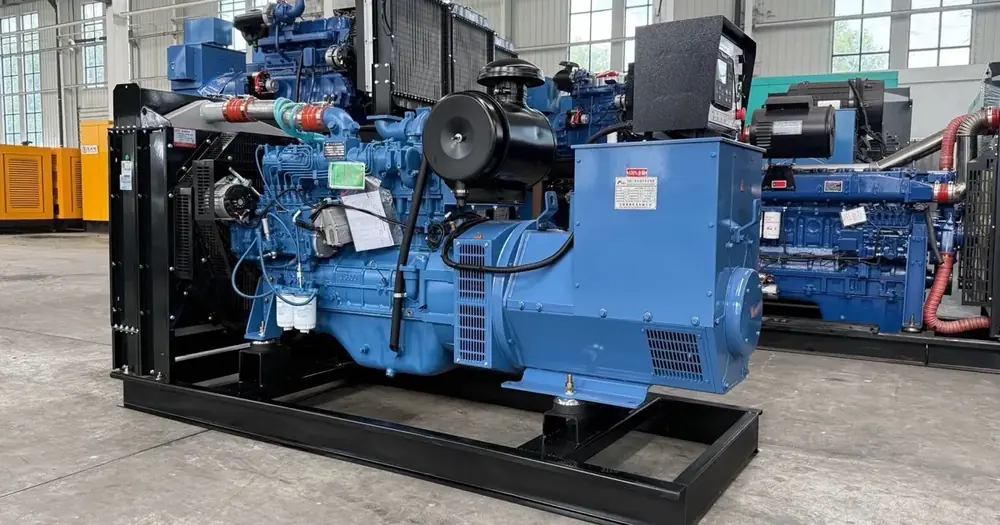
Send the compressor ratings and how many can start together, whether defrost is electric or hot gas, and the evaporator fan load. The compressor start and the defrost step decide the rating; the hours run decide the cost of owning it.
What a cold room actually draws
A cold room looks like a simple load: a compressor, some fans, a few lights. In practice it is a set of loads with very different behaviour, and the one that governs the generator is not the one that runs longest. Compressors cycle. Evaporator fans run continuously. Defrost heaters come on in steps on a timer. Door openings add load unpredictably, and a room being loaded with warm stock can run near continuous for hours.
The compressor is the machine that decides the rating. A hermetic or semi-hermetic compressor starting against a settled refrigerant pressure draws several times its running current for as long as it takes to build pressure differential, and the set has to carry that step without collapsing the voltage to the rest of the plant. If two compressors can start together — because a controller sequences them, or because a defrost terminates and both restart — that coincidence is the number the set must survive.
Everything else on site is small by comparison but adds up: condenser fans on a remote condensing unit, evaporator fans in each room, lighting, a pump for hot-gas defrost if that is the arrangement, and the office and cold-chain paperwork that has somehow ended up on the same board.
| Load | Duty | Electrical behaviour | What it decides |
|---|---|---|---|
| Compressor (hermetic or semi-hermetic) | Cycling, day and night | High locked-rotor current, long acceleration against pressure | The peak rating of the set |
| Second compressor start | Coincident with the first | Two steps in quick succession | Whether the set needs to be a frame larger |
| Defrost heaters | Timer-driven, several times a day | Large resistive step, no inrush | Transformer-free but still a step the set must absorb |
| Evaporator fans | Continuous | Many small motors, modest inrush | The overnight base load and the fuel bill |
| Condenser fans | Cycling with head pressure | Small motors | Behaviour in the hot season |
| Lighting and office | Continuous when staff are present | Electronic, sensitive to sag | Complaints about flickering and controller resets |
| Door heaters and controls | Continuous or cycling | Resistive and electronic | Small, but they must not reset during a start |
Compressor starting is the governing case
An induction motor at standstill with no back-EMF behaves close to a short circuit. That is why a compressor start is a step rather than a ramp, and why the set's voltage regulation matters more at that instant than at any other time in the day. The number on the compressor nameplate that matters is the locked-rotor current, not the running current.
Cold rooms in Nigeria are frequently fitted second-hand or reconditioned plant, and the nameplate may be missing, painted over, or in a language nobody on site reads. In that case the only reliable route is to measure: a clamp meter on the compressor during a start tells you more than any assumption about what a compressor of that size should draw.
There are three ways to reduce the step, and they are not interchangeable. A larger set absorbs it. A soft starter or a drive on the compressor reduces it, where the compressor is suitable. Better control sequencing prevents two compressors from starting together, which is free and is the most commonly skipped measure.
| Approach | What it does | Cost of getting it wrong | When to choose it |
|---|---|---|---|
| Oversize the set | Starting step becomes a smaller fraction of rating | Higher purchase price and light-load running | Where the compressor cannot be modified |
| Soft starter on the compressor | Reduces the step, extends acceleration | Some compressors are not suitable; heat in continuous duty | Where the compressor motor has six terminals or is inverter-ready |
| Sequenced starting | Prevents coincidence of starts and defrost | Requires a controller and a discipline | Almost always, in addition to something else |
| Reduce the load the set carries | Removes non-critical load during a start | Needs a split board | Where the room shares a board with office and lighting |
Starting-current multiples quoted elsewhere on this page are rules of thumb. The limitations are set out in their own section below.
Defrost is the step nobody puts in the load list
Frost builds on the evaporator, and the plant removes it on a timer. If the defrost is electric, a bank of heaters switches on for a fixed period several times a day, and that bank can be a substantial load in its own right. If the defrost is hot gas, the compressor keeps running and the load is different rather than absent.
The reason defrost deserves its own section is coincidence. Defrost timers on several rooms frequently run on the same clock, so three rooms can defrost together. Compressors are often locked out during defrost and restart together when it ends. The generator then sees a heater step, followed by a compressor step, at a time of day that has nothing to do with the plant's busy period and everything to do with when the timers were set.
The fix is administrative before it is electrical: stagger the defrost timers so that rooms do not defrost simultaneously, and make sure the compressor restart after defrost is staggered too. A plant that does this often finds the set it already owns is adequate.
Why undersizing shows up as short cycling
A compressor is protected against rapid restart by a timer, because starting against head pressure is hard on the motor. When the set is undersized, or when the voltage sags on each start and the compressor stalls, the plant responds by cycling more, not less: it starts, trips, waits, starts again. Each cycle is a fresh step on the generator, so the problem compounds through the day.
There is a second cycling effect that is easier to miss. A cold room that cannot hold temperature because the set is too small runs its compressor almost continuously, so the load the set sees is higher than the duty cycle assumed in the load list. The plant's own control system then behaves as though the room were warmer than it is, and the cycle becomes the whole day.
The observable symptom on site is a set that runs hot and a compressor that trips on overload rather than on pressure. Owners usually replace the compressor first. Measuring the voltage at the compressor terminals during a start is cheaper.
Running unattended overnight
Most cold room hours are unattended. The staff lock up, the room keeps running, and the first person back in the morning finds either a normal store or a loss. That asymmetry is what should drive the specification: the plant needs to be able to fail loudly, not silently.
Three things make the difference. A temperature alarm that runs on battery and calls or messages someone, rather than a display that only the night guard can read. A generator controller with remote notification or at least a fault log, so that a failed start at two in the morning leaves a record. And a log of room temperature against time, because after an incident the value of the stock that can be saved depends on how long the room was above temperature.
The loss window is not the same for every product. Frozen goods hold temperature for a while if the doors stay shut; chilled product and ice cream do not. A store that knows its own holdover time — measured, not assumed — can decide whether a second set, a bigger fuel tank or an alarm is the better investment.
The fuel bill is the business's second cost
A cold room generator does not run for an emergency hour a month. It runs for most of the hours the room exists, which makes it unlike almost any other generator on this site. For many frozen food businesses the fuel bill is the largest running cost after the stock itself, and it is the line item most often estimated rather than measured.
Measuring it is not difficult. Record the hours run and the litres added, per week, in one place. After a month the business knows its own litres per hour at its own load, and from that point every supplier's claim about economy, every decision about whether to run the room colder at night, and every comparison between repairing the old set and replacing it becomes a calculation rather than an opinion.
The other half of fuel is custody. A tank that is filled at night, by a driver who is not the owner, on a site where nobody counts, loses more than any efficiency measure can save. A lockable filler, a dip before and after delivery, and a signature on the delivery note are worth more than a fuel additive.
| Cost line | What drives it | How to measure it |
|---|---|---|
| Fuel | Hours run, average load, set efficiency, load factor | Litres added and hours run, logged weekly |
| Oil and filters | Running hours, dust, ambient | Service log against hour meter |
| Compressor wear | Number of starts, voltage quality at the terminals | Start counter where available, and a clamp meter on starts |
| Stock loss | Holdover time, alarm response, door discipline | Temperature log against incident log |
| Repairs to the set | Load factor, cooling airflow, fuel quality | Fault log and the reason for each visit |
None of these are purchase-price lines, and together they usually exceed the difference between two quotations for the same room. That is the argument for measuring before buying.
Sizing the set against the room
The load list for a cold room has four lines that matter: compressor running current, compressor locked-rotor or measured starting current, defrost heater rating, and the continuous fan and lighting load. Add the running total, then test the worst coincidence the plant can produce — the largest compressor starting while everything else runs.
Then apply the refrigeration side. A room being loaded with warm stock, or a room with poor door discipline, runs its compressor far longer than its design duty. If the room is already struggling to hold temperature during grid hours, the generator will inherit that struggle, because the same refrigeration plant is now being asked to do the same work on a set that may deliver a slightly different voltage.
Where the room is being expanded, or where a second room is planned, say so before the quotation. Cold room expansions are usually incremental — one more evaporator, one more condensing unit — and the generator is the component that cannot absorb the increment quietly.
Where the rules of thumb stop
This page uses three shortcuts: a direct-on-line motor draws roughly five to seven times full-load current while accelerating, a generator delivers roughly eight tenths of its kVA rating as kW, and the compressor start is the governing case. Each is a first approximation and none is a design calculation.
Compressor starting current depends on motor design, refrigerant pressures at start, and whether the compressor has an unloader or a soft start. A compressor restarting against head pressure is harder than a cold start. Power factor varies with load and is worse on a lightly loaded set than its nameplate implies. And on a room with electric defrost, the heater step can govern rather than the compressor, particularly where several rooms defrost together.
For a commercial room the defensible method is a measured load list — clamp meter readings at start and at running — checked against the alternator's ability to take the step, and confirmed with a load test that includes a defrost cycle and a compressor start. Where that is not possible, the set should be quoted with margin and the defrost timers staggered before the first night.
Siting a set beside a condensing unit
A cold room rejects heat, and so does a generator. Putting them in the same yard, facing each other, is the most common installation mistake on a cold room site: the condensing unit discharges hot air into the generator's radiator intake, the set runs hotter than it should, and both machines lose capacity in the hottest month, which is exactly when the room needs them most.
The remedies are simple and should be part of the quotation rather than discovered on site. Separate the discharges, or turn them so they do not face each other. Keep the radiator airflow path clear of drums, crates and spare parts. Give the set a plinth and a roof so that rain and washdown water do not reach it, while leaving the air path open.
Noise matters more than owners expect, because a cold room in a market or a residential street runs all night. A canopy helps, but placement helps more: a set at the boundary wall is a complaint, the same set at the back of the yard with the exhaust turned away is usually not.
Reading a cold room quotation
Two quotations for the same room often differ in exactly the places that decide whether the plant survives a bad night. The checklist below is the one we use when a cold room owner asks us to comment on a competing offer.
| Line item | Why it decides the outcome | What to ask |
|---|---|---|
| Rating basis | The set runs as a working machine, not an occasional standby | Prime or standby, and ambient temperature basis |
| Starting provision | Compressor start is the governing case | Oversized set, soft start, or sequenced starts |
| Defrost in scope | Heater step must be carried, not discovered | Has the defrost load been included in the calculation |
| Controller and alarms | Unattended overnight operation | Remote notification, fault log, high-temperature alarm |
| Fuel tank and custody | Running cost and theft | Tank size, gauge, lockable filler |
| Changeover | Nobody is present at 2am | Automatic with a defined transfer |
| Load test | Proves a compressor start and a defrost on the set | Included at commissioning, with the room at temperature |
| Service interval | Hours run, not calendar months | Basis of the service plan and who attends |
The week after commissioning is the most informative period in the plant's life. Log hours, litres and room temperature from day one; that record is what makes the second year cheaper than the first.
Get a written quotation
Three fields. We reply with the rating, the engine option and the delivery basis.
FAQ
How do I size a generator for a cold room in Nigeria?
Start from the compressor: its running current, its locked-rotor or measured starting current, and how many compressors can start together. Add the defrost heater step and the continuous fan load, then test the worst coincidence the plant can produce.
Why does the generator struggle when the compressor starts?
A compressor starting against refrigerant pressure draws several times its running current while it accelerates. If the set is close to the compressor rating, the voltage collapses and either the compressor stalls or the set trips. A larger set, a soft starter, or sequenced starts are the usual answers.
Can a cold room run entirely on a generator overnight?
It can, and many do. The set should then be quoted as prime power rather than standby, the fuel plan should be based on measured litres per hour, and the room should have an alarm that works while nobody is present.
Does electric defrost change the generator size?
It can. Electric defrost heaters are a large resistive step, and if several rooms defrost on the same timer the plant can present that step and a compressor restart close together. Staggering the timers is the cheapest fix.
Is fuel really the biggest running cost of a cold room?
For a room that runs most hours on generator, the fuel bill is usually the largest running cost after the stock itself. It is also the easiest to measure and the most often estimated instead of logged.
Should I choose hot gas or electric defrost for a generator-backed room?
Both work. Electric defrost is a clean resistive load but a large step; hot gas keeps the compressor running and changes the load profile rather than removing it. The choice should follow the refrigeration design, with the generator sized for whichever is installed.
What information do I need before asking for a quotation?
Compressor ratings and how many can start together, whether defrost is electric or hot gas, evaporator and condenser fan ratings, room volume, and whether expansion is planned. A clamp-meter reading of one compressor start is worth more than a nameplate guess.
