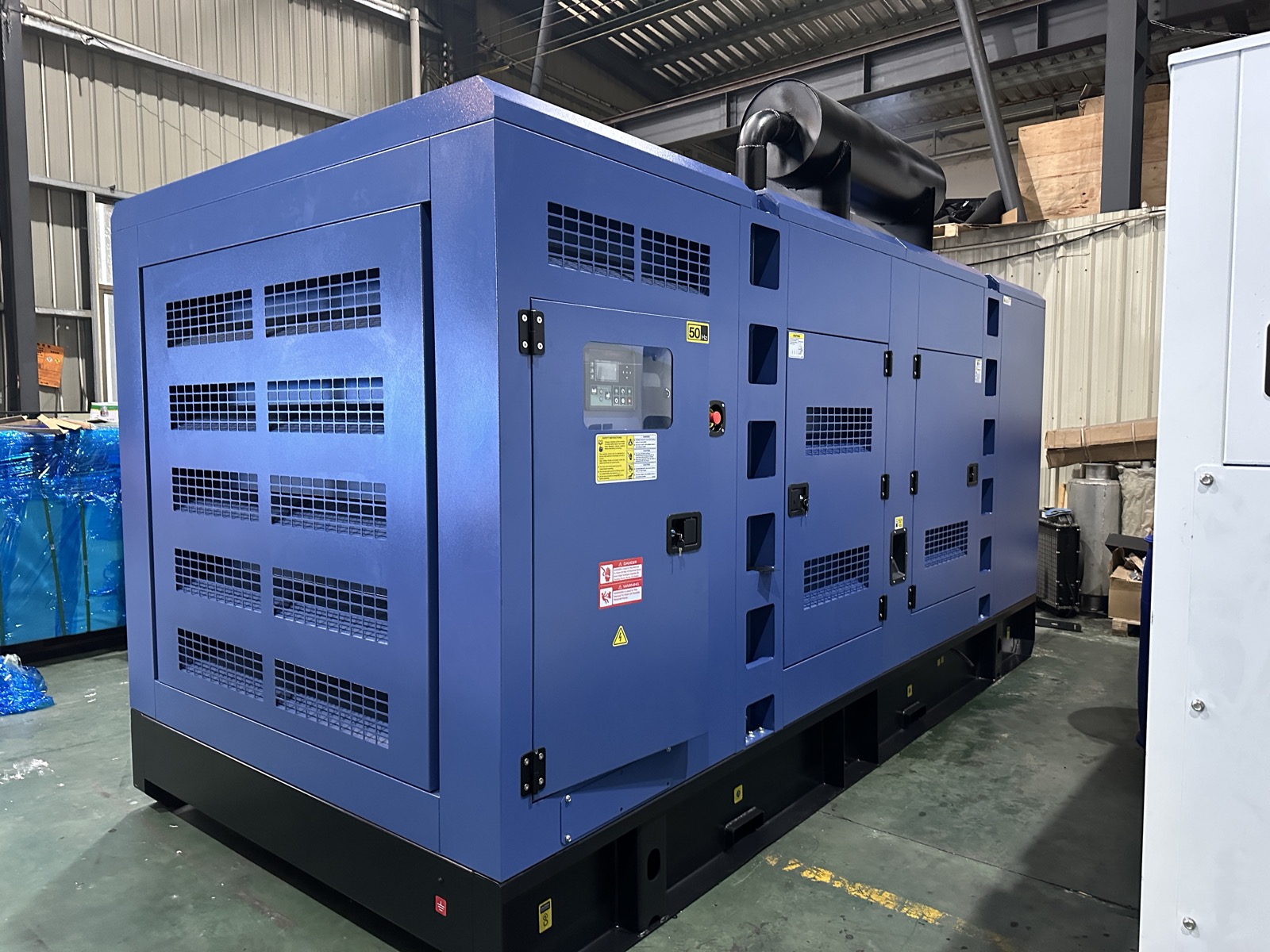
A diesel generator is happiest between roughly half and four-fifths of its rating. Below about 40 per cent it stops reaching clean combustion temperatures, and the unburned fuel shows up as wet stacking, carbon and diluted oil rather than as an immediate fault.
The size-up instinct, and what it actually buys
When a buyer is unsure between two ratings, the instinct is to take the larger one. It feels like margin, and for a transformer or a cable it would be. For a diesel generator it is a different trade: the set never works hard, and a diesel engine that never works hard does not stay in good condition.
The reason is combustion temperature. A diesel burns cleanly when the cylinder is hot enough and the fuel charge is matched to the load. At a quarter load the charge is small, the heat released per cycle is small, and the surfaces the flame touches stay cooler than the design intends. Fuel that does not fully burn leaves deposits instead of going out of the exhaust as gas.
That is the counter-intuitive part of generator selection: the risk of being too small is visible and immediate, while the risk of being too large is invisible for a year and then expensive. The sizing guide sets out the demand side; this page sets out what the machine does when the demand never arrives.
What actually happens below about 40 per cent load
The first sign is wet stacking: unburned fuel and oily residue collecting in the exhaust manifold, the turbo and the silencer. It shows as a dark, damp deposit rather than dry soot, and on a set with a turbo it can eventually seep past seals. It is not a fault in the injection system; it is the exhaust of an engine running below its working temperature.
The second is carbon on the injector tips, the piston crowns and the valve seats, together with glazing of the cylinder bores. Glazing is the polished, hardened surface that stops the rings bedding and sealing properly, and once it forms the engine starts burning oil as well as fuel. Neither condition is repairable by an additive.
The third is oil dilution. Fuel that reaches the sump past the rings thins the oil, and thin oil protects less. That shows up first in oil analysis and later as accelerated wear on bearings and the turbo. A set in this condition is not broken, which is exactly why the damage goes unnoticed until it is structural.
The efficiency cost is real, and it is the smaller half of the problem
Specific fuel consumption is not flat across the load range. A diesel engine produces its best fuel economy per kWh at a high fraction of its rating and gets progressively worse as the load falls, because the fixed losses of turning the engine are spread over fewer useful kilowatt hours. At a quarter load the litres per kWh can be substantially worse than at three-quarters.
So an oversized set costs twice: once in the purchase, and then continuously at the fuel pump. That second cost is the one that shows up in the operating budget every month, and it is covered in more detail in fuel consumption and in the cost-per-kWh method on kW, kVA and kWh.
It is worth being precise about which cost is larger. For most sites the mechanical damage is the bigger risk, because it arrives as a repair or a replacement rather than as a slightly higher fuel bill. The efficiency argument is the easy one to make, and the weaker one.
Where the healthy band actually sits
The bands below are the working rule rather than a law of physics, and the exact boundaries move with engine platform and rating definition. What does not move is the shape: too little load is a condition, not a margin.
Read the table against the site's typical load rather than its peak. A set sized for a peak that arrives twice a year spends the rest of its life in the first row.
| Load band | What the engine is doing | What to watch |
|---|---|---|
| Under about 40 per cent | Combustion temperature too low to burn the charge cleanly | Wet stacking, carbon, glazed bores, diluted oil |
| Around 40 to 50 per cent | Workable for limited periods, not a steady state | Exhaust condition and oil analysis over time |
| Around 50 to 80 per cent | The band the set was designed to live in | Only the normal wear items |
| Above about 80 per cent continuously | Thermal margin narrows and exhaust temperatures climb | Cooling performance and exhaust gas temperature |
| Standby, occasional full load | What a standby rating is defined for | Exercise it on load rather than at idle |
Recovering a set that has been idling for months
A lightly glazed set can often be brought back without a rebuild, by putting real load on it and keeping it there. The usual method is a load bank, applied progressively over several hours, followed by an oil and filter change and an oil analysis to see whether the dilution has stopped. Deposit in the exhaust usually burns off during the loaded run, which is why the process smells worse than it looks.
What does not work is running the set at no load for longer, or adding a fuel additive and hoping. Both leave the engine below its working temperature, which is the condition causing the problem. The maintenance items that matter in this situation are the ones in the maintenance service schedule, done on the hour meter rather than the calendar.
If a set has been sitting for months and will not start at all, the diagnosis path is different and starts with the battery and fuel system rather than the load: see will not start diagnosis.
Sizing so the set spends its life in a healthy band
The method is to plot the site's load profile before choosing a rating: what it draws overnight, what it draws at the busiest hour, and how long each lasts. The rating is then chosen so that the common condition lands in the healthy band and the peak is covered with the site's derating factors applied. Both numbers matter, and the peak alone is the wrong input.
Where the profile is genuinely spiky, the answer is often not a bigger set but a different arrangement: a smaller set for the base plus a second for peaks, or a set sized to the base with the largest motor started on a soft starter. That is a design decision rather than a catalogue one, and it connects to the derating question in high-temperature derating, because the same peak has to be met at 40 degrees C.
Whatever the arrangement, the number to hold onto is the typical load as a fraction of the rating. If that fraction is below about 40 per cent, the set is the wrong size regardless of how comfortably it covers the peak.
FAQ
At what load percentage is a diesel generator considered under-loaded?
Below roughly 40 per cent of its rating for extended periods. That is a working rule rather than a hard boundary, and it shifts with engine platform, but the shape of the problem does not: the further below it the set runs, and the longer it stays there, the more likely the deposits form.
Can under-loading damage a generator permanently?
It can, through glazed bores and carbon that eventually affects sealing and combustion. Most early cases recover by running the set under real load for several hours, changing the oil and confirming with oil analysis, but a set left at light load for years can need mechanical work.
Is it better to be slightly oversized than slightly undersized?
Neither extreme is good, but they fail differently. Undersized fails immediately and visibly at peak. Oversized fails slowly and quietly, and the bill arrives much later. The right answer is a rating where the typical load sits in the healthy band.
Does a load bank fix a set that has been running at low load?
It is the standard way to bring one back, applied progressively over several hours with the exhaust monitored. It is a recovery method, not a cure for the sizing decision that caused the condition.
Does the same rule apply to a standby set that only runs during outages?
A standby set runs loaded when it runs, which is what the rating is for. The risk appears when the outages are long and the site load during them is small, so the set sits at light load for hours at a time.
