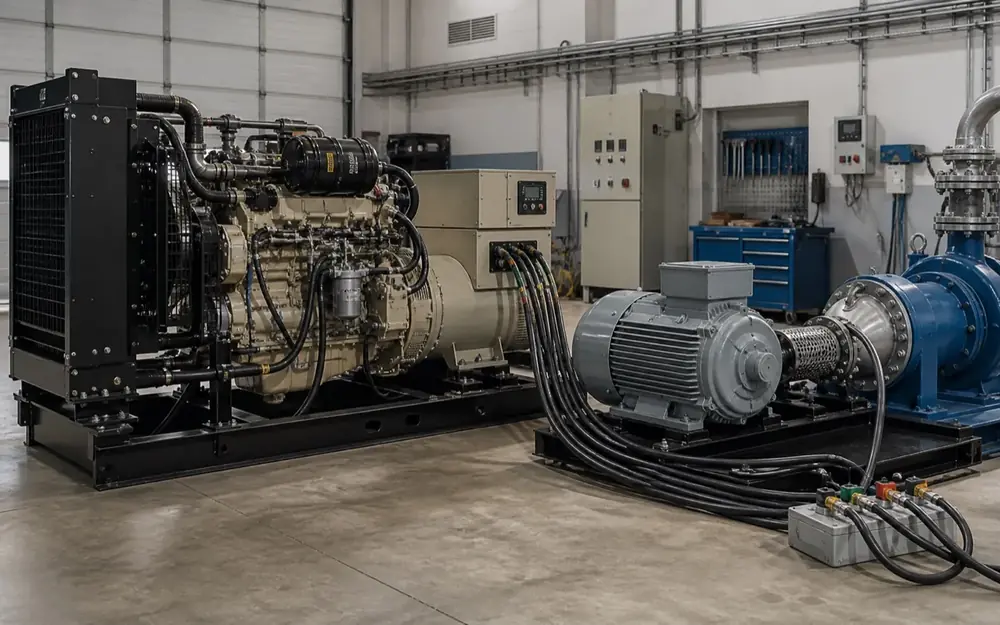
A motor draws far more current during acceleration than it does at running speed. The generator has to supply that starting current while also carrying every load that is already running, and that combination is what sets the required rating.
Why a motor load cannot be sized from kW alone
The question of generator size for 3 phase motor loads is decided by the start rather than by the total, which is why motor starting current is the first number to establish with the motor supplier.
A nameplate gives a motor's mechanical output at rated speed. It does not describe what happens in the seconds before the rotor reaches that speed, and those seconds are what the generator has to survive.
During acceleration the motor behaves close to a short circuit from the supply's point of view. The current it draws is a multiple of its rated current, and the voltage drop that follows is what causes the contactors to chatter, the drive to trip, or the set to fall out of frequency.
So the sizing question is not how many kW of motors are installed. It is which motor is the largest, how that motor starts, and what else is running at the moment it starts.
Starting methods and the current they draw
The starting method is the single biggest lever a buyer controls over the required generator rating, and it is usually a property of the starter or drive rather than of the generator.
| Starting method | Approximate starting current | Practical note |
|---|---|---|
| Direct-on-line (DOL) | About 6 to 8 times running current | Simplest and cheapest starter; hardest on the generator. |
| Star-delta | About 2 to 2.5 times running current | Requires a motor suitable for it; a step change occurs at transition. |
| Soft starter | About 3 times running current | Ramps the voltage; useful where mechanical shock must be limited. |
| Variable frequency drive | Ramps up, approaching running current | Smoothest start, but the drive itself has to be compatible with the load and the site. |
A practical sizing rule for DOL motor loads
For a load started direct-on-line, a workable rule is a generator rated at roughly two to three times the kW of the largest motor, plus the running load of everything else on the system.
Take a submersible pump rated at 7.5 kW as an example. Working in apparent power at a power factor of 0.8, its running demand is about 9.4 kVA. The rule is not applied to that running figure alone, because the start is what the set must absorb. Applying the rule means the pump's starting demand is considered at roughly two to three times its kW, and the running loads of lighting, refrigeration or workshop equipment are then added on top.
The multiplier is a planning rule, not a specification. The firm figure comes from the motor's own starting data and the manufacturer's generator sizing guidance for that set.
If the largest motor is started with a soft starter or a drive instead, the multiplier falls and a smaller set becomes feasible. That is often the cheapest capacity on a project, because it is bought in the starter rather than in the generator.
Handling several motors on one supply
Where a site has more than one significant motor, the sequencing matters as much as the ratings. Starting the largest motor first, and the remaining motors afterwards, keeps the peak demand lower than starting everything together.
Write the intended order down and give it to the panel supplier, because the control logic has to match it. Two sites with identical equipment lists can require different generator ratings purely because of the order in which the loads are brought on.
Where simultaneous starting genuinely cannot be avoided, say so explicitly. The honest answer to that constraint is a larger alternator frame and a larger set, and it is much cheaper to state that before the order than to discover it on the first day of operation.
Starting method sits inside a wider sequence of decisions, which is set out step by step in the generator sizing guide.
Voltage drop and the cable between them
Motor starting is a supply problem as well as a generator problem. During the start, voltage dips across the system, and the amount of dip depends on the generator, the cable size and the length of the run as much as on the motor.
As an engineering rule of thumb, voltage drop during starting should be kept within about ten to fifteen percent so that the motor and its control contactors stay stable through the start. Undersized cable makes a marginal installation fail even when the generator itself is adequate.
This is one of the reasons to describe the installation rather than only the load. A set mounted close to the main panel behaves differently from the same set at the end of a long run, and the quotation should be built on the arrangement you will actually have.
Related reading: the three-phase motor sizing page and the single-phase versus three-phase guide cover the supply configuration side.
Describing a motor load so it can be sized
List each motor with its kW rating and its starting method, mark the largest one, and say which motors can start at the same moment. Add the non-motor running load, the voltage and phase, the duty and the daily hours.
That message can be answered with a specification. A message that gives only a total kW figure can only be answered with a guess. The kW, kVA and kWh guide explains how the running figures convert between units.
Request motor load sizing
Send the motor list with kW ratings and starting methods, mark the largest motor, and state which motors can start together. That is enough to size the set against starting current rather than a running total.
Get a written quotation
Three fields. We reply with the rating, the engine option and the delivery basis.
Motor starting questions
How much starting current does a motor draw?
A motor started direct-on-line typically draws about six to eight times its running current. A star-delta starter reduces this to roughly two to two and a half times, and a soft starter to about three times.
How do I size a generator for a motor load?
Start with the largest motor, its kW rating and its starting method. A practical rule for a direct-on-line load is a generator rated at roughly two to three times that motor's kW, plus the running load of all other equipment.
Can a soft starter reduce the generator size I need?
Often yes. Because it reduces starting current, the required generator rating falls. In many projects the soft starter or drive is a cheaper way to buy capacity than a larger generator.
Why does voltage drop matter during starting?
Because the motor and its control contactors need stable voltage to complete the start. As a rule of thumb, the dip during starting should be kept within about ten to fifteen percent, which depends on the generator, the cable and the run length together.
Should all motors start at the same time?
Usually not. Starting the largest motor first and the others afterwards keeps peak demand lower and can allow a smaller generator. The intended order should be written down and given to the panel supplier.
Does the type of motor change the sizing?
Yes. The driven equipment, the starter type and the starting method all affect the current profile, so the sizing decision should follow the motor's own starting data rather than a generic multiplier alone.
