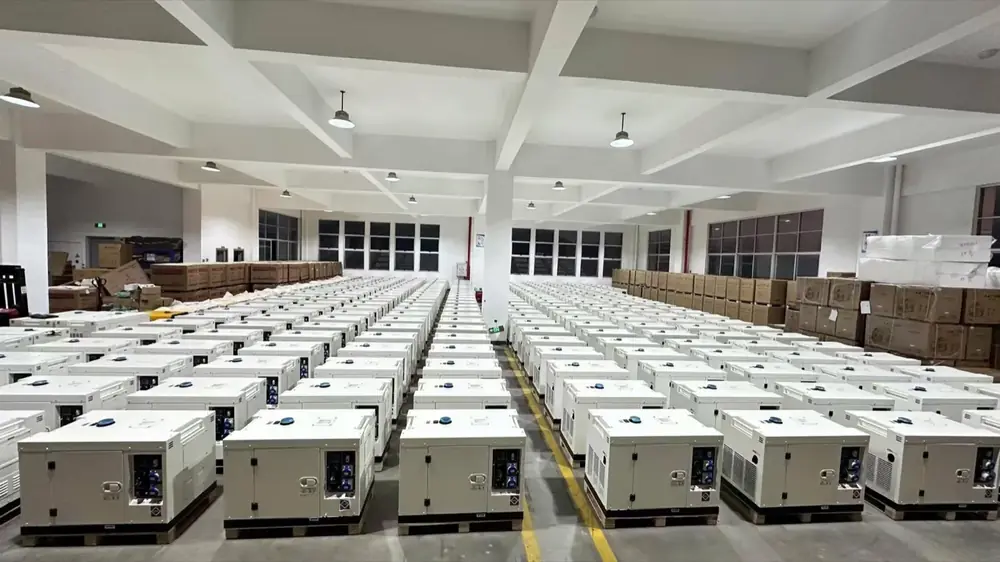
Hotel sizing starts from the largest simultaneous load rather than the arithmetic sum of connected appliances, because room air conditioning, lifts, pumps and kitchen equipment rarely peak together.
The load groups that make up a hotel demand
Work through the building rather than through a single total. Each group below has its own peak time and its own starting behaviour, and the generator has to satisfy the combination you decide to keep live.
| Load group | Typical behaviour | What to record |
|---|---|---|
| Guest room air conditioning | Peaks in the evening and overnight | How many units run together and whether they are inverter or fixed speed |
| Lifts | Intermittent, heavy start | Motor rating, starting method and how many cars operate |
| Water pumps and borehole | Intermittent, heavy start | Rating, starting method and whether a pressure set is fitted |
| Kitchen equipment | Peaks at service times | Which appliances are essential and which can wait |
| Laundry | Batch operation, heavy motors | Whether laundry runs during an outage or is deferred |
| Lighting and sockets | Steady through occupied hours | Which circuits must remain live after transfer |
| IT, security and fire systems | Must stay live | Whether these are on a separate essential board or a UPS |
Why the simultaneous load is the honest number
A hotel generator size that suits one property will not suit another, because the answer follows the load groups kept alive and the largest motor among them rather than the number of rooms.
Adding every appliance on the schedule produces a figure that no hotel ever reaches, because air conditioning, laundry and kitchen equipment do not all run at their peak at the same moment.
It also produces a figure that hides the real risk. The moment that decides the required rating is the one where the largest motor starts while everything else is already running, which is usually an evening peak rather than a midday service.
The practical method is to write two lists: loads that must remain live continuously during an outage, and loads that can be restored in sequence. That division is what allows a sensible rating, and it is also what the changeover design has to implement.
Enclosure choice follows the position, not the rating
Hotels place the set near people, which is why the enclosure question arrives early. A sound-attenuated canopy is normally specified where the set will stand within roughly twenty to thirty metres of guest rooms, as an industry practice rather than a rule, and the actual position should be described when the quotation is requested.
Distance is only part of it. The direction of the exhaust, the presence of walls that reflect sound, and whether the position is under a window all change how the installation is experienced. These are layout decisions, so share the intended position rather than only the rating.
Ventilation is the trade. A canopy that restricts airflow will derate the set it is protecting, so the cooling arrangement has to be designed for the enclosure and the local ambient together, not treated as an accessory.
Deciding what the changeover should restore
An automatic transfer arrangement is a scope, not a checkbox. It can be sized to restore the whole building, or to restore an essential board only, and the two options differ in panel rating, cable work and control logic.
For many hotels the essential board approach is easier to justify: lighting on circulation routes, guest room circuits, water pumping, security and refrigeration are restored immediately, while laundry and some kitchen loads are brought back manually or in sequence.
Whichever approach is chosen, decide it before the order. Retrofitting a changeover arrangement after the building is wired is more expensive than quoting it with the set, and the set's controller configuration depends on the decision.
Where a programme cannot be interrupted at all, the answer is usually a second set rather than a faster panel; the event centre case is worked through in event centre load and backup planning.
Sending a hotel request that can be answered
Give the room count, the load groups with the largest motor in each, which circuits must stay live, the intended generator position and its nearest guest area, and the changeover requirement.
If the hotel is being built or refurbished, share the intended position and the route for cabling and exhaust. Those details cost nothing to plan now and are awkward to correct after the set is on its plinth.
Related reading: the silent generator guide for hotels, the shopping mall backup power guide for a comparable multi-load building, and the ATS panel selection guide.
Request a hotel standby quotation
Send the room count, the load groups with the largest motor in each, the circuits that must stay live and the intended generator position. That is enough to quote the set, the enclosure and the changeover scope on one specification.
Get a written quotation
Three fields. We reply with the rating, the engine option and the delivery basis.
Hotel generator questions
How do I size a generator for a hotel?
Start from the largest simultaneous load, not the sum of connected appliances. List the essential loads, identify the largest motor among them and its starting method, then decide which remaining loads can be restored in sequence.
Do I need a silent generator for a hotel?
A sound-attenuated enclosure is normally specified where the set stands within roughly twenty to thirty metres of guest rooms, as an industry practice. The actual decision depends on the position, the exhaust direction and the surrounding structure.
Should the generator back up the whole hotel?
Not necessarily. Restoring an essential board covering lighting, guest room circuits, pumping, security and refrigeration is often easier to justify than restoring laundry and heavy kitchen loads, which can return in sequence.
What must be decided before ordering?
The load groups and the largest motor, which circuits must stay live, the intended position and its distance from guests, and whether the changeover restores the whole building or an essential board.
Does the enclosure affect the generator rating?
It can. An enclosure that restricts airflow will derate the set, so the cooling arrangement has to be designed for both the canopy and the local ambient temperature rather than assumed.
Can a hotel generator share the site with other loads?
It can, provided the heavy loads are not started simultaneously. If the hotel shares a compound or a commercial block, describe the other loads and their operating hours so the combination can be assessed.
