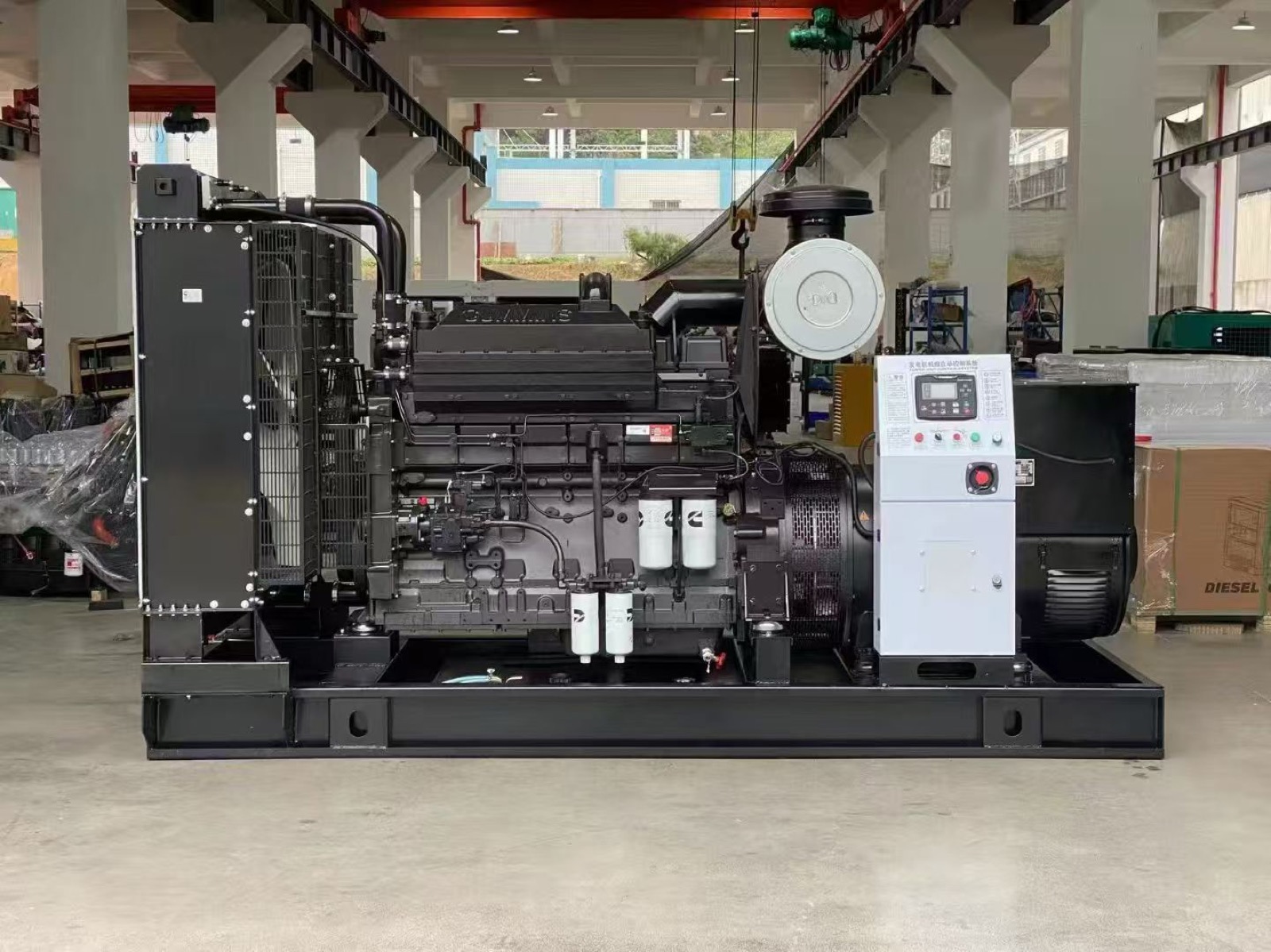
Check the air path before the fuel system: a restricted filter explains most black smoke and costs least to rule out.
Smoke is the engine reporting its mixture, not its mood
A diesel engine smokes when the fuel and the air it receives do not match the load it is being asked to carry. That is the whole mechanism. Everything else on this page is a way of narrowing which side of that mismatch you are looking at, because the colour of the smoke and the moment it appears tell you more than any single gauge reading.
The mistake most operators make is to treat smoke as a symptom to be suppressed. They turn the fuel screw, they add an additive, they fit a bigger exhaust. Each of those can hide the visible sign while the underlying condition continues, and two of them make the engine worse. A pump adjusted rich to cure a black haze will raise exhaust temperature and cylinder pressure on a set that was already running at its limit.
The useful approach is to describe the smoke precisely before touching anything: what colour, at what load, for how long after starting, whether it clears when the load comes on or when it comes off, and whether the exhaust is wet or dry. Four of those five answers usually decide the branch of diagnosis without opening a single panel.
Reading the colour against the moment it appears
Colour alone is not a diagnosis, because the same colour can come from two different faults at two different load points. Read the table as a first cut, then confirm with the checks in the sections that follow rather than ordering parts from it.
| What you see | Most likely cause | First check |
|---|---|---|
| Black, heavy, only under load | Over-fuelling against available air, or load beyond the rating | Air filter restriction, then boost pressure against the load |
| Black, heavy, even at light load | Injector or pump delivering too much fuel, or timing advanced | Injector balance test; pump timing mark |
| Black, with a loss of power and a whistle | Boost leak on the charge-air side | Clamps and hoses between turbo and manifold |
| White, at start-up only, clears as it warms | Cold combustion; normal in cool mornings | None, if it clears within a short warm-up |
| White, continuous, sweet smell | Water or coolant entering the combustion chamber | Coolant level and pressure test; exhaust for moisture |
| White, continuous, with a miss | Injector not atomising, or timing retarded | Injector pop test; pump timing |
| Blue, on start-up then fading | Oil draining past valve guides while standing | None if it clears; monitor oil consumption |
| Blue, continuous under load | Oil past rings or through the turbo seal | Crankcase pressure; turbo inlet and outlet for oil |
| Grey or blue-grey haze, constant | Lightly loaded engine running cool; wet stacking beginning | Load history; put the set on real load and re-observe |
Why fuel quality is the first suspect, before any mechanical fault
In Nigeria the diesel that reaches a site has usually passed through more hands than the engine manual assumes. Water, particulate and lighter fractions are the three things that go wrong, and all three change combustion in ways that show up as smoke before they show up as a breakdown.
Water is the most damaging and the least visible. It sits at the bottom of the tank, it gets picked up when the tank is low or when the site is on a slope, and it reaches the injection pump as an abrasive-free but lubricity-free slug that scores plungers and nozzles. The engine's response is rough running, white smoke and a miss that moves between cylinders as the slug passes.
Particulate does the slower damage: it blocks the primary filter, it wears the injector nozzle seat, and it produces a grey haze that looks like over-fuelling but does not respond to any fuel adjustment. The test that separates the two is the filter: a filter that is black and heavy long before its interval is telling you about the tank, not the engine.
Black smoke that appears only when the load comes on
Black smoke that arrives with the load and leaves with it is the engine asking for air it is not getting. The fuel rack moves to match the load, the turbo spins up, and if the air side cannot deliver the mass flow the pump is already fuelling for, the excess shows as carbon at the stack.
Three things cause it, in order of how often they are found. A clogged air filter element, which is the cheapest and most common. A restriction on the intake path before the filter, which happens where a set has been installed in a plant room with a louvre opening sized for a smaller machine. And a leak on the charge-air side, where the boost the turbo makes is lost between the compressor outlet and the manifold.
A boost leak has a signature: the smoke is accompanied by a whistle that rises with load, and power falls away faster than the smoke suggests it should. It is worth checking the clamps and the hoses before the filter, because a leaking hose can be found by hand in a minute and a filter restriction needs a gauge.
The air side, measured rather than guessed
Air restriction is invisible until you measure it. A filter that looks dusty in the housing may still be flowing within its limit, and a filter that looks clean may be collapsed internally or the wrong element for the housing. The only reliable reading is the restriction indicator or a water gauge across the element.
Exhaust back pressure is the other half of the air path and the one most often ignored. A long exhaust run with tight bends, a silencer sized for a smaller engine, or a rain cap that has seized closed all raise the pressure the turbo has to push against. The engine then cannot scavenge its cylinders, and the result is black smoke at load with normal boost on the gauge.
Both readings belong in a commissioning record, taken when the set is new, so that a later reading has something to be compared against. Without a baseline, a restriction indicator that has been in the red for months looks normal.
| Check | How to take it | Healthy signature |
|---|---|---|
| Filter restriction | Restriction indicator on the housing, or a water gauge across the element | Indicator still in the white zone; reading stable at full load |
| Charge-air leaks | Visual and hand check of every clamp and hose from compressor to manifold | No whistle rising with load; hoses firm, not soft or oil-weeping |
| Boost pressure | Boost gauge against the engine data for that rating | Reaches the stated figure at rated load and holds steady |
| Exhaust back pressure | Tap at the turbo outlet, measured at rated load | Within the engine maker's limit for that build |
| Intake path | Trace from the louvre to the filter housing | No collapsed duct, no nesting material, louvre free area not obstructed |
| Aftercooler | Check for oil mist and for blocked fins | Dry, fins clear, no oil film at the outlet |
White smoke: unburnt fuel, water, or both
White smoke is fuel that did not ignite, or water that turned to vapour before it could. The two smell different and behave differently, and telling them apart is the first job.
Unburnt fuel white smoke appears when the cylinder is too cold to ignite the charge: a cold morning, a set that has been standing, a failed glow arrangement on a small engine, or injection timing that has slipped retarded. It smells of raw diesel and it stings the eyes. It usually clears as the engine warms, and if it does not, the timing or the injectors are the place to look.
Water white smoke is steam, and it has a sweet smell from the coolant. It appears continuously, it does not clear with warmth, and the coolant level falls without an obvious external leak. On a wet-liner engine a porous liner or a failed liner seal will do it; on any engine a failed head gasket will. This is the one branch where continuing to run the set risks a much larger repair, so it is worth stopping and confirming before the next start rather than after the next load test.
Blue smoke means oil, and the location decides the cost
Blue smoke is lubricating oil being burned. Where it enters decides whether the repair is a set of valve stem seals or an engine overhaul, so the diagnosis is mostly about localising it.
Oil that appears only on the first start after the set has stood is draining past worn valve guides while the engine is off, then burning off in the first minutes. It is common, it is cheap to fix at the next top-end service, and it is not urgent.
Oil that appears continuously under load is being pushed past the rings by crankcase pressure, or drawn in through the turbo seal. Crankcase pressure is measurable: a slack breather, oil at the dipstick tube, and oil mist at the breather outlet all point one way. A turbo seal shows as oil in the inlet or outlet duct and is confirmed by removing the hose, not by removing the turbo. On a lightly loaded set, blue haze that comes and goes is often wet stacking rather than worn rings, which is why the load history matters as much as the compression reading.
The grey haze that follows a set that never works hard
A generator that spends its life at a small fraction of its rating develops a haze that is neither the black of over-fuelling nor the blue of worn rings. It is a light grey or blue-grey that hangs at the stack and smells acrid, and it is the visible part of running too cool.
In this state the combustion temperature is low enough that fuel does not fully burn, soot and unburnt fuel accumulate in the exhaust and the turbo, and the cylinder walls glaze. The set will keep starting and it will keep carrying its light load, which is why the condition goes unnoticed until an outage arrives, the load steps up, and the set cannot deliver what it used to.
The remedy is load rather than repair: a period at a substantial fraction of rating, repeated on a schedule, with a load bank if the site cannot provide one. Where a site will never load the set, the honest answer is that the rating was chosen too large, and the money spent on the extra capacity is being paid back in fuel and in engine wear.
| Signal | Light-load haze | Rings or turbo wear |
|---|---|---|
| When it appears | After long periods at light load; fades after real load | Worsens as load increases |
| Oil consumption | Essentially unchanged | Rising steadily |
| Crankcase pressure | Normal | High; oil mist at the breather |
| Exhaust | Dry soot, acrid smell, damp stack at low load | Oily, blue-tinted |
| Compression | Within specification | Down on one or more cylinders |
| Response to load | Clears when the set works | Does not clear |
What to measure before you open anything
The sequence below is ordered so that the cheap, non-invasive checks come first and the results narrow what the invasive checks need to look at. Doing it in this order usually avoids opening the injection system on what turns out to be an air filter.
Record every reading with the load at which it was taken. A boost pressure, an exhaust temperature or a restriction reading without a load figure beside it cannot be compared with anything, including the same engine on another day.
| Step | What you do | What it rules out |
|---|---|---|
| 1 | Describe colour, load point, duration and whether the exhaust is wet | Separates fuel, air, oil and water branches |
| 2 | Check the air filter restriction indicator | The most common single cause of black smoke |
| 3 | Walk the charge-air path by hand, listening for a whistle under load | Boost leaks before any fuel adjustment |
| 4 | Drain a sample from the bottom of the fuel tank and the filter bowl | Water and particulate before touching the pump |
| 5 | Check coolant level, condition and pressure cap | The water branch, which is the only urgent one |
| 6 | Read boost and exhaust temperature at rated load | Confirms whether the air side is delivering |
| 7 | Check crankcase pressure and breather condition | Rings and bore wear |
| 8 | Only then, injector balance and pump timing | Fuel delivery faults, last because they need the most work |
Where this guide stops and a workshop starts
Everything above is a rule of thumb built from how these faults usually present on generator sets in Nigerian service. It is a sequence for narrowing a fault, not a specification, and it cannot substitute for the engine maker's own data for your model.
It also assumes a set that was correctly sized and correctly installed. On a set that is running beyond its rating, or that sits in a plant room with no ventilation, the smoke is telling you about the installation rather than about any component, and no amount of part replacement will fix it. I have written about the installation side separately, because it is a different diagnosis with a different remedy.
Finally, the colour descriptions assume natural daylight and a clean stack. A stack that is already coated in soot, a set running under a leaking canopy, or an exhaust that discharges against a wall will all change what you see. Judge colour at the outlet, in daylight, after the set has been at a steady load for several minutes.
What to send us so the answer is about your set
A description of the smoke on its own is not enough to say anything useful, and anyone who answers from that alone is guessing. Send the following and the reply can be specific.
| What we need | Why |
|---|---|
| Engine model and set rating | Different injection systems fail in different ways |
| Colour, and the load at which it appears | Separates air starvation from over-fuelling |
| Whether it clears when load is removed | The single most useful yes or no |
| Hours since the last service, and what was changed | A filter fitted the wrong way round is a real cause |
| Fuel source and how the tank is filled | Points at water and particulate before any component |
| Whether coolant level is falling | Decides if the set should be stopped now |
FAQ
Why does my generator smoke black only when the load increases?
Because the fuel rack moves with the load before the turbo can supply the matching air. That gap is either a restricted intake, a charge-air leak, or a set being asked for more than its rating. Check the filter restriction first; it is the cheapest and the most common.
Is black smoke always a sign of over-loading?
No. It can come from a clogged filter, a boost leak or an injector delivering too much fuel at any load. Over-loading is one branch, not the default answer.
What does white smoke with a sweet smell mean?
Water or coolant is reaching the combustion chamber. Stop the set and confirm before the next start: continuous white smoke with a falling coolant level can become a much larger repair if it is run.
Can bad diesel cause blue smoke?
It can contribute through poor atomisation and incomplete burn, but blue smoke is oil. The usual sources are valve guides, rings or the turbo seal, and the load history decides which is most likely.
My set smokes grey all the time but starts and runs fine. Is that serious?
It is the visible sign of running too cool for long periods. It does not stop the set today, but it glazes bores and coats the turbo, and it is corrected with load rather than with parts.
Does an additive fix a smoking generator?
It can change what you see without changing the cause. On a set that is over-fuelling or short of air, an additive buys time and hides the signal, which is the opposite of what a diagnosis needs.
How do I know if the smoke is from the engine or from the installation?
Run the set at a steady moderate load with the plant room doors open and observe. If the smoke clears, the room is the problem. If it does not, the fault travels with the engine.
