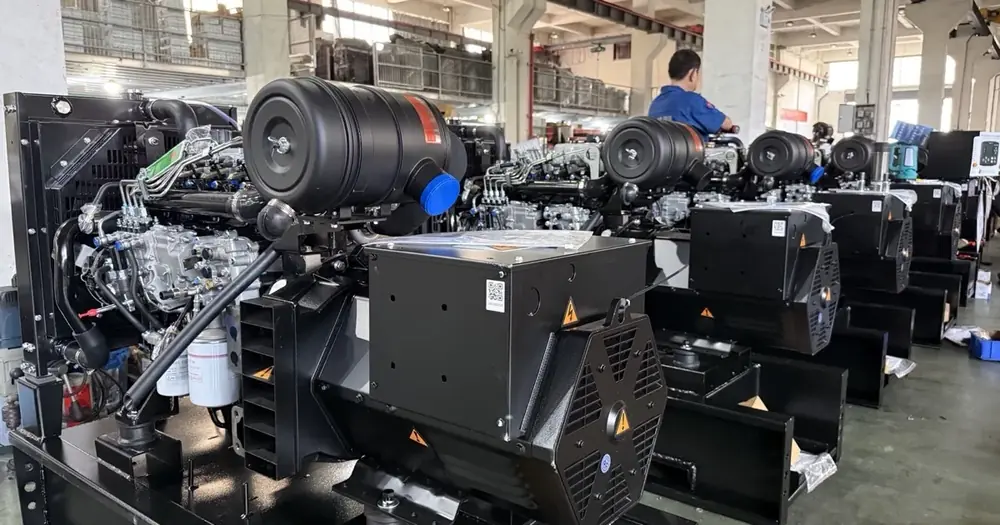
A part that fits is not the same as a part that is correct. The difference is the identification, and it is the only thing that separates a repair from a repeat visit.
What an AVR does, and why it fails
The automatic voltage regulator controls the excitation current fed to the alternator's field winding. By varying that current it holds the output voltage steady as the load changes. When it works, nobody notices it. When it fails, the symptoms are dramatic: voltage that swings, voltage that collapses under load, or no output at all.
An AVR fails for a handful of reasons. Heat is the most common, because the component sits in a panel that is often poorly ventilated. Voltage spikes from the load side are another, particularly where the set supplies equipment with its own switching. Moisture and dirty connections cause intermittent faults that are hard to reproduce. And undersized or wrong-model replacements fail early, which is why a substituted AVR so often appears to fix the problem and then returns.
The important point for a buyer is that an AVR failure is a symptom as often as it is a cause. Before replacing it, the alternator windings, the excitation wiring and the load-side condition should be checked. Replacing an AVR on an alternator with a failing winding replaces the part and leaves the fault.
Genuine, equivalent and salvage
Three kinds of part reach a Nigerian site, and they are not equally risky in the same way.
A genuine part carries the original manufacturer's identification and comes through a route the manufacturer recognises. An equivalent part is made to the same specification by another manufacturer, and can be entirely serviceable if the specification is genuinely matched. A salvage part is removed from another machine, and its condition is unknown regardless of how it looks.
The risk is not evenly distributed. A salvage sensor or a salvage controller carries the history of the machine it came from. An equivalent filter or belt is usually a reasonable proposition. The problem is that the three are often sold with the same description, so the buyer has to ask which one it is.
| Check | What a genuine part shows | What a risky part shows |
|---|---|---|
| Part number | Matches the engine or alternator parts list for that model. | A number that cannot be matched, or no number at all. |
| Rating and specification | Stated on the part and consistent with the model. | Generic rating, or a rating that is close but not equal. |
| Packaging and labelling | Consistent branding, sealed, with documentation. | Plain packaging, photocopied labels, or none. |
| Source | A route the manufacturer or its distributor recognises. | An unnamed market stall or an online listing with no traceability. |
| Provenance | New, and stated as new. | Described as tested, pulled, or serviceable but not new. |
Why the part number comes before the price
Buyers often start by searching for a price. That is the wrong first question, because the price of a part is meaningless until the part is identified. The same visible component can exist in several ratings, several revisions and several quality levels, and the cheapest listing is usually the one with the least identification.
The sequence that works is: identify the machine, identify the part number from the parts list, establish which of the three kinds of part is being offered, and only then compare. Doing it in that order removes most of the risk, because a part that cannot be identified cannot be compared at all.
This page does not publish part prices, and it would not help if it did. What decides whether a repair works is whether the part is the right one, not whether it was bought at the lowest figure.
When replacing the part is the wrong fix
There are four situations where a new part will not solve the problem, and each has a recognisable signature.
The first is a repeat failure on the same system. If the same component has failed twice, the cause is upstream: heat, vibration, a load-side fault or a wiring problem. The third part will fail the same way.
The second is a fault that moves. When the symptom changes after a part is replaced, the original diagnosis was incomplete. That is a diagnostic problem rather than a parts problem.
The third is a machine that no longer performs to its rating even when healthy. A set that has lost compression, or whose alternator insulation has degraded, will not be restored by any component. The repair, overhaul or replace guide sets out how to judge that.
The fourth is a machine whose parts are no longer obtainable. Where the platform is obsolete, a repair can stall halfway, leaving the site with a dismantled set and no route forward.
What is worth holding on site
A sensible spares holding is small and specific. It covers the consumables that the maintenance schedule will certainly need, plus the one or two items whose failure stops the site.
The consumables are the filters, belts, coolant and oil specified for the engine. These are ordered by part number, and holding one service set removes the delay between deciding to service and being able to.
The critical items are site-specific. A site that cannot tolerate a stop may hold a spare AVR, a spare sensor set or a spare battery, depending on what has failed before. The right way to decide is to look at the failure history rather than to buy a generic kit.
The spare parts page covers how to match an engine to the parts it needs, and the maintenance page sets out the service scope those parts belong to.
Checks before you pay for a part
These are the checks that separate a repair from an experiment. They take minutes and they are all documentary.
Where a seller cannot answer them, the answer is not necessarily that the part is bad. It is that the part is unidentified, which is the same problem from the buyer's side.
| Check | What to ask for |
|---|---|
| Machine identification | Engine model and serial, and alternator make and model. |
| Part number | The number from the parts list for that model. |
| Part category | Genuine, equivalent or salvage, stated plainly. |
| Specification match | The rating and revision, not just the fit. |
| Documentation | Whatever the seller can provide on origin and specification. |
| Return position | What happens if the part does not resolve the fault. |
When the answer is a different machine
There is a point where the parts conversation stops being useful. It is reached when the cost of the next repair approaches what the machine is worth to the site, when the platform's parts are no longer obtainable, or when the set no longer carries the load it was bought for.
At that point the decision is not about parts at all. It is the repair, overhaul or replace decision, and it should be made on the same evidence either way: running hours, failure history, an oil analysis, and an honest view of what the site needs next.
It is worth being clear about what this site does. We supply complete generating sets; we do not sell individual parts. So the useful thing we can do here is help establish whether a repair is worth pursuing, and if it is not, what the replacement should be specified to do.
If the set is beyond economic repair, the practical next step is to describe the load and the duty rather than the old model. A replacement sized on what the site actually needs will usually be a different rating from the one being replaced, because the site has changed since the original was bought.
Voltage dip on a motor start, and how fast recovery has to be
Starting a large induction motor draws a multiple of its running current for a short period, and that current surge pulls the terminal voltage down. How far it drops, and how quickly it comes back, are the two numbers that decide whether the rest of the site notices. Contactors can drop out, drives can trip on undervoltage, and control systems can reset, all because a motor started on a set that was already close to its limit.
Recovery speed is a property of the excitation system, not of the engine. The engine responds through the governor, which takes longer because it is moving mechanical parts and a column of fuel. The voltage comes back as soon as the exciter pushes current into the field, which is a much faster electrical response. That difference is why a site can see the lights dim and recover while the frequency is still settling.
There is no universal figure for an acceptable dip, and the honest position is that the limit is set by the most sensitive load on the board rather than by the generator. What can be stated is the direction: a set with more rotating mass and a stronger excitation system will dip less, and the only way to know how a particular set behaves is to test it with the actual motor.
The governor and the AVR do different jobs
The governor holds frequency by controlling fuel, and therefore controls the kW the engine delivers. The automatic voltage regulator holds voltage by controlling field current in the alternator, and therefore controls the kvar and the terminal voltage. They are two separate control loops acting on two separate quantities, and confusing them sends fault-finding in the wrong direction.
The diagnostic consequence is simple. If the frequency sags under load and recovers, the governor side is involved. If the voltage sags while the frequency holds, the excitation side is involved. If both move together, the load step was simply larger than the set could absorb, and the answer is about capacity rather than about either controller. The same logic applies to a set that hunts at steady load: a slow regular swing in frequency points at the governor, while a fast flicker in voltage points at the regulator or its sensing.
| What the site does | Loop involved | First thing to check |
|---|---|---|
| Voltage dips on a motor start and recovers within a moment | Excitation, reacting to a load step | Whether the dip is within what the sensitive loads tolerate |
| Voltage drops and stays low | Excitation | Regulator sensing, field wiring, exciter output |
| Frequency dips and recovers slowly | Governor | Fuel supply, linkage, governor setting |
| Frequency and voltage both fall and stay down | Capacity, not control | The load against the rating at site conditions |
| Voltage high at no load, correct under load | Excitation | Sensing leads and regulator adjustment |
| Slow regular hunting at steady load | Governor | Fuel system and governor stability |
PMG and AREP excitation, and what changes on a hard start
The standard arrangement takes the excitation power from the alternator's own output, through a transformer and a regulator. It works well, and it has one characteristic weakness: the excitation depends on the very voltage that a hard start is pulling down, so a severe dip reduces the field current just when more of it is wanted.
A permanent magnet generator is a small separate machine on the shaft that feeds the regulator independently of the main output. Because its output does not collapse when the terminal voltage dips, the excitation holds up through a motor start, which shortens the dip and speeds recovery. An alternative excitation arrangement achieves something similar by drawing from a winding with a different characteristic. Both are legitimate ways to buy starting performance, and both add cost and a component that can fail.
Where a site's problem is genuinely a hard start, the choice between a stronger excitation system and a larger set is a commercial one as much as a technical one, and it belongs with the sizing question rather than with the spare parts list. The interaction between the motor and the set is set out in three-phase motor sizing, and the cooling consequences of running a set near its limit are covered in overheating diagnosis.
Tell us the symptom and the machine
Describe the fault, the set's rating and how long it has run. We do not supply parts, but we can tell you whether the symptom points to a part, to the machine, or to the site, and what a replacement would need to be specified for.
Get a written quotation
Three fields. We reply with the rating, the engine option and the delivery basis.
Frequently asked questions
How do I know if an AVR is genuine?
Match the part number to the alternator's parts list, confirm the rating and revision, and ask the seller to state whether the part is genuine, equivalent or salvage. Appearance and packaging are weaker signals than identification.
Why does my generator keep blowing AVRs?
Repeated AVR failure usually points to a cause outside the AVR: heat in the panel, voltage spikes from the load side, moisture, or a fault in the excitation circuit. Replacing the component again will reproduce the failure.
Can I fit a different AVR to my alternator?
Only if the specification genuinely matches, including the sensing and excitation arrangement. A part that fits physically but does not match electrically can damage the alternator.
Do you sell spare parts?
No. We supply complete generating sets and do not sell individual parts. This page is written to help buyers judge a part, not to sell one.
When is it better to replace the machine than repair it?
When the same system keeps failing, when the platform's parts are no longer obtainable, when the set no longer carries its rated load, or when the next repair approaches what the machine is worth to the site.
What information do I need before ordering any part?
The engine model and serial, the alternator make and model, and the part number from the parts list. Without those three, any part supplied is a best guess.
Is a used part ever a sensible option?
For a non-critical item on an older machine, sometimes. For a controller, sensor or protection component, the history of the donor machine is unknown, which makes the outcome unknown too.
