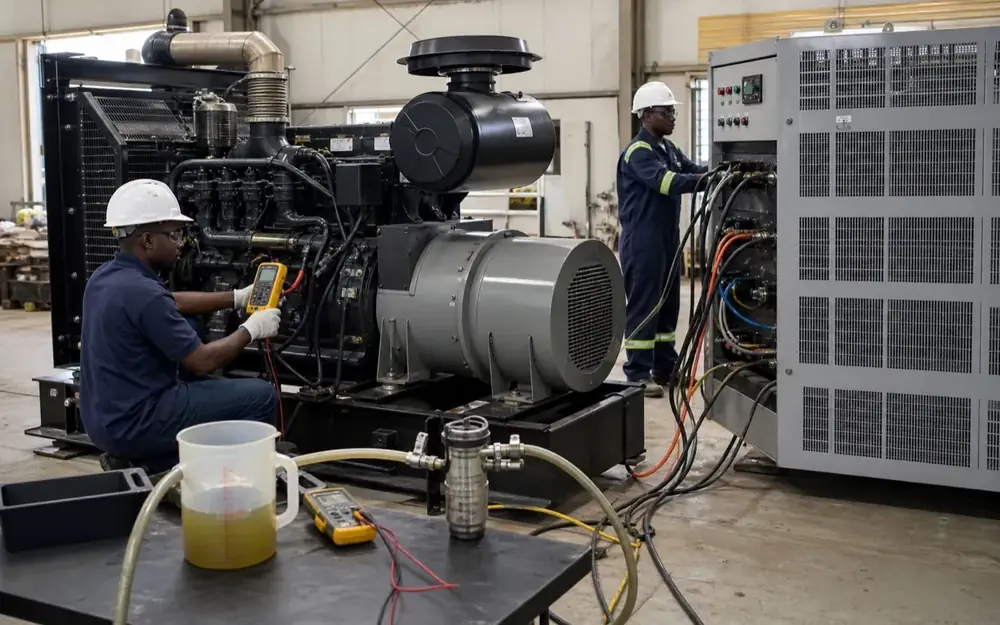
This calculator does not invent a universal fuel figure. Ask the supplier for the proposed engine model's fuel-consumption table first, then enter the applicable litres per hour.
Diesel generator fuel consumption calculator
Enter the litres-per-hour value for the exact engine and load point shown on the proposed supplier datasheet. Then add the actual operating schedule.
- 1. Enter verified L/hUse the exact engine model and expected load point.
- 2. Add your scheduleEnter running hours, operating days and local diesel price.
- 3. Compare the resultReview daily litres, monthly litres and estimated NGN cost.
Planning result only. Actual consumption can differ with load changes, ambient conditions, maintenance and operating pattern.
Do not have a litres-per-hour figure yet? Review the 10kW planning guide for a clearly labelled estimate, or request model-specific fuel data before comparing suppliers.
A tool that takes the load, the part-load behaviour and the running hours is at the fuel consumption calculator.
Use real kW load, not generator kVA alone
Generator kVA identifies a rating range, but fuel is burned according to engine operation and actual electrical demand. A lightly loaded generator and a generator working near its rated output will not consume the same amount of diesel.
For a worked example at a lower load factor, see the 40kVA running cost and fuel use page, which separates litres per hour from litres per day.
| Step | Data to use |
|---|---|
| 1. Build the load list | Record running kW and the starting method of the largest motor, pump, compressor or chiller. |
| 2. Select duty | State whether the generator is standby backup or prime/long-hour power. |
| 3. Confirm exact engine | Use an engine model number, not only a brand or a generic generator size. |
| 4. Match the load point | Use the supplier's litres-per-hour figure closest to the expected percentage load. |
| 5. Apply runtime | Litres per hour x operating hours gives daily consumption; multiply again by operating days. |
Evidence to request before accepting a fuel claim
A useful quotation should connect the fuel figure to the exact engine and generator configuration being offered.
- Exact engine make and model
- Prime and standby rating basis
- Fuel table at multiple load points
- Alternator and controller model
- Factory test scope for the ordered unit
- Written assumptions behind the calculation
The fuel price itself moves, which is why any running-cost figure is only as good as the price behind it; the Lagos position is discussed in diesel price per litre in Lagos.
What changes monthly generator operating cost
Fuel is only one part of generator operating cost. Service intervals, filters, oil, coolant, batteries and the consequences of running at very low or very high load should also be included in the buyer's comparison.
If your site runs for long hours, ask for prime-duty sizing and service recommendations. For a backup-only site, send the essential-load list and largest motor so the generator is not oversized simply by guesswork.
If you want to repeat the numbers yourself, step-by-step fuel consumption calculation works through the same method.
Litres per hour is only half the picture; converting fuel into a cost per unit of energy delivered is set out in working out the cost per kWh.
Calculate fuel use before requesting a generator price
After estimating runtime and fuel cost, open the relevant quotation page and send the actual load schedule. The kW figures below are planning conversions, not guaranteed usable site load.
| Quotation page | Planning conversion at 0.8 power factor | Important input |
|---|---|---|
| 10kW / 12.5kVA generator quote | 10kW is approximately 12.5kVA | Small business load list, fuel preference, phase and daily runtime. |
| 100kVA generator price Nigeria | Approximately 80kW | Hotel, school, office or commercial load plus the largest motor. |
| 250kVA generator price Nigeria | Approximately 200kW | Cold room, estate or factory load schedule and starting method. |
| 500kVA generator price Nigeria | Approximately 400kW | Detailed project load, duty, ATS, load-test and shipping scope. |
Request verified fuel data and a generator quote
Complete the known project details. WhatsApp will open with a structured request that the supplier can answer model by model.
Fuel consumption at 25, 50, 75 and 100 per cent load
A single litres-per-hour figure is not a specification. The same engine consumes very different amounts at different load points, and the shape of that difference varies with the engine platform, the injection system and the governor. A supplier who quotes one number without saying what load it belongs to has quoted nothing you can budget against.
Specific fuel consumption, quoted in grams per kilowatt hour, is the figure that makes engines comparable, because it normalises the fuel against the work actually done. It is lowest near the rated load point and rises steadily as load falls, for a simple reason: the losses involved in turning the engine at all, and in driving the cooling fan, the alternator and the pumps, do not shrink when the electrical output does. Spread those fixed losses over fewer useful kilowatt hours and the fuel per kilowatt hour climbs.
That is why a set running at a quarter load can burn noticeably more per kilowatt hour than the same set at three quarters, even though its litres-per-hour figure looks reassuringly small. The absolute consumption is lower; the efficiency is worse. Both statements are true at once, and which one matters depends on whether you are filling the tank or costing the output.
The table gives indicative figures by load point and by set size, built from the common rule of thumb for diesel generating sets with the usual part-load penalty applied. It is here to show the shape and to give a starting point for a budget, not to replace the curve for the engine you are actually offered. Every figure should be replaced by the value in that engine's own data, read at the load point the site will actually run at.
| Load point | Litres per kWh | Grams per kWh | 50 kW set, L/h | 150 kW set, L/h | 400 kW set, L/h |
|---|---|---|---|---|---|
| 100 per cent of rating | 0.21 to 0.25 | 175 to 210 | 10.5 to 12.5 | 31.5 to 37.5 | 84 to 100 |
| 75 per cent of rating | 0.23 to 0.27 | 193 to 227 | 8.6 to 10.1 | 25.9 to 30.4 | 69 to 81 |
| 50 per cent of rating | 0.25 to 0.30 | 210 to 252 | 6.3 to 7.5 | 18.8 to 22.5 | 50 to 60 |
| 25 per cent of rating | 0.29 to 0.36 | 244 to 302 | 3.6 to 4.5 | 10.9 to 13.5 | 29 to 36 |
To use the table, start from the site's own load profile rather than its peak. If the site sits at roughly a third of the rating for most of the day and reaches three quarters for two hours, the daily litres come from the first row multiplied by the long hours and the second row multiplied by the short ones. Budgeting from the peak row alone overstates the bill; budgeting from a single average understates it. The monthly total is what the operating budget should carry, and the fuel quality question that sits alongside it is covered in the calculator on this page and in under-loading damage, because the same part-load condition that raises the litres per kWh also raises the risk of wet stacking.
Fuel consumption FAQ
How do I calculate diesel generator fuel consumption?
Use the proposed engine model's litres-per-hour figure at the expected load, then multiply it by daily running hours and operating days.
Why is there no universal litres-per-hour value for each kVA?
Fuel use changes with the engine model, actual load, duty rating, ambient conditions, maintenance and operating pattern.
What evidence should a generator supplier provide?
Request the exact engine model, a model-specific fuel table, rating basis and the available factory test scope.
