This page is for industrial and project buyers who have been offered an open set and want to know what the offer does and does not cover, and for buyers comparing an open set with a silent one on price alone.
What an open set actually is
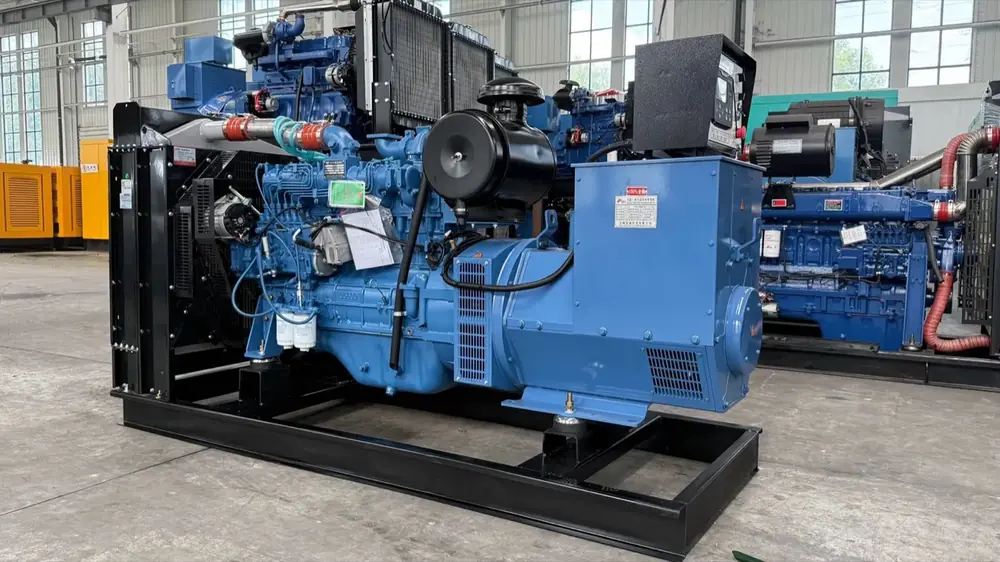
An open set is a generator with no enclosure: engine, alternator, radiator, control panel and base frame, mounted together and ready to be installed indoors. The machinery is the same as the silent version at the same rating. What has been removed is the canopy and what it provides — weather protection, acoustic attenuation and a defined airflow path.
That is why the comparison is not a straight one. A silent set arrives as a complete installation object. An open set arrives as a component that expects a room to be prepared for it.
Buyers who already have a plant room with proper ventilation, drainage and acoustic treatment get a simpler machine with better access for service. Buyers who do not are buying the first half of a project.
The room is part of the specification
A plant room has to do four things: admit combustion air, remove radiator heat, keep weather out, and keep noise in. Miss any of them and the installation underperforms regardless of the generator.
Ventilation is the one most often missed. The radiator needs an inlet and a discharge with no path between them inside the room, otherwise hot air returns to the intake and the set derates progressively. This is visible on a hot afternoon and invisible on a datasheet.
Acoustic treatment is the second. A bare concrete room amplifies rather than absorbs, so an open set in an untreated room can be louder at the boundary than a silent set standing outside it. That outcome surprises buyers who chose open to save money.
| Requirement | What it means in practice | Symptom if it is missing |
|---|---|---|
| Combustion air | A dedicated inlet sized for the engine, not a gap under a door | Hard starting, black exhaust, reduced output |
| Radiator discharge | Ducted to outside, with no return path to the intake | Progressive overheating and derating through the day |
| Acoustic treatment | Absorbent lining and a baffled path for air | Boundary noise higher than an enclosed set would produce |
| Weather protection | Roof, sealed penetrations, drained floor | Water ingress, corrosion, electrical faults |
| Drainage | Floor drain or bunded sump for fuel and water | Standing water at the base frame, corrosion and slip risk |
| Access | Clearance on the sides a technician needs | Slow service, and inspections that are skipped |
Where the difference really goes
The gap between an open quotation and a silent quotation at the same rating is not profit. It is the canopy and the work the canopy replaces.
If a room already exists and is properly ventilated, the open set is genuinely cheaper to own. If the room must be built or corrected, the saving is usually absorbed by civil work, ducting, acoustic lining and time — items that arrive as separate invoices from separate trades.
That is why project buyers should compare total installed scope. A single quotation for a silent set is easy to compare against a single quotation for an open set plus four contractors, and the comparison usually reverses once the room is counted.
Where open type is the better answer
Open sets are not a compromise. On the right site they are the better engineering choice.
Factories and industrial plants with an existing generator hall benefit from direct access to all sides of the machine. Maintenance that requires removing a canopy panel becomes a job that takes minutes instead of an hour, and inspections actually happen.
Large project sites where the set is installed in a purpose-built plant room, with an acoustic design and a ventilation design done by engineers, get a better result than a canopy chosen from a catalogue. The room can be designed around the machine rather than the machine compromised to fit a box.
Sites with high ambient temperatures also benefit, because a room with a properly designed air path can be easier to keep cool than a canopy with limited surface area for its radiator.
Can an open set stand outdoors?
Technically yes, practically almost never. Without an enclosure the machine is exposed to rain, dust and sun, and the control panel is the first casualty. A temporary roof over an open set is not weather protection; it is a delay.
The exception is a covered, well-ventilated structure built for the purpose — a generator house with louvres and a roof. That is a plant room by another name, and it should meet the same four requirements.
If the site genuinely has no room and cannot build one, the silent set is the correct answer, and the comparison should be made on that basis rather than on the cheaper unit price.
Electrical scope with an open set
The electrical scope is identical to a silent set of the same rating, with one difference: an open installation usually involves more site wiring, because the control panel and the changeover are further apart and the cable route is longer.
An automatic transfer switch works exactly as it would with an enclosed set. What matters is that its rating suits the site load, that it switches neutral where the installation requires it, and that the generator controller has the output to drive it.
On industrial sites, the changeover is often part of a larger switchboard rather than a standalone unit. In that case, confirm who supplies the interface and who commissions it, because the boundary between generator supplier and electrical contractor is where scope gaps appear.
Acceptance for a project set
A project installation should be accepted against a load test, not a start. The set should be run at stated load steps with voltage, frequency, coolant temperature and oil pressure recorded, and the room should be observed at the same time — a set that holds load while the room overheats has not passed.
Nameplate photographs matching the approved datasheet matter more on project work than anywhere else, because the specification usually passed through several hands before the order was placed.
Ask for the wiring diagram that matches the build, the controller settings as commissioned, and the consumables list with part numbers. On an open installation, also ask for the room's ventilation design assumptions, so a later modification does not silently break them.
Comparing the two offers
The list below is what should be present in an open-set quotation before it is set against a silent one. Anything missing is scope the buyer will pay for later, from someone else.
| Line | In the open-set quote? | Usually paid separately |
|---|---|---|
| Engine, alternator, radiator, base frame | Yes | — |
| Control panel | Yes | — |
| Enclosure | No | Canopy if added later |
| Plant room civil works | No | Builder |
| Ventilation ducting and louvres | No | Sheet metal or HVAC contractor |
| Acoustic treatment | No | Specialist contractor |
| Exhaust system and insulation | Sometimes | Often |
| Changeover and cabling | Sometimes | Electrician |
Read down that list and the honest comparison becomes clear: an open set is the right purchase when the right-hand column already exists or is properly budgeted. When it does not, the silent set is not the expensive option — it is the complete one.
Get a written quotation
Three fields. We reply with the rating, the engine option and the delivery basis.
FAQ
Is an open type generator cheaper than a silent one?
The unit is, at the same rating. The installation may not be, because an open set needs a plant room with ventilation, acoustic treatment, drainage and weather protection, and those items are usually quoted by other trades.
Can an open type generator be used outdoors?
Not sensibly. Without an enclosure the machine is exposed to rain, dust and sun, and the control panel suffers first. A covered, ventilated structure is acceptable, but that is a plant room rather than outdoor use.
Can an ATS work with an open type generator?
Yes, identically to a silent set of the same rating. Confirm the ATS rating against the site load, whether it switches neutral, and whether the generator controller has the output to drive it.
What ventilation does an open set need in a plant room?
A dedicated combustion air inlet sized for the engine, and a ducted radiator discharge with no return path to the intake. If hot air can circulate back into the room, the set derates progressively as it runs.
Is an open set louder than a silent set?
In the open, yes, substantially. In a properly treated plant room it can be quieter at the boundary than a silent set standing outdoors, but that depends entirely on the room's acoustic design rather than on the generator.
Why do project buyers often choose open type?
Because a purpose-built plant room allows access to all sides for maintenance, and the ventilation and acoustic design can be engineered around the machine instead of compromised to fit a canopy.
What should be checked before accepting an open-set installation?
A load test at stated steps with voltage, frequency and temperatures recorded while the room is observed, nameplate photographs against the approved datasheet, a wiring diagram matching the build, and the ventilation design assumptions for the room.
