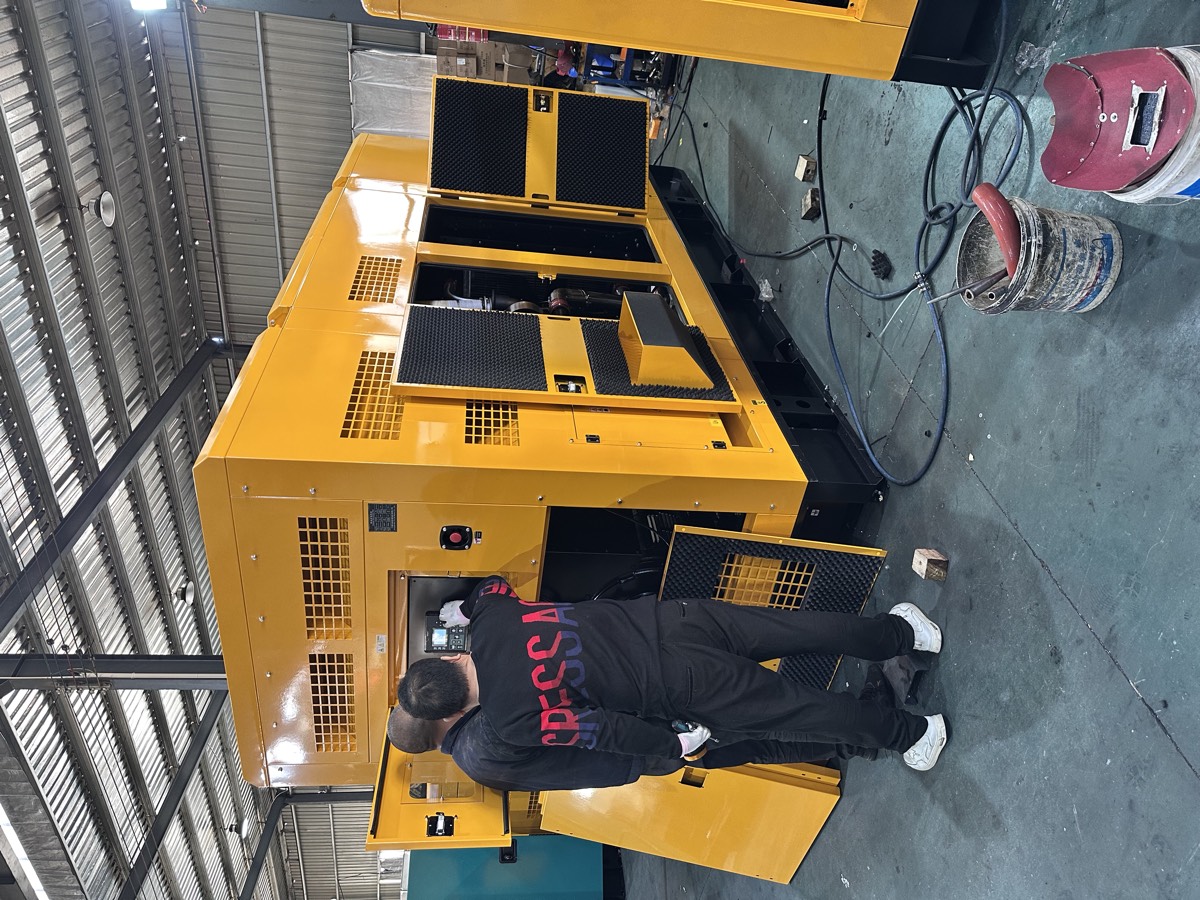
A generator cooling system moves heat from the engine into the air through a radiator, or into a secondary water circuit through a heat exchanger. Which arrangement suits a site depends on where the air can go and how far the radiator has to be from the set. Undersized airflow or a coolant fault shows up as overheating at load, not at idle.
The circuit, component by component
Coolant is pushed by the engine-driven pump through the block and head, where it absorbs heat, and then either through the radiator or back around the engine depending on the thermostat. The thermostat is what makes the engine reach working temperature quickly and then holds it there; a missing or stuck-open thermostat keeps the engine cold at light load and is a common cause of sludged oil rather than of overheating.
The radiator transfers the heat to the air pulled through it by the fan. The pressure cap raises the boiling point of the coolant so the system can run above atmospheric pressure without boiling, and the expansion tank gives the coolant somewhere to go as it heats. A cap that no longer holds pressure lets the system boil at a lower temperature, which looks like overheating with no obvious cause.
The fan, the radiator core, and the air path in and out of the room form one system. Treating them separately is how a set ends up with an adequate radiator and an inadequate room, which is the failure described in room ventilation.
Radiator, remote radiator, or heat exchanger
The standard arrangement mounts the radiator on the set with the fan behind it. It is compact, it needs no secondary circuit, and it dumps the heat into whatever space the set is in, which is fine outdoors and a problem in a small room.
A remote radiator keeps the engine-mounted circuit but puts the radiator elsewhere, connected by pipework, with an electric fan. It lets the heat be rejected outside the room while the set sits inside, at the cost of a pump sized for the extra resistance and pipework that has to be installed properly.
A heat exchanger replaces the radiator with a liquid-to-liquid unit that transfers heat into a secondary water circuit, which is then cooled by a cooling tower or a dry cooler. It suits sites where the set is deep inside a building or where the secondary circuit already exists. It adds a second circuit, a second pump and more to go wrong, which is why it is chosen for constraint rather than for preference.
| Arrangement | Where the heat goes | Suits | What it demands |
|---|---|---|---|
| Set-mounted radiator | Into the air around the set | Outdoor installs, canopied sets, rooms with generous airflow | An air path sized for the heat rejected |
| Remote radiator | To a radiator elsewhere, fan-driven | Indoor sets where air cannot be ducted through the room | Pipework sized for the flow, an electric fan, a remote location for the radiator |
| Heat exchanger | Into a secondary water circuit | Deep indoor sites, plant rooms with an existing cooling circuit | A second circuit, a cooling tower or dry cooler, more maintenance |
| Ducted air with the radiator in place | Out through a duct | Rooms where the set must stay put | Duct sizing and a fan that can overcome the resistance |
Airflow is the part that decides the outcome
A radiator only rejects heat in proportion to the air passing through it and to the temperature difference between the coolant and that air. In a hot climate the difference is smaller to begin with, so the airflow has to do more of the work. That is the mechanism behind high-temperature derating, seen from the cooling side.
Anything that reduces airflow through the core has the same effect as undersizing the radiator: a blocked core, a fan running the wrong way, a restriction behind the set, or hot air recirculating from the discharge back to the intake. The last is the hardest to see and the most common indoors.
The measurement that separates them is simple. Read the air temperature at the radiator intake while the set runs at load. If it is close to the outdoor ambient, the air path is working; if it is much higher, the room is feeding the set its own exhaust.
Coolant mix, pressure and the faults that follow
The coolant is not water. It is a mix of water and a glycol-based concentrate that raises the boiling point, lowers the freezing point and carries corrosion inhibitors. The ratio belongs to the supplier's data and to the site's climate, and mixing brands or topping up with plain water dilutes the inhibitors that protect the block from cavitation and corrosion.
Pressure is part of the same system. Running with a cap that does not hold its rated pressure lowers the boiling point, and the first sign is coolant loss at load with no visible leak. The cap is a service item, not a permanent fitting.
Air in the circuit is the third common fault. It collects at the highest point, reduces flow, and produces local hot spots that a temperature gauge at the outlet will not show. Filling and venting to the procedure in the manual is what prevents it, and a heater or a set that has been drained and refilled without venting will overheat for reasons that look mysterious.
What overheating at load is telling you
The table maps the observation against the likely cause. The first distinction to make is whether the problem appears only under load, only at idle, or continuously, because those three patterns point at different parts of the system.
| Symptom | Likely cause | Where to look first |
|---|---|---|
| Overheats only at high load | Cooling capacity or airflow short of what the load needs | Core condition, airflow, air intake temperature |
| Overheats at idle too | Coolant level, thermostat, pump, or air in the circuit | Level, cap, thermostat, venting |
| Temperature climbs slowly over hours | Marginal capacity; scale or a partially blocked core | Core cleaning, coolant condition |
| Coolant lost with no visible leak | Pressure cap, head gasket, or a hot engine boiling | Cap test, then combustion gas test |
| Fan belt slipping or squealing | Belt tension or wear | Belt condition and tension |
| Radiator core blocked with dust or fluff | Maintenance, not design | Cleaning interval, and the environment the set sits in |
The maintenance that prevents the call-out
Core cleaning is the highest-value item and the most often skipped. Dust, fluff and insects accumulate on the air side, invisible from the outside and decisive for performance. Cleaning it on a schedule that reflects the site's environment does more than any other single action.
The second is the coolant itself: level, concentration and condition. Coolant that has lost its inhibitors corrodes from the inside, and the debris then blocks the core. Checking concentration at service intervals and changing on the manufacturer's schedule is the routine that keeps both problems away.
Both items belong in the maintenance schedule, and the consequences of ignoring them are set out in overheating diagnosis. Where the set is indoors, the room and the cooling system have to be maintained as one, which is the argument on installation location.
FAQ
What is the difference between a radiator and a heat exchanger on a generator?
A radiator rejects the engine heat into air through a fan-cooled core. A heat exchanger transfers it into a secondary water circuit that is cooled elsewhere, usually by a cooling tower or dry cooler. The heat exchanger suits deep indoor sites and adds a second circuit to maintain.
Why does my generator only overheat when it is loaded?
Because heat rejection rises with load while cooling capacity stays fixed. A marginal radiator, a partly blocked core, restricted airflow or hot air recirculating will all show up at load and look normal at idle, which is why the fault is often described as intermittent.
Can I top up the radiator with plain water?
Only as an emergency measure. Plain water dilutes the corrosion inhibitors and changes the boiling point. The correct top-up is the same coolant mix the system was filled with, and repeated top-ups usually indicate a leak that should be found.
What does a radiator pressure cap do?
It raises the boiling point of the coolant so the system can run above atmospheric pressure without boiling. A cap that no longer holds its rating makes the engine boil at a lower temperature, which looks like overheating with no other fault.
How often should the radiator core be cleaned?
The interval depends on the environment: dusty or lint-heavy sites need it far more often than clean ones. It is set from inspection rather than from a fixed calendar, and it is the single maintenance item with the largest effect on cooling performance.
