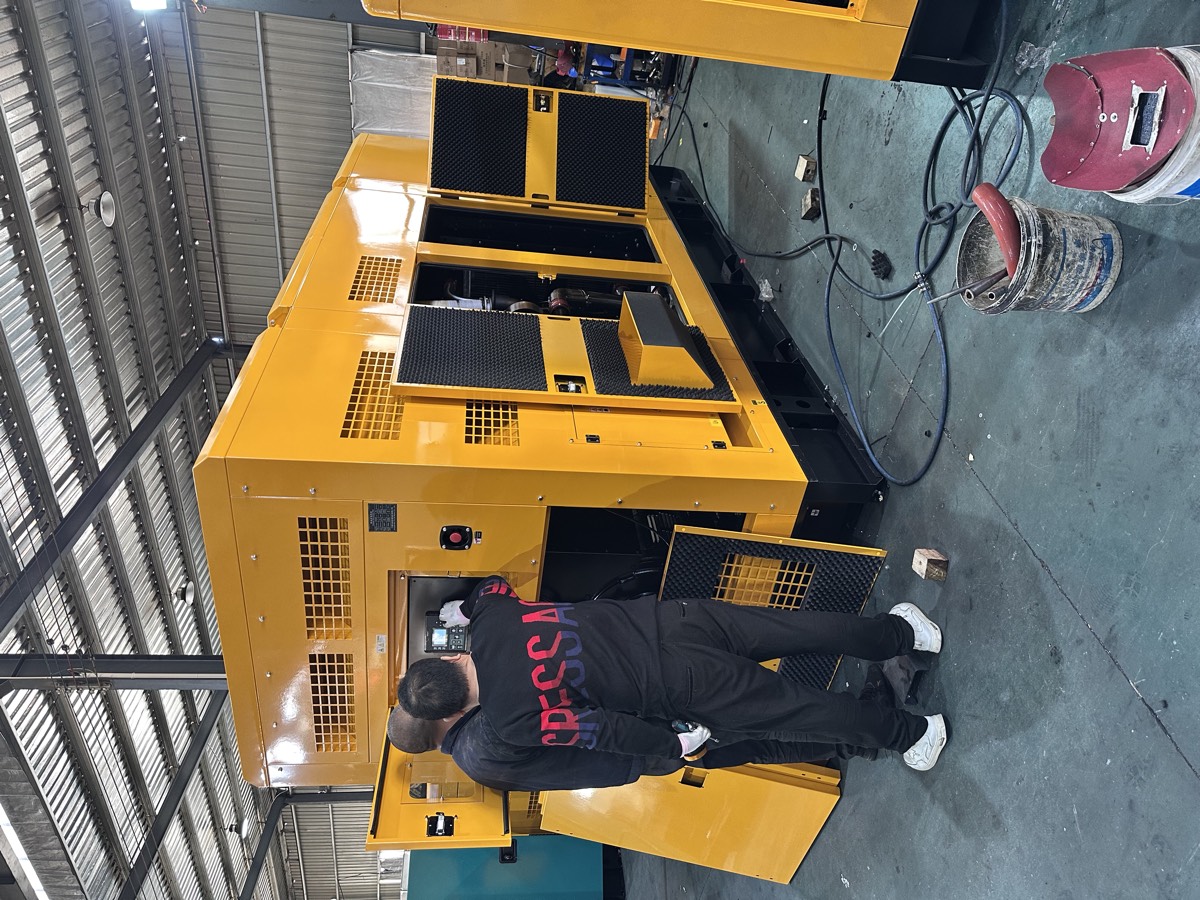
Branch first, parts later. Cranking behaviour alone rules out half the possible causes in under a minute.
A generator that will not start is three different faults wearing one description
Before anything is opened, the set has to be put into one of three branches, because the checks that matter are completely different in each. The branches are: the engine cranks but does not fire; the engine does not crank at all; and the engine fires and then stops within seconds.
Most wasted effort on a no-start comes from skipping this step. A mechanic who starts by bleeding the fuel system on a set whose battery cannot turn it over has spent an hour on the wrong system. A mechanic who replaces a starter on a set that is being shut down by its own low-oil-pressure switch has spent more than that.
The branch is decided by two observations and nothing else: does the cranking sound normal and sustained, and does the engine catch at all before it dies. Thirty seconds of listening settles it, and everything after that follows.
| What you observe | Branch | Where to start |
|---|---|---|
| Cranks at normal speed, never fires, no smell of fuel at the exhaust | Cranks, no fire | Fuel reaching the injection pump, then the stop solenoid |
| Cranks at normal speed, never fires, strong fuel smell at the exhaust | Cranks, no fire | Air in the fuel, or injection timing |
| Cranks slowly, or clicks, or nothing at all | No crank | Battery state of charge, then terminals, then starter |
| Fires once or twice and dies immediately | Fires then stops | Stop solenoid, low oil pressure switch, controller protection |
| Runs for a few seconds then dies, repeatable | Fires then stops | Fuel supply restriction, or a protection input that is really active |
Before the next crank attempt, three things to settle
Repeated cranking on a set that is not firing does damage that is easy to avoid. The starter is not designed for long bursts, and unburnt fuel washing into the sump dilutes the oil. Both turn a small fault into an expensive one.
First, confirm the fuel valve is actually open and the tank has usable fuel. This sounds trivial and it is the single most common cause of a call-out that ends with no repair at all. A tank that reads a quarter on the gauge may be drawing air if the pick-up is above the level, and a tank that was filled yesterday may be sitting on a layer of water.
Second, confirm the set is not in a protection lockout from the previous run. Many controllers latch an alarm and will not allow a start until it is reset, and the operator interprets the silence as a starter failure. Third, confirm the emergency stop is released and any canopy door switch is closed, because a door switch on a silenced set will prevent cranking and give no obvious symptom at the panel.
Branch one: it cranks normally and never fires
Normal cranking speed with no fire means the engine is turning but not receiving ignitable fuel, or is receiving it at the wrong moment. The fuel system is the place to start, and it is checked from the tank forward rather than from the pump backward, because the upstream faults are more common and much cheaper to fix.
The order is: is there fuel at the filter, is the filter full and flowing, is there fuel at the injection pump inlet while cranking, and is the stop solenoid holding the rack in the run position. A pump inlet that stays dry while the engine cranks means air is being drawn somewhere between tank and pump, and the leak is usually at a joint that the owner tightened by hand rather than at the pump itself.
If fuel arrives and the rack is free but the engine still does not fire, the question moves to timing and compression. A set that ran yesterday and will not fire today is almost never a timing fault, which is why the order matters: timing follows evidence, not suspicion.
Air in the fuel is the most common single cause, and it hides
Diesel injection systems move very small volumes at very high pressure, and they cannot compress air. A bubble the size of a pinhead reaching a delivery valve is enough to make one cylinder miss, and enough of them will stop the engine firing at all.
Air gets in three ways. Through a suction-side restriction or a loose joint between tank and lift pump, where the pump pulls air instead of fuel. Through a filter that was changed without being filled, so the system started with a slug of air in it. And through a tank pick-up that uncovers when the level drops or the vehicle or skid is on a slope.
The bleed sequence matters more than the bleeding itself. Work from the filter to the pump, then to the injectors, and close each point before moving to the next, otherwise the air from downstream is pushed back upstream and the job never converges. Crank in short bursts with rests, and stop the moment the engine begins to fire rather than running it up on a system that may still have air in it.
The stop solenoid fails in the position that stops the engine
Almost every diesel generator has an electrically held fuel shutoff. It is energised to run and de-energised to stop, or the reverse on some older mechanical systems, and when it fails it usually fails closed. The result is a set that cranks perfectly, has fuel at the pump, and never fires, with no fault code that points at the cause.
The test is direct: with the ignition on, listen for the click at the pump, and feel the solenoid body. A solenoid that is not energised, or that is energised but not pulling, has to be confirmed by removing it and watching the plunger while a helper cycles the key. On a mechanical pump the same check applies to the manual stop lever, which is sometimes left partly engaged after a service and never noticed.
Two related failures look identical. A blown fuse or a corroded connector in the solenoid circuit removes the hold, and a controller that is not sending the run signal leaves the solenoid unpowered. Both are electrical, both are cheap, and both are found with a multimeter at the solenoid plug before anything is removed.
Branch two: it does not crank, or barely turns
A set that clicks, or turns slowly, or does nothing, is an electrical problem far more often than a mechanical one. The battery is the first suspect because it is the component that degrades silently in hot climates, and because a battery that will run the control panel and the lights can still be unable to deliver cranking current.
Open-circuit voltage tells you the state of charge but not the ability to deliver current. A battery resting at a healthy voltage with a collapsed cell will read normally at rest and fall to nothing the moment the starter engages. The only reliable test is under load, either with a proper load tester or by watching the voltage at the battery posts while cranking.
Terminals and earth straps come next, and they matter more in Nigeria than the manuals assume. A terminal that looks tight can be corroded under the insulation, and a chassis earth that was bolted to paint will pass a multimeter test and fail under 200 amps of cranking current. Voltage drop, measured while cranking, finds both.
| Resting voltage | Approximate state of charge | What it means for starting |
|---|---|---|
| 12.7 V or above | Fully charged | Should crank normally if the battery is healthy |
| 12.4 V | Around three quarters | May crank, but a marginal battery will fail under load |
| 12.2 V | Around half | Cranking will be slow and the starter will draw high current |
| 12.0 V | Around a quarter | Unlikely to crank a diesel; recharge before further attempts |
| Below 11.9 V | Discharged | Do not keep cranking; charge or replace first |
| Reads normal at rest, collapses while cranking | Failed cell or high internal resistance | Battery must be replaced, not recharged |
Starter circuit, and the interlocks that make it look dead
If the battery is proven and the set still does not crank, the next question is whether the start signal reaches the starter at all. That is a two-minute check with a meter at the solenoid terminal on the starter: signal present and no crank means the starter or its earth; no signal means the problem is upstream in the controller, the key switch or an interlock.
Interlocks are the part that catches people. A canopy door switch, a low coolant level switch, a fuel leak detector or an emergency stop that is partly latched will all inhibit cranking, and most of them do not produce an obvious message on a basic controller. Where a set has been recently serviced, the interlock that was disturbed during the service is a better suspect than any component.
The starter itself fails in three ways: the solenoid engages but the motor does not turn, the motor spins without engaging the flywheel, or it engages and grinds. Each has a different cause, and none of them is fixed by hitting the casing, although that occasionally gets a worn solenoid to make one more contact.
Branch three: it catches, runs for a moment, and stops
This branch is the most misdiagnosed, because the engine clearly can run. That eliminates most of the fuel and compression possibilities and points instead at something that is removing the run command or protecting the engine after it starts.
The order to check is: does it stop at the same interval every time, and does the controller show any alarm at the moment it dies. A consistent interval of a few seconds points at a protection input or a fuel supply that runs dry as soon as demand rises. A random interval points at an intermittent connection in the run circuit or at air still working through the system.
Three protection inputs cause most of these stoppages on standby sets: low oil pressure, high coolant temperature and over-speed. All three are usually correct, and the fault is in the sensor or its wiring rather than in the engine. A sender with a chafed wire will report zero pressure on a healthy engine, and the controller will do exactly what it was designed to do.
| When it stops | Most likely | First check |
|---|---|---|
| Within a second or two, every time | Stop solenoid losing its hold, or run circuit opening | Voltage at the solenoid after the engine catches |
| After a few seconds, every time | Low oil pressure switch or sender | Mechanical gauge against the controller reading |
| After a few seconds, only when cold | Oil too thick to build pressure quickly at the sender | Oil grade against ambient; sender location |
| After a minute or more, repeating | High coolant temperature, or a cooling fault developing | Coolant level, belt, radiator airflow |
| At random intervals | Intermittent wiring, or air entering the fuel line | Wiggle test on the run circuit; inspect fuel joints |
| Immediately after taking load | Fuel starvation under demand, or an over-speed trip | Filter restriction, lift pump delivery, speed setting |
Reading the controller instead of guessing at it
A modern controller stores the reason it stopped the engine, and reading that record is faster than any physical inspection. Even a basic panel usually latches an indicator for the last shutdown, and a set with a communications port will list the event with a time stamp.
The trap is treating the alarm as the diagnosis. Low oil pressure is a measurement, not a cause: the cause may be the sender, the wiring, the oil level or the pump. The alarm narrows the system; it does not name the failed part. The same applies to high temperature, which can be a real cooling failure, a failed sender, or simply a set running in a room with no airflow.
Record the alarm, the running hours and the interval before shutdown before clearing anything. Once the code is cleared, the evidence is gone and the next start repeats the same cycle with no more information than the first time.
Where this sequence stops and a workshop begins
This is a rule of thumb sequence assembled from how no-start faults usually present on generator sets in Nigerian service. It is a way of ordering checks, not a specification, and it does not replace the engine maker's data for your model or the controller manufacturer's fault list.
The voltage figures in the battery table are general reference values for a 12 V lead-acid battery at rest, measured after the surface charge has been removed by a load or by standing. They are not a load test result and they cannot tell you the cold cranking capability of a battery in a hot climate; only a load test does that.
The sequence also assumes the set was working before it stopped. A set that has never run since installation, or that has just arrived from a container, has a different first question: whether the build matches the site, including voltage, frequency and the control wiring. That is a commissioning question rather than a fault, and it is worth separating before parts are ordered.
What to send us so the answer is specific
A no-start described in one sentence cannot be diagnosed. Send the following and the reply can name the branch and the first two checks rather than a list of possibilities.
| What we need | Why it matters |
|---|---|
| Does it crank at normal speed, slowly, or not at all | Decides the branch before any part is touched |
| Any alarm on the controller, and when it appears | Narrows to a protection input or a fuel fault |
| Battery resting voltage and voltage while cranking | Separates a flat battery from a failed one |
| Whether fuel reaches the pump inlet while cranking | Splits the fuel system in half |
| What was serviced or moved before the fault appeared | Finds disturbed interlocks and unfilled filters |
| Engine model and controller model | Needed for the correct fault list and wiring |
FAQ
My generator cranks but will not start. What is the most likely cause?
Air in the fuel, or the stop solenoid not holding the rack open. Both give normal cranking with no fire. Check fuel at the pump inlet while cranking before touching anything else.
Why does it start and then die after a few seconds?
Usually a protection input: low oil pressure or high coolant temperature, often from a failed sender rather than a real fault. Read the controller alarm before clearing it, because clearing it destroys the evidence.
The battery reads 12.6 V but the engine will not turn over. Why?
Resting voltage does not prove the battery can deliver cranking current. A collapsed cell reads normally at rest and falls away under load, which only a load test or a cranking voltage reading will show.
Can a generator fail to start because of a door switch?
Yes. A canopy door switch or an emergency stop that is not fully released will inhibit cranking, and many panels give no clear message for it.
How long should I crank before stopping?
Short bursts with a rest between them, and stop as soon as it begins to fire. Long continuous cranking overheats the starter and washes unburnt fuel into the oil.
It starts fine cold but not when hot. What does that point to?
Fuel or compression changing with temperature: a pump that is losing delivery when hot, or a battery and starter that are marginal and worse when heat raises resistance in the circuit.
Do I need to bleed the system after changing the fuel filter?
Yes. A filter fitted dry puts a slug of air into the pump, and the engine will crank without firing until it is bled in the right order, from filter to pump to injectors.
