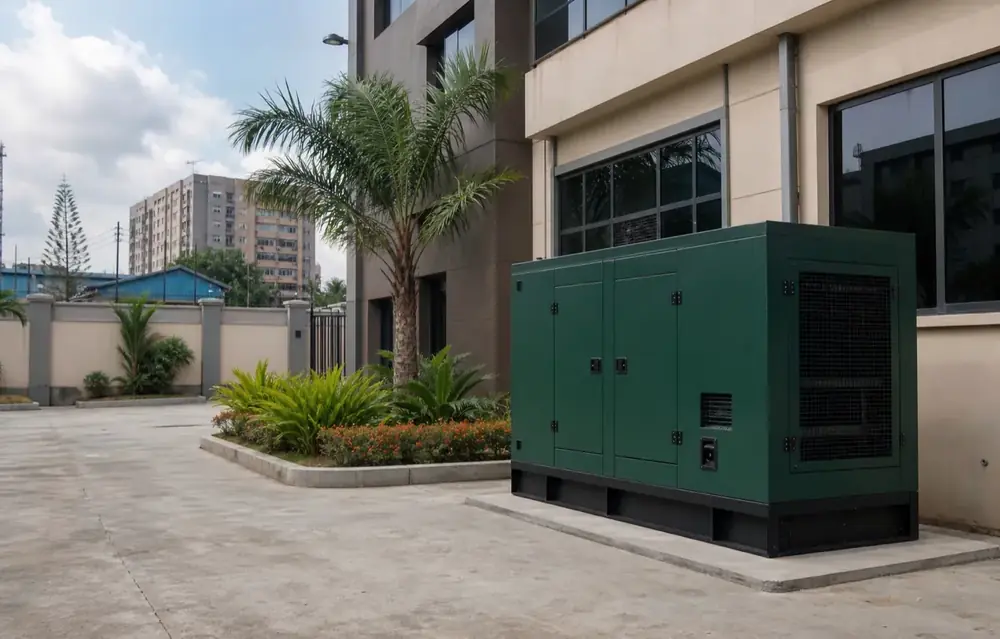
A canopy trades airflow for quiet. That trade is fine where there is room for air to move and fatal where there is not, which is why the siting decision comes before the enclosure decision.
What soundproof actually means
A soundproof generator is not silent. It is an open set mounted inside a canopy built to reduce the noise that reaches the surroundings. The canopy works by absorbing sound on its inner surfaces, sealing the gaps that would otherwise leak it, and routing the cooling air and the exhaust through paths that are lined and baffled.
The word soundproof is doing commercial work rather than technical work. What matters is how much reduction the canopy achieves, at what distance, and under what test method. Those three things belong in the offer, and a supplier who answers only with the word soundproof has not answered.
Practically, the difference a buyer notices is between a set you can stand next to while talking, and one you cannot. Both are diesel engines; the canopy changes how much of that noise leaves the enclosure, not whether the engine makes it.
What the canopy is actually made of
Four things do the acoustic work, and each one has a failure mode that shows up later.
The lining absorbs sound inside the canopy. It degrades if it gets wet or oily, and it is the first thing to check on a used set. The panels and seals close the gaps; a canopy with a badly fitted door or a cable gland left open leaks more noise than its lining saves. The air path is the lined inlet and outlet, and it is where the acoustic design fights the cooling requirement. The exhaust silencer is a separate component, and a residential silencer is not the same as the standard one.
A canopy that gets any one of those four wrong will be noisy, hot, or both. That is why the specification has to name them rather than describe the result.
| Component | What it does | How it fails |
|---|---|---|
| Acoustic lining | Absorbs sound inside the canopy. | Soaked or oil-soaked lining stops absorbing and starts smelling. |
| Panels and seals | Close the gaps that leak noise. | A distorted door or an open gland undoes the lining. |
| Lined air path | Lets cooling air in and out without leaking noise. | Undersized or blocked path causes overheating. |
| Residential silencer | Reduces exhaust noise at the outlet. | A standard silencer substituted for a residential one. |
When a canopy is the right answer
A canopy is the right answer when the set is close to people who did not choose to hear it. That includes a set beside a shop front on a residential street, a set serving a guest house with rooms above it, a set in a hospital compound, and a set in a estate where the neighbours are close enough to complain.
It is also the right answer where a rule requires it. Some estates, some commercial buildings and some institutional sites set their own noise conditions, and the canopy is how the installation meets them. That is a site rule rather than a technical one, and it is worth confirming before the order rather than after.
The third case is a set that has to sit close to the building it serves because there is nowhere else to put it. In dense parts of Lagos, that is common. The silent set page for Lagos covers the siting pattern that goes with it.
When an open set is the better answer
An open set is the better answer where noise is not the constraint. A detached plant room, a service yard behind a wall, a factory floor where machinery already runs, or a site where the set is far enough from occupied rooms that the noise does not reach anyone who would object.
Open sets are also easier to live with mechanically. There is nothing to trap heat, nothing to remove for a service, and no lining to degrade. On a site where the set will be serviced by a local technician with hand tools, that matters more than a few decibels.
Cost is a real factor, though this page does not put figures on it. The honest statement is that a canopy is an additional engineered enclosure, and the money buys noise reduction and weather protection rather than capacity or reliability.
The trade-offs, side by side
The comparison below is the one that decides most Nigerian installations. It is deliberately about consequences rather than about specifications, because the specifications follow from which consequence matters.
| Consideration | Open set | Soundproof set |
|---|---|---|
| Noise reaching neighbours | High, and directional | Reduced, with the reduction stated at a distance |
| Cooling | Straightforward; air moves freely | Depends entirely on the canopy air path |
| Service access | Direct to every side | Through doors and removable panels |
| Weather protection | Minimal | Panels protect the set and the controls |
| Footprint | Smaller for the same rating | Larger, and it needs clearance on the air sides |
| Effect on rating | None | None, but a restricted air path de-rates in practice |
| Where it fails | Noise complaints | Overheating in a cramped position |
The cooling penalty nobody mentions
Every panel that keeps sound in also keeps air out. A canopy has to move enough air through a lined path to carry away the heat the engine and alternator produce, and the path is the part most often compromised on site.
The failure is quiet at first. The set runs, then runs warmer, then starts to derate or to shut down on high temperature, and the owner concludes the set is unreliable. In most cases the set is doing exactly what it should; the installation has removed its ability to reject heat.
Three site conditions make it worse: a canopy pushed against a wall on the air side, a canopy in a recess with no free air above it, and a canopy next to another heat source. Any of those will undo a correctly specified canopy. This is why the position has to be described in the enquiry, not decided after delivery.
What a canopy cannot fix
A canopy reduces airborne noise. It does not deal with structure-borne vibration, which travels through the mounting into the floor and then radiates as sound in other rooms. A set that is quiet at the canopy and audible upstairs has a mounting problem, not a canopy problem.
The remedy is anti-vibration mounting, and sometimes a floating base, decided when the foundation is designed. Fitting a canopy to a set that is bolted directly to a concrete slab will reduce the noise at the set and leave the noise in the building.
The same applies to exhaust. A residential silencer reduces the noise at the outlet, but the exhaust has to be routed away from windows and air intakes. A well-silenced exhaust discharging beside a bedroom window is still a problem.
How to verify a canopy claim
Ask for the reduction, the distance and the method. A claim without those three is a description rather than a specification.
Ask also what happens to the air path when the set is in its final position. A canopy specified for free air on all sides and installed in a recess is a different installation from the one that was quoted.
Finally, ask what the canopy is lined with and how the lining is protected from oil and water. That question separates a canopy built for a service life from one built to pass an inspection.
| Ask | Why it matters |
|---|---|
| The noise reduction claimed, and at what distance | A figure without a distance cannot be checked. |
| The test method used | Different methods produce different numbers. |
| Whether the silencer is residential grade | A standard silencer changes the result at the outlet. |
| The clearance required on each side | Decides whether the position can work at all. |
| The lining material and how it is protected | Decides how the canopy performs after a few years. |
What to put in the enquiry
The enclosure decision is made by the site, so the enquiry has to describe the site. The items below are what a supplier needs in order to recommend one configuration over the other rather than quoting both and leaving the choice to you.
If the answer is still unclear, the safer route is to specify the position first and the enclosure second. A set that fits its position with an open configuration will work; a soundproof set that does not fit its position will not.
| Item | Why it decides the configuration |
|---|---|
| Distance to the nearest occupied room or boundary | Sets how much reduction is actually needed. |
| Whether the site has its own noise conditions | A rule decides the answer before preference does. |
| Available footprint and clearances | Decides whether a canopy can breathe. |
| Whether the set sits in a plant room or outdoors | Changes both the noise path and the cooling. |
| Mounting surface and structure | Decides whether vibration will travel. |
| Exhaust route and discharge point | Decides whether the silencer is enough. |
Describe the position, not just the rating
Tell us where the set will sit, how far the nearest occupied room or boundary is, and what clearance is available. We will recommend open or soundproof on that basis, and say what the air path needs.
Get a written quotation
Three fields. We reply with the rating, the engine option and the delivery basis.
Frequently asked questions
Is a soundproof generator completely silent?
No. A canopy reduces the noise that reaches the surroundings; it does not remove the engine noise. Ask for the reduction claimed, the distance it is measured at, and the method used.
Does a canopy reduce the generator's capacity?
It does not change the rating. It does change the airflow, and a canopy with a restricted air path will make the set run hotter, which reduces what it can deliver in practice.
Can I add a canopy to an open set later?
Sometimes, if the set was built for one and the canopy is designed for that model. A canopy added to a set that was not designed for it usually compromises either the cooling or the noise result.
Why does my soundproof set overheat?
Almost always because of the position rather than the canopy: a blocked air inlet, no clearance on the air side, or a recess with no free air above. The installation has removed the set's ability to reject heat.
Is a soundproof set better for the engine?
Not inherently. A canopy protects the set from weather and reduces noise, but it also traps heat and makes service access harder. Whether it is better depends on the site.
What is the difference between a standard and a residential silencer?
The residential grade is built to reduce exhaust noise further, at some cost in back pressure. Substituting a standard silencer for a residential one is a common way a canopy underperforms.
Can a canopy fix noise heard upstairs?
Usually not, because that noise is travelling through the structure rather than through the air. The fix is anti-vibration mounting, decided when the foundation is designed.
