A maintenance schedule is a list of checks tied to an interval, plus a record that proves the check happened. On a standby set the hours accumulate slowly, so the calendar matters too; on a prime-power set the hours accumulate fast, and the hour meter alone will drive the whole schedule.
Why the hour meter should set the schedule
A generator has two clocks. One is the calendar, which keeps running whether the set runs or not. The other is the hour meter, which only moves when the engine does. Maintenance intervals published by any engine maker are written in running hours, because wear is a function of revolutions, heat cycles and load — not of how long the machine has stood in a compound.
That distinction matters most in Nigeria, where the same model can live two completely different lives. A standby set behind a shop may accumulate very few hours in a year, sitting idle for long stretches and then running hard through a bad week on the grid. A prime-power set at a factory or a mill may run most of every working day. Both need the same list of checks, but at very different moments, and a schedule copied from a calendar will be wrong for one of them.
The practical rule is to record the hour reading at every service and at every start-up, and to trigger the interval from that reading. The calendar then covers only the items that degrade with time rather than use: fuel quality, battery self-discharge, coolant condition, belt set, and the insulation of an alternator that has been standing in humid air.
There is a second reason to write the schedule down. When a set is sold, the log is the only evidence of how it was treated. A used set with a continuous record is a different asset from an identical set with no paperwork, and that difference is discussed in what the used-versus-new price gap actually hides.
Every start-up: the walk-round before load
The start-up walk-round is not a service. It is a short inspection done with the engine cold and the load still off, and its purpose is to catch the faults that turn into failures within the first hour of running. It takes a few minutes and it is the highest-value part of the whole schedule, because it is the only check that happens often enough to catch a slow leak.
Look at the floor under the set before looking at the set. Fresh oil, coolant or fuel tells you more than any gauge, and it tells you where to look next. Then check the coolant level at the cap only when the engine is cold, the lube-oil level on the dipstick, and the fuel level in the day tank — a set that runs out of fuel under load will need the fuel system bled before it starts again, which is a job nobody wants at night.
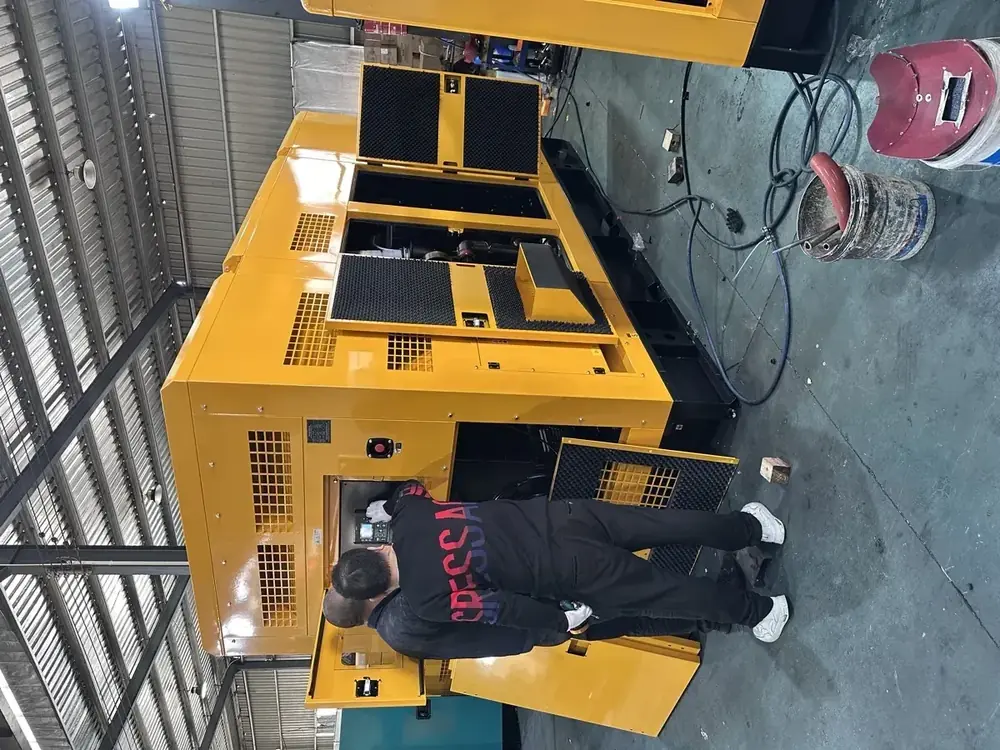
Walk the exhaust and the air intake next. A blocked intake or a nest in the exhaust outlet is common on a set that stands outdoors, and both cause the engine to run rich or hot. Check that the radiator and the air filter housing are clear of dust and debris, and that the fan belt has tension and no glazing. On a silent canopy set, open the access doors rather than peering through the grille.
Finish at the control panel: battery voltage, any alarm history, and the hour reading, which you write down. If the panel has a pre-heat or a battery charger, confirm both are working. A flat battery is the single most common reason a healthy standby set fails to start, and it is almost always visible on the charger before it becomes a call-out.
Running the set briefly without load is a check in itself, but it is not maintenance. Idling a diesel engine for long periods does it no favours, and a set that is only ever exercised at no load will glaze its cylinders over time. If the set is standby, exercise it under a real load, which is the point made in how a maintenance scope should be written.
The first service and the 250-hour interval
The first service on a new engine is not the same as the ones that follow, and skipping it is the most expensive shortcut available. A new engine sheds fine metal during its first hours of running, and that material ends up in the oil. The first oil and filter change exists to remove it. The same interval is when the initial torque checks, valve clearance check on some platforms, and a first look at belt tension are due.
In practice, most industrial diesel engines express the routine interval in hundreds of hours, and the two figures that appear most often in manuals for this class of engine are 250 hours for the routine service and 500 hours for the larger one. Those two are the shape of the schedule rather than universal constants: the figure that applies to your set is the one printed in its own manual, and it can differ with the engine platform, the duty and the fuel. What does not differ is the structure — a short list of checks that repeats at a fixed number of running hours, with a heavier list at the longer interval.
After that, the routine interval is the one in the engine manual, and on most industrial diesel engines it is expressed in hundreds of hours. The items that belong to it are consistent: lube oil and oil filter, fuel filters, air filter element depending on dust, a coolant condition check, a belt inspection, a battery and charging check, and a general leak inspection across the engine, the radiator and the fuel lines.
The interval should be shortened, not lengthened, in the conditions this market actually presents. Dusty sites clog air filters long before the hour count says so. Fuel of uncertain quality loads the filters faster and can leave water in the system, which is why a water separator and a regular drain belong in the routine. A set running continuously at high load in a hot compound will also want more frequent oil checks than a set doing occasional standby duty.
Parts availability is what decides whether this interval is actually kept. A schedule that calls for a filter nobody stocks locally becomes a schedule that slips. That is the argument for agreeing a spares kit at the point of purchase, and the list of what belongs in it is set out in generator spare parts and what to keep on hand.
The longer interval: coolant, battery, fuel system, alternator
The longer interval is where a schedule stops being about oil and starts being about the systems around the engine. Coolant loses its inhibitor package over time and becomes corrosive, so the condition matters as much as the level. Hoses harden from the inside. A pressure cap that no longer holds its rating lets the engine run hot without boiling over, which is a fault that hides until it is expensive.
The fuel system deserves its own attention on any set that stands for long periods. Diesel ages, water condenses in a part-full tank, and biological growth can form in the tank and lines. A fuel polishing routine, a tank drain, and a filter change based on condition rather than only on hours will prevent most of the starting faults that get blamed on the battery.
Batteries age by chemistry as well as by use. A battery that is two or three years old may still show a healthy voltage at rest and still fail to crank a cold engine. Load-testing it, rather than trusting the voltmeter, is the check that matters. The alternator end of the set has its own time-based item: insulation resistance, which degrades on a machine that sits in humid air without running, and which is why a standby set benefits from being run under load rather than only started.
All of this is easier to argue for when it is written into the commercial agreement rather than left to goodwill. What a support arrangement should actually commit to is covered in warranty and after-sales terms worth agreeing in writing.
The schedule at a glance
The table below is deliberately brand-neutral. It sets out which checks belong to which interval, why each one earns its place, and what record should exist afterwards. The exact hour figures come from the engine manual for the specific model; the structure does not change.
| Interval | What is checked | Why it matters | Record kept |
|---|---|---|---|
| Every start-up | Floor under the set, coolant level cold, lube-oil level, fuel level, belt tension and condition, air intake and exhaust clear, battery voltage, alarm history | Catches leaks and blockages before they become failures under load | Hour reading, date, initials |
| Weekly, or after any long run | Water separator drain, fuel filter bowl, radiator exterior cleanliness, canopy ventilation openings | Water and dust are the two most common causes of a derate | Note in the log, with the hour reading |
| First service | Lube oil and oil filter, fuel filters, air filter element, initial torque and belt checks | Removes the metal shed during running-in | Service sheet, hour reading, parts used |
| Routine interval (commonly 250 hours; confirm in the manual) | Lube oil and filter, fuel filters, air filter element as conditions require, coolant condition, belts, battery and charging, leak inspection | The core wear items; the interval that keeps the engine inside its design life | Service sheet with parts and hour reading |
| Longer interval (commonly 500 hours; confirm in the manual) | Coolant condition and hoses, pressure cap, battery load test, fuel tank drain and polishing, alternator insulation resistance | Time-based degradation that hours alone will not reveal | Test values recorded, not just a tick |
| Annual, or before a long idle period | Full inspection against the acceptance list, preservation of the fuel system, battery isolation, canopy and base condition | Protects a set that will stand unused | Signed inspection report |
The log book is the actual deliverable
A schedule without records is a list of intentions. The record is what turns maintenance into evidence, and it needs only three things per entry: the hour reading, the item, and the person who did it. Parts used belong there too, because a filter change that cannot be traced to a part number is not much use when the same fault returns.
The log pays for itself in three ways. It shows the next interval without anyone having to remember. It shortens fault-finding, because a technician can see what changed since the last service. And it protects the resale value of the set, which in this market is a real number even when the machine is old.
The same discipline applies at the other end of the asset life. When a set is delivered, the acceptance inspection establishes a baseline — the readings that later services are compared against. What belongs in that first inspection is set out in the generator inspection and acceptance checklist, and the factory-side version of the same test is described in pre-shipment inspection before a set leaves China.
What this means at the point of purchase
A maintenance schedule is cheaper to design into a purchase than to retrofit. Three things are worth agreeing before the order is placed: the interval in running hours for the specific model, the spare-parts kit that covers the first two services, and the access the set will need on site so that the checks are physically possible.
Access is the one that gets forgotten. A canopy set pushed into a corner with the doors blocked cannot be inspected, and a radiator with no clearance will recirculate its own hot air. If the set is going into a container or a plant room, the maintenance envelope belongs in the layout, not in the afterthought. The same constraint is discussed from the installation side in what an installation quote should cover.
Fuel consumption sits next to the schedule as the other number that decides running economics. A set that is serviced on time holds its consumption; a set with a clogged air filter and tired injectors does not. How to estimate the figure, and which variables move it, is covered in diesel generator fuel consumption.
Request a maintenance schedule with the quotation
Send the model, the duty (standby or prime), and the site conditions — dust, heat, whether the set sits in a canopy or a plant room. The quotation can then carry the interval in running hours, the service items at each interval, and the spares kit that goes with the set.
Get a written quotation
Three fields. We reply with the rating, the engine option and the delivery basis.
Maintenance schedule questions
How often should a diesel generator be serviced?
The interval is set in running hours by the engine manufacturer, with the first service coming earlier than the routine one. In practice the interval also has to be shortened for dust, heat and fuel quality. The calendar covers the time-based items — coolant, battery, fuel condition, alternator insulation — that hours alone will not catch.
Is it enough to service the generator once a year?
Not for a set that runs. An annual visit suits a standby set with very low hours, provided the start-up checks are done in between. A prime-power set accumulating hours through the working week will pass the routine interval well before a year is out.
What should be checked every day?
Fluid levels with the engine cold, the floor under the set for leaks, belt condition and tension, air intake and exhaust clearance, battery voltage and the charger, plus the hour reading and any alarm history on the panel. It is a short inspection, not a service.
Does running the generator without load count as maintenance?
No. A no-load run confirms that the set starts, which is useful, but it does not exercise the alternator or bring the engine to working temperature under load. Long idling periods are actively unhelpful for a diesel engine. Exercise under a real load where the installation allows it.
Who should keep the maintenance record?
The owner or the site operator, not the visiting technician alone. The record needs the hour reading, the item, the parts used and the person, and it needs to be kept in one place. It is the only evidence of how the set has been treated, and it matters at resale.
Can a maintenance schedule be agreed as part of the purchase?
Yes, and it is easier to agree it then. The interval for the specific model, a spare-parts kit covering the first services, and the physical access the set will need are all cheaper to settle before the order than after delivery.
