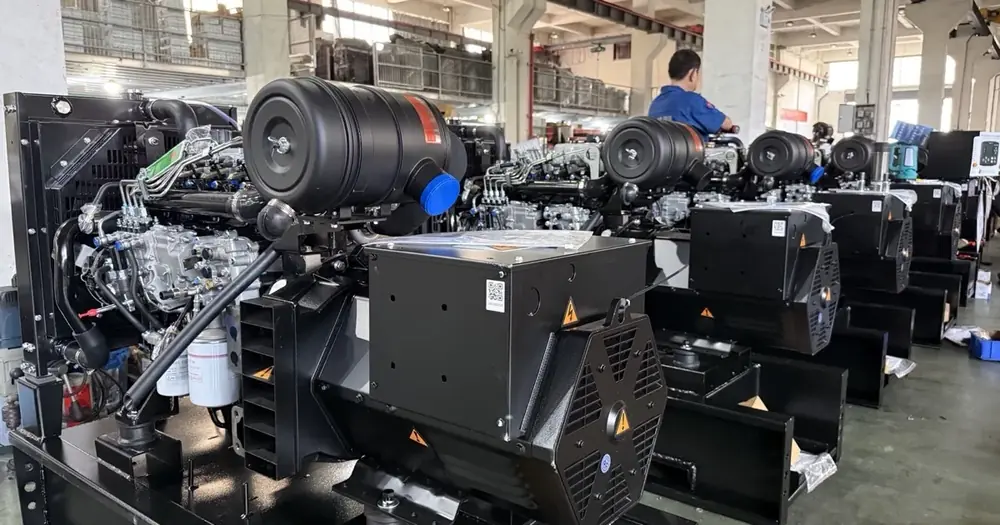
A warranty is a written allocation of who pays when something fails. If the allocation is not written down, the answer will be decided by whoever is holding the money.
What a generator warranty actually covers
A warranty on a generating set is not a single promise. The set is an assembly: an engine, an alternator, a controller, a protection and breaker arrangement, a cooling package and a structure around them. Each part can carry its own terms, and the terms are not always the same.
In practice the engine and the alternator usually carry the terms that matter most, because they are the two most expensive components. Consumables and wearing items, such as filters, belts, lubricants and batteries, are normally treated separately.
Damage caused by the operating environment is also treated separately. A set installed with poor ventilation, fed dirty or contaminated fuel, run without the recommended service, or connected to a load beyond its rating is usually outside a parts warranty, whatever the wording says elsewhere.
That is why the useful question is not whether there is a warranty, but which component the warranty covers, and on what conditions it is honoured.
The clauses to fix before you pay
These are the items worth having stated in the order confirmation. A supplier who is comfortable with the equipment will normally be comfortable writing them down.
Where a supplier declines to state one of these, treat the omission as information about how a future claim would be handled.
| Clause | What it should state |
|---|---|
| Covered components | Which assemblies and parts are covered, and which are treated as consumables. |
| Start date | The event the period runs from, and what evidence fixes that date. |
| Exclusions | Operating conditions, installation requirements and maintenance obligations that void a claim. |
| Claim route | Who is contacted, in which country, and what the buyer must provide. |
| Parts | Whether covered parts are supplied free, at cost, or not at all. |
| Labour and travel | Who pays for the technician, the visit and any travel or visa cost. |
| Response basis | What the supplier commits to doing after a reported failure, without promising a figure they cannot hold. |
| Registration | Whether the set must be registered, and with whom, for the terms to apply. |
| Service schedule | The maintenance intervals the buyer must follow to keep the terms valid. |
The spare parts question behind the warranty
Most warranty disputes are really parts disputes. If a covered part cannot be supplied to your city, the warranty is a document rather than a repair, and the downtime continues while the discussion happens.
Before ordering, ask which parts the supplier can supply from stock in Nigeria and which would be shipped from the factory. Then ask the same question for the two or three components most likely to be needed first: filters, belts, sensors, and the wear parts inside the engine.
It is also worth asking whether the offered engine platform has a parts channel in Nigeria independent of the supplier. A platform with local distribution reduces the risk that a single supplier's departure leaves your set unserviceable. The engine platform pages on this site describe these options in more detail for the Cummins and Perkins positions.
The parts position is described separately in the generator spare parts page.
How to talk about response without a false promise
Response time is the hardest term to state honestly from a supplier based outside Nigeria, because it depends on flights, visas, parts availability and the diagnosis. A supplier who promises a precise response in hours is either local or optimistic.
The practical approach is to agree the sequence rather than the clock. Ask what happens in the first day after a reported failure, who is reachable and how, what information the buyer must send, and how a decision is reached on whether the fault is covered.
Then agree the buyer-side arrangement in the same document: a named local technician if one exists, the consumables held on site, and the routine service that keeps the terms valid. Much of the cost of downtime can be removed by that preparation, before any warranty discussion happens.
Before the set ships, the inspection stage is where most of this becomes verifiable. See the factory acceptance test page and the pre-shipment inspection page for what can be recorded while the set is still at the factory.
What this site does and does not claim
No authorised distributorship of any engine brand is claimed by this website or by a quotation from this website. That is a commercial relationship held by others, and a claim of it would be worth verifying rather than accepting.
What can be verified before payment is the offered engine model, the serial and nameplate evidence, the supplier's legal identity, and the warranty route in writing. Those four items are what a buyer can check without relying on a promise.
The product directory lists the ratings this site describes, and the buying guides index collects the longer explanations.
What keeps a set running after the warranty discussion is planned service, covered in maintenance and service scope, and the supply arrangement behind it in the distributor programme.
Ask for the after-sales terms in writing
Ask for the warranty and after-sales terms to be stated in the order confirmation: covered components, start date, exclusions, claim route, parts, who pays for labour and travel, and the service schedule you must follow.
Get a written quotation
Three fields. We reply with the rating, the engine option and the delivery basis.
Warranty and after-sales questions
What does a generator warranty normally cover?
Usually the engine and alternator terms matter most, because they are the most expensive assemblies. Consumables and wear items are normally treated separately, and damage from poor ventilation, contaminated fuel, missed service or overload is usually excluded.
When should the warranty period start?
The order confirmation should state the event the period runs from and what evidence fixes that date, because a period that starts at shipment is not the same as one that starts at commissioning or delivery.
Who pays for the technician if something fails?
That is exactly what the wording should settle. Agree who pays for parts, who pays for labour, and who pays for travel or visas, and have it written into the order confirmation rather than agreed in a message.
Is it realistic to expect a fast response in Nigeria?
A precise response time is hard to promise from outside the country, because it depends on flights, visas, parts availability and diagnosis. It is more useful to agree the sequence: who is contacted, what must be sent, and how the coverage decision is made.
Does this website claim to be an authorised distributor?
No. No authorised distributorship of any engine brand is claimed by this website or by a quotation from it. What can be verified before payment is the offered engine model, the nameplate evidence, the warranty route in writing, and the supplier's legal identity.
How do I keep the warranty valid after installation?
Follow the service schedule in the offer, keep the consumables on site, ventilate and fuel the set as specified, and keep to the load limits agreed. Most voided claims trace back to one of those four items rather than to a defective part.
