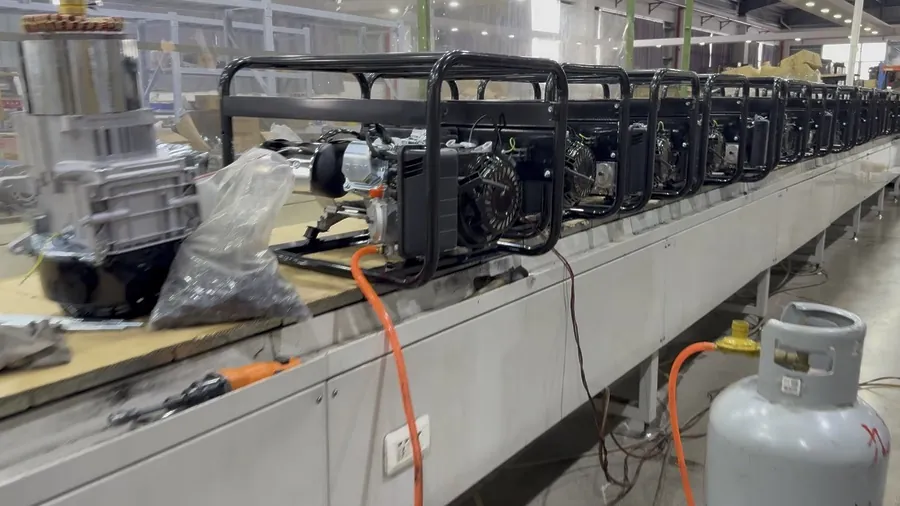
Treat conversion as a fuel-system project with an output penalty attached, not as a like-for-like fuel swap. The three questions that decide it are the derate at site conditions, the gas supply the site can actually sustain, and whether the engine warranty survives.
What a conversion kit actually changes on the engine
A conversion kit is a second fuel system grafted onto an engine that was designed around diesel injection. It adds a tank or cylinder connection, a regulator that reduces supply pressure, a device that introduces gas into the air stream or the inlet port, a controller that decides how much gas to admit, and a changeover arrangement so the engine can still run on diesel when required.
On a smaller set the introduction is often a mixer or venturi ahead of the throttle, using the engine's own intake depression to draw gas. On larger or electronically governed engines it is more likely to be a fumigation rail or a sequential injection system with its own electronic control unit reading load and speed. The two approaches differ in cost, in how precisely the mixture is controlled, and in how gracefully the engine transitions between fuels.
What the kit does not change is the part of the engine that sets its efficiency and its rating. The compression ratio, the combustion chamber shape, the piston and the injector timing were all chosen for diesel, which ignites on compression. Gas needs either a spark or a pilot quantity of diesel to ignite, and it burns at a different rate. A kit manages that difference; it does not remove it.
This is why the phrase converted engine should be read carefully in a quotation. The block, the head and the rating plate are unchanged. What has changed is the fuel path and the control strategy, and the consequences of that show up as reduced output, altered fuel consumption and a different maintenance regime rather than as a new machine.
| Kit item | What it does | What it does not do |
|---|---|---|
| Regulator or vaporiser | Reduces supply pressure to what the engine can use | Create supply where the site has none |
| Mixer or injection rail | Introduces gas into the intake or the port | Restore the diesel rating |
| Electronic control unit | Meters gas against load and speed | Make the engine a factory gas engine |
| Changeover valve | Allows running on diesel or on gas | Guarantee the engine warranty survives |
| Gas filter and shut-off | Protects the system and isolates supply | Solve storage or vaporisation limits |
The derating question: why the same set makes less power on gas
A diesel engine draws in air and injects a measured quantity of fuel into it. The amount of power it can make is limited by how much fuel it can burn cleanly in the air it has. Gaseous fuel arrives already mixed with air, so it displaces some of that air before combustion begins. The cylinder charge therefore contains less oxygen than it would on diesel, and less oxygen means less fuel can be burned.
A second factor works in the same direction. The compression ratio that suits diesel, where the fuel ignites from the heat of compression, is not the ratio that extracts the most work from gas. A purpose-built gas engine usually runs a different ratio together with different valve timing and a different combustion chamber. A converted diesel engine keeps the diesel geometry, so it operates away from the optimum for its new fuel.
The practical result is a derate: the set that carried a given load on diesel will not carry the same load on gas, and the size of the penalty depends on the engine, the kit and the load profile rather than on a single figure that applies to every set. A conversion supplier should be able to state the expected output on gas for the specific engine being converted, at the site's ambient conditions. If that figure is missing, the quote has not been written for this site.
For a buyer, the derate is the number that decides whether the project works. If the site was already running the set close to its rating, a derate means the set no longer covers the load and the conversion has bought a fuel saving at the cost of capacity. If the set habitually ran at a fraction of its rating, the derate may be absorbed without consequence and the conversion becomes a straightforward fuel decision.
Fuel supply: cylinder, virtual pipeline or piped gas
The technical conversation about conversion is usually easy compared with the commercial conversation about supply. Gas reaches a Nigerian site by one of three routes, and each imposes its own limit on how the set can be run.
Liquefied petroleum gas in cylinders is the commonest route for smaller sets. The constraint here is vaporisation rate rather than total quantity. A cylinder draws heat from its surroundings to boil the liquid into gas, and that process has a rate limit which depends on the cylinder size, the ambient temperature and how many cylinders are manifolded together. A single small cylinder feeding a set under continuous load will cool, then frost, then stop delivering. Manifolding several cylinders, or using a vaporiser, is what makes continuous running possible.
Compressed natural gas usually arrives by virtual pipeline: a cascade of high-pressure cylinders delivered to site by truck and connected to a pressure-reduction unit. This gives a much larger energy content per delivery and suits sets running long hours, but it requires a safe compound, a defined refuelling schedule and a supplier who will actually make the trip. It also means the site's operating cost now depends on a delivery relationship rather than on a fuel pump down the road.
Piped gas is the cheapest per unit where it exists, and the least available. Where a site sits on a distribution network, conversion becomes far more attractive because the storage and vaporisation problems disappear. Where it does not, the project is really about cylinder logistics, whatever the quotation calls it.
What stays diesel, and why dual-fuel is the usual answer
Most conversions sold into this market are not gas conversions at all. They are dual-fuel conversions that keep the diesel system intact and substitute gas for part of the diesel that would otherwise be burned. In a diesel engine converted this way, a small pilot quantity of diesel still ignites the charge, and the gas supplies the rest of the energy.
Keeping the diesel system has three practical advantages. The set retains its full diesel capability, so a gas supply failure becomes an inconvenience rather than a shutdown. The pilot injection preserves the ignition behaviour the engine was designed around, which avoids some of the harsher combustion problems that appear when gas is spark-ignited in a diesel chamber. And the site keeps a fuel route it already knows how to buy, store and account for.
The substitution rate is the figure to ask about. It describes how much of the energy comes from gas at a given load, and it is not fixed: it varies with load, with the kit, and with how the control unit is set. A supplier who quotes a single substitution figure without saying at what load is giving a marketing number rather than an engineering one.
Dual fuel is also what makes a staged decision possible. A site can convert, run on gas where supply is reliable, and revert to diesel when it is not, without committing to a fuel it cannot yet guarantee. That flexibility is worth more than the last increment of substitution, and it is the reason the approach dominates the market.
Reading a conversion quote: kit, labour, certification, warranty impact
A conversion quotation should have four visible parts, and a quote that shows only the first is not comparable with one that shows all four. The kit is the hardware. Labour is removal and refitting, pipework, wiring and mounting. Commissioning is the setting up of the control unit on the actual engine under load. Certification is whatever documentation the site needs to satisfy its insurer, its landlord or its own safety process.
The warranty question is the one buyers most often leave until it is too late. Converting an engine generally takes it outside the manufacturer's warranty for the affected systems, and some manufacturers treat any fuelling modification as voiding coverage more broadly. If the set is still inside its warranty period, the conversion decision is really a decision about giving that warranty up, and the value of what is being surrendered should appear in the comparison.
Commissioning deserves its own line because it is where installations fail. A kit fitted correctly but never set up under load will run, and will run badly: hesitant on load steps, unable to hold frequency, or refusing to take load at all. Ask what the commissioning includes and whether it is done on site with the site's own load, not on a test bench in a workshop.
Finally, ask who is responsible for what after handover. Which party responds if the set will not start on gas, which party maintains the regulator and the filters, and whether spare parts for the kit are held locally. A conversion adds a second fuel system that needs its own maintenance, and a quote that does not say who does that work has left the site to discover it later.
When conversion loses to buying a dual-fuel set
Conversion wins where the existing set is sound, has plenty of rating headroom, and is going to stay in service long enough to earn back the kit and the commissioning. It loses in a set of circumstances that are easy to recognise in advance.
It loses when the set has no headroom. If the site already runs the set near its rating, the derate removes capacity the site needs, and the conversion has created a problem rather than solved one. It loses when the set is old enough that an overhaul is due anyway, because the money spent on conversion is then competing with money that has to be spent regardless.
It loses when the gas supply is not genuinely secured. A conversion justified on a supply that has been promised but not contracted is a conversion that will run on diesel most of the time, which means the site has paid for a kit and gained nothing. It loses when the engine is still under warranty and the warranty has real value to the owner.
And it loses when what the site actually needs is a purpose-built gas or dual-fuel engine. Those engines exist because the combustion geometry, the compression ratio and the control strategy can be designed around the fuel from the start. They cost more than a kit, and they deliver the rating they claim. Where output matters more than the capital difference, the honest recommendation is the new set, and it is worth saying so rather than selling a conversion that will disappoint.
How to state expected gas consumption per hour in the RFQ
The Reddit thread that prompted this page asked how long a cylinder would last when the set was used across a working day. That is the correct question, and it is answerable: gas consumption per hour is a function of load, and load is something the site already knows from its own operating pattern.
Ask for consumption in the units the supplier will actually bill in, at named load points. For LPG that is usually kilograms per hour; for CNG it may be cubic metres per hour at a stated pressure. Ask for the figure at the loads the site actually runs, not only at full load, because a set lightly loaded burns disproportionately more per unit of output and the cylinder calculation changes completely.
Then convert the answer into runtime and check it against the supply plan. If the consumption figure at the site's normal load implies a cylinder change every few hours, the site is not buying a generator problem, it is buying a logistics problem, and the cylinder count or the supply route has to change before the conversion makes sense.
The enquiry should also state the derate the site is prepared to accept and the substitution rate expected in dual-fuel operation. With those three figures, the decision becomes arithmetic rather than opinion. The wider arithmetic of fuel per unit of output is set out in the fuel consumption calculator guide, and the multi-fuel set range is described on the multi-fuel generator page. Engine platform choices are compared in diesel generator brands, and site cost per unit is covered in cost per kWh.
Request a conversion assessment for your set
Send the engine make and model, the rating, the duty and the hours it runs, together with the gas supply you can actually secure at site. The reply will state the expected output on gas, the consumption per hour at your working loads, and what the conversion includes and excludes, so that the comparison with a purpose-built dual-fuel set can be made on the same basis.
Get a written quotation
Three fields. We reply with the rating, the engine option and the delivery basis.
Gas conversion questions
Will a converted generator still produce its rated output?
No. A set rated on diesel produces less on gas, because gaseous fuel displaces air in the cylinder and because the engine keeps its diesel compression ratio and combustion geometry. Ask the supplier for the expected output on gas for that specific engine at site conditions, and compare it with the load the site actually needs.
How long will a gas cylinder last on a generator?
It depends on the load and on the cylinder's vaporisation rate, not only on its capacity. Ask for consumption in kilograms or cubic metres per hour at the loads you actually run, then divide that into the supply you can hold on site. A single small cylinder will also limit continuous running through cooling and frosting regardless of how full it is.
Does converting a generator affect the warranty?
Generally yes. Fuelling modifications commonly take the engine outside the manufacturer's warranty for the affected systems, and some manufacturers treat any modification as voiding coverage more widely. Establish the position in writing before committing, particularly if the set is still inside its warranty period.
Is dual fuel better than a full gas conversion?
For most Nigerian sites, yes. Dual fuel keeps the diesel system working, so a gas supply failure is an inconvenience rather than a shutdown, and the site keeps a fuel route it can already source. It also avoids some of the harsher combustion behaviour seen when gas is spark-ignited in a chamber designed for diesel.
Can any diesel generator be converted?
Mechanically many can be, but the sensible question is whether this one should be. A set with little rating headroom, an overhaul due, or a live warranty is usually a poor candidate. The conversion also has to be supported by a gas supply the site can genuinely sustain, not one that has been promised.
