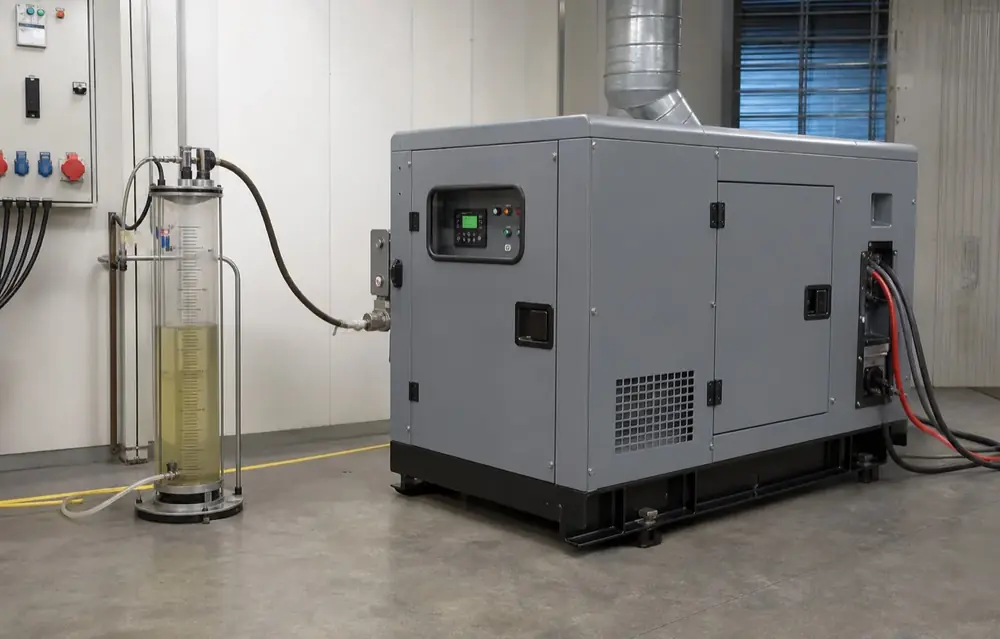
An hourly fuel figure is only as good as the two things behind it: how much load the set actually carries, and which engine's consumption rate was used. A figure produced without both is an assumption with a decimal point, not a measurement.
The three inputs behind an hourly fuel figure
Fuel use is not fixed by the size of the set. It follows the load the set is carrying, so an honest hourly figure has to start from two things rather than one: how much power is actually being drawn, and how much fuel the specific engine needs for each unit of energy it produces.
The calculator below works in that order. It converts the rated output into running kW using the power factor, applies your average load factor to show the load the set is really carrying, and then applies the consumption rate for the offered engine to give litres per hour.
Running loadEnter the fieldsFuel per hourEnter the fieldsFuel per dayAdd running hoursThe result is a planning estimate built from the fields above. It is not a tested figure for a specific machine, and it does not replace the data sheet for the engine being offered.
The three results answer different questions. The running load shows whether the set is working inside the range it was built for. Litres per hour is the figure to place beside a supplier's data sheet. Litres a day is the input for a fuel budget and for tank planning, and it is the number most buyers actually need.
Where each input should come from
A rough input gives a rough output, so it is worth separating the entries that are supplier facts from the entries that are your own operating assumptions.
Two of the fields come from the offer and three come from your site. Mixing them up is the most common reason two buyers with similar projects reach very different fuel figures.
| Input | What it means | Where a buyer should get it |
|---|---|---|
| Rated output | The kVA printed on the rating plate and repeated on the quotation. | The written quotation, not a verbally quoted size. |
| Power factor | The factor that converts kVA into kW. This site's kW, kVA and kWh guide explains the 0.8 example used for planning. | The technical guide linked below, or stated for the offered alternator. |
| Average load factor | How much of the rated output the site draws on average, expressed as a percentage. | Your own operating pattern. A cold room, a pump set and a workshop each produce a different one. |
| Consumption rate | Litres per kWh for the offered engine at the load point you are planning for. | The engine data sheet or fuel table supplied with the quotation. This site's fuel guide explains the published full-load range and why part load is worse. |
| Running hours | Hours per day the set is expected to work. | Your operating plan, not the manufacturer's assumption. |
Why the same engine uses more fuel per kWh at part load
A diesel engine carries a fixed cost in keeping itself running. Friction, the cooling fan, the alternator's own losses and the governor's work do not shrink when the electrical load falls, so the fuel needed to cover that overhead stays roughly where it was while the useful output drops away.
The consequence is practical rather than theoretical. A set carrying a light load can use noticeably more fuel for each unit delivered than the same set carrying a heavy load, so two identical machines on two different sites will report different running costs and neither report is wrong.
That is why the load factor field deserves more care than it usually gets. Entering full load because it is the number on the rating plate overstates the fuel the site will really use, while entering a low load factor without asking what the engine does at that point misstates it in the other direction.
What the estimate deliberately leaves out
The figure the calculator returns is a planning estimate built from the fields you filled in. It is narrow by design, and the following sit outside it.
| Outside the estimate | Why it matters |
|---|---|
| Load variation through the day | A set that idles in the morning and runs loaded in the evening does not average out arithmetically in fuel terms. |
| Ambient temperature and site altitude | Both change how much fuel the engine needs to produce the same output. |
| Fuel quality | Diesel that is contaminated, aerated or off-specification changes combustion and the resulting consumption. |
| Maintenance condition | Injectors, fuel filters and air cleaners out of condition raise consumption long before any warning appears. |
| Tank, line and return losses | Spillage, evaporation and return-line losses never appear in a published datasheet figure. |
| Starting and warm-up periods | Cranking, warming and cooling down burn fuel without producing any kWh. |
Four input mistakes that produce a confident wrong answer
Each of these produces a plausible-looking number, which is exactly why they survive unchallenged into budget documents.
| Mistake | What it does to the result |
|---|---|
| Treating the rating plate kVA as the working load | Overstates fuel, often by a wide margin, and can make a larger and more expensive set look necessary. |
| Leaving the power factor field at its example value without checking it | Shifts every downstream figure, because the kW figure is derived from it. |
| Using a consumption rate from a different engine or a different load point | Breaks the link between the rate and the machine actually being quoted. |
| Reading the daily figure as a tank size | Ignores how long the site must run without a refill, the working capacity of the tank and the bunding arrangement. |
Which of the two fuel tools on this site to use
This page is the estimating tool. It suits the stage before you hold a supplier's data, when the size of the job is known but the litres per hour is not.
The fuel consumption calculator on the diesel fuel page does the opposite job. It begins with a litres-per-hour figure you already have from a data sheet and turns it into daily and monthly volumes and a fuel cost. If a rate is already in your hand, that is the faster route.
The fuel consumption and running cost guide explains the method and the published full-load range in words. The kW, kVA and kWh page covers the power factor conversion this calculator uses, and the 10kW fuel consumption page walks a single small rating through in detail.
The tool gives litres and hours; turning either into money needs the fuel price and the energy delivered, which are covered in the Lagos diesel price and in cost per kWh.
Request the fuel data behind the estimate
Send the set's rating, the average load factor you expect and the hours you plan to run, and ask for the offered engine's consumption figures at those load points in writing.
Get a written quotation
Three fields. We reply with the rating, the engine option and the delivery basis.
Fuel calculator questions
Does this calculator produce the fuel figure for a specific engine?
No. It applies the consumption rate you enter. Take that rate from the data sheet for the engine being offered, at the load point you plan to run, and treat the result as a planning estimate rather than a tested figure.
Why does the result change when only the load factor changes?
Because fuel follows load rather than rating. The same machine working at a light load uses more fuel for each unit delivered than at a heavy load, so the hourly figure moves with the load factor you enter.
Which power factor should be entered?
The factor that belongs to the load you are planning for, stated alongside the result. This site's kW, kVA and kWh guide explains the 0.8 example used for planning so you can see how the conversion behaves.
Can the litres per day figure be used to size a fuel tank?
Use it as an input rather than as an answer. Tank sizing also depends on how long the site must run without a refill, the working capacity of the tank, the bunding arrangement and where the storage sits.
Is running a set at part load a real saving?
Running below the rating lowers litres per hour but raises litres per kWh, so the saving is smaller than the reduction in load suggests. At some points the extra wear and the lower efficiency outweigh what the fuel saving was worth.
Do you publish fuel figures for a specific model?
Fuel data is supplied for the offered engine as part of the written quotation. Ask for the rates at the load points that match your operating pattern, and ask which duty rating those rates apply to.
