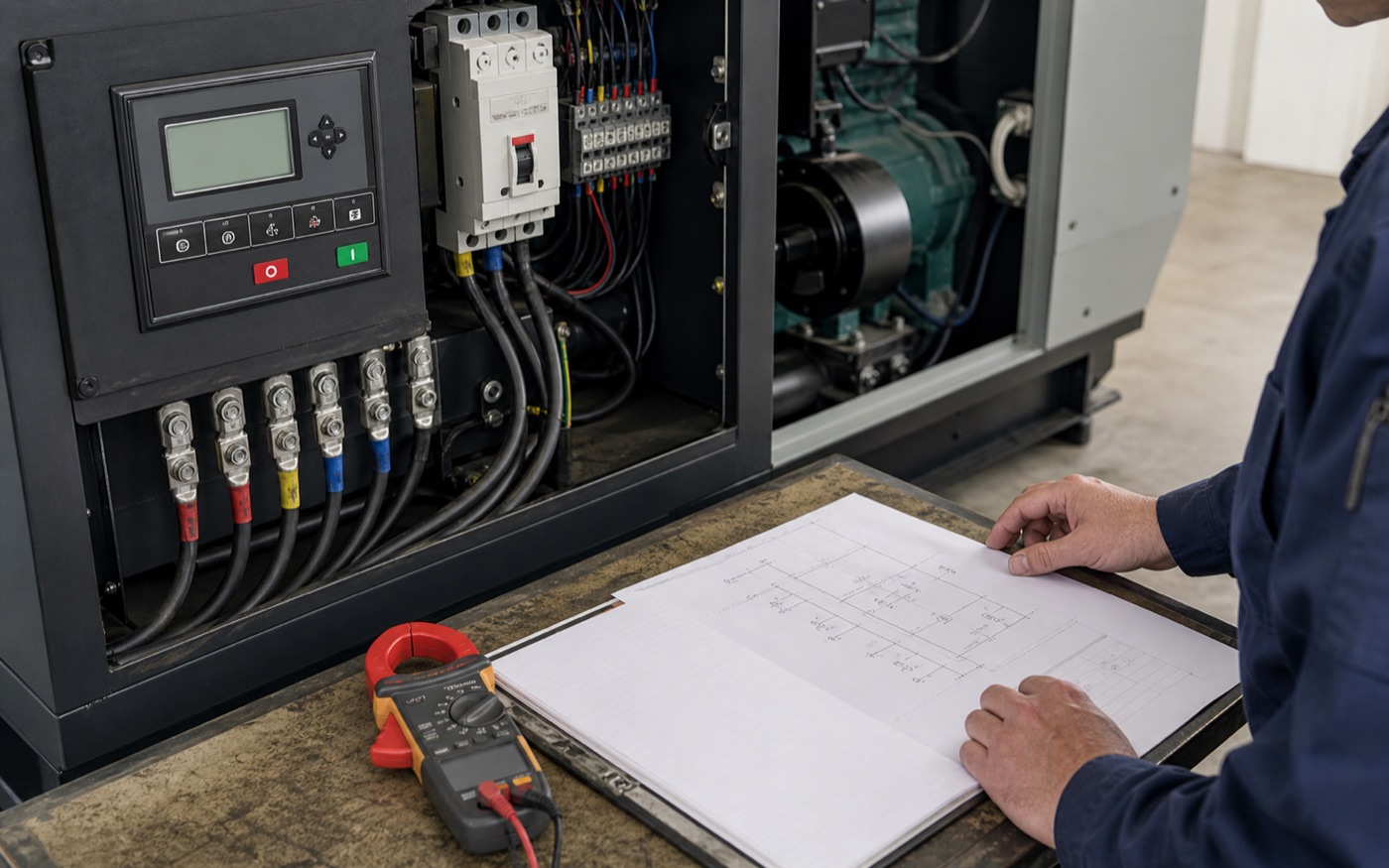
Use peak running kW and the load power factor for the base kVA conversion. Then check motor starting, load steps, harmonics, duty and future expansion before choosing the generator model.
What kW, kVA and kWh mean on a generator project
| Term | What it describes | How a buyer uses it |
|---|---|---|
| kW | Real power doing useful work at a moment in time. | Add the running kW of equipment that operates together, then identify major startup loads. |
| kVA | Apparent power the generator and alternator must supply. | Compare generator ratings only when the stated power factor and duty are also clear. |
| Power factor | The relationship between real power and apparent power. | Use the project value or measured data instead of assuming every site behaves the same way. |
| kWh | Energy consumed over a period of time. | Useful for runtime, fuel planning and operating cost, but not enough to identify peak generator size. |
kW to kVA formula and a 200kW example
Therefore, kVA = kW / power factor.
If the maximum running load is 200kW and the confirmed power factor is 0.8, the basic conversion is 200 / 0.8 = 250kVA. This does not automatically mean a 250kVA generator is the final selection.
The engineer or generator supplier must still check the largest motor starting event, the order in which loads connect, acceptable voltage and frequency dip, nonlinear equipment, ambient conditions, standby or prime rating and sensible future capacity. A quotation that shows only one kVA number without its assumptions is difficult to compare.
Why daily kWh cannot determine generator size by itself
Two factories can both consume 1,000kWh per day and still need different generators. One may operate a stable 50kW load for 20 hours. Another may have a much higher peak for a shorter production shift. The daily energy total is the same, but the instantaneous power demand is not.
For generator sizing, request or prepare a load profile showing which machines run together and the largest starting event. For fuel planning, use daily operating hours and model-specific fuel-consumption data at the expected load percentage. Our diesel generator fuel-consumption guide explains that second step.
What to send for a useful generator quotation
Send the maximum simultaneous running kW, daily kWh if known, measured or expected power factor, largest motors, motor starting methods, operating hours, required voltage and frequency, standby or prime duty, ATS need and delivery city. A one-line diagram or equipment schedule is especially helpful for factory projects.
For motors and pumps, use our three-phase motor generator sizing guide. Nigeria Generator Supply is a China-based factory-direct supply website. A Nigerian warehouse, installation team or local service office is included only when specifically written in the quotation.
Technical basis and further reading
Caterpillar's official genset sizing guidance explains why voltage, phase, load steps and starting demands matter. The Cummins generator application manual provides further background on kW, kVA and application factors. Final selection should be checked against the proposed generator data sheet and the actual site load.
FAQ
What is the difference between kW and kVA on a generator?
kW is real power used to do useful work. kVA is apparent power supplied by the generator. Power factor links the two values.
How many kVA is 200kW at 0.8 power factor?
The base conversion is 200 / 0.8 = 250kVA. Motor starting, load steps, nonlinear loads and operating margin still need to be checked.
Can daily kWh be used to choose generator size?
No, not by itself. Daily kWh shows energy over time, but it does not reveal the highest simultaneous demand or motor starting load.
Should a generator quotation state standby or prime rating?
Yes. The rating basis should be written clearly because daily prime-power use and emergency standby use are different applications.
