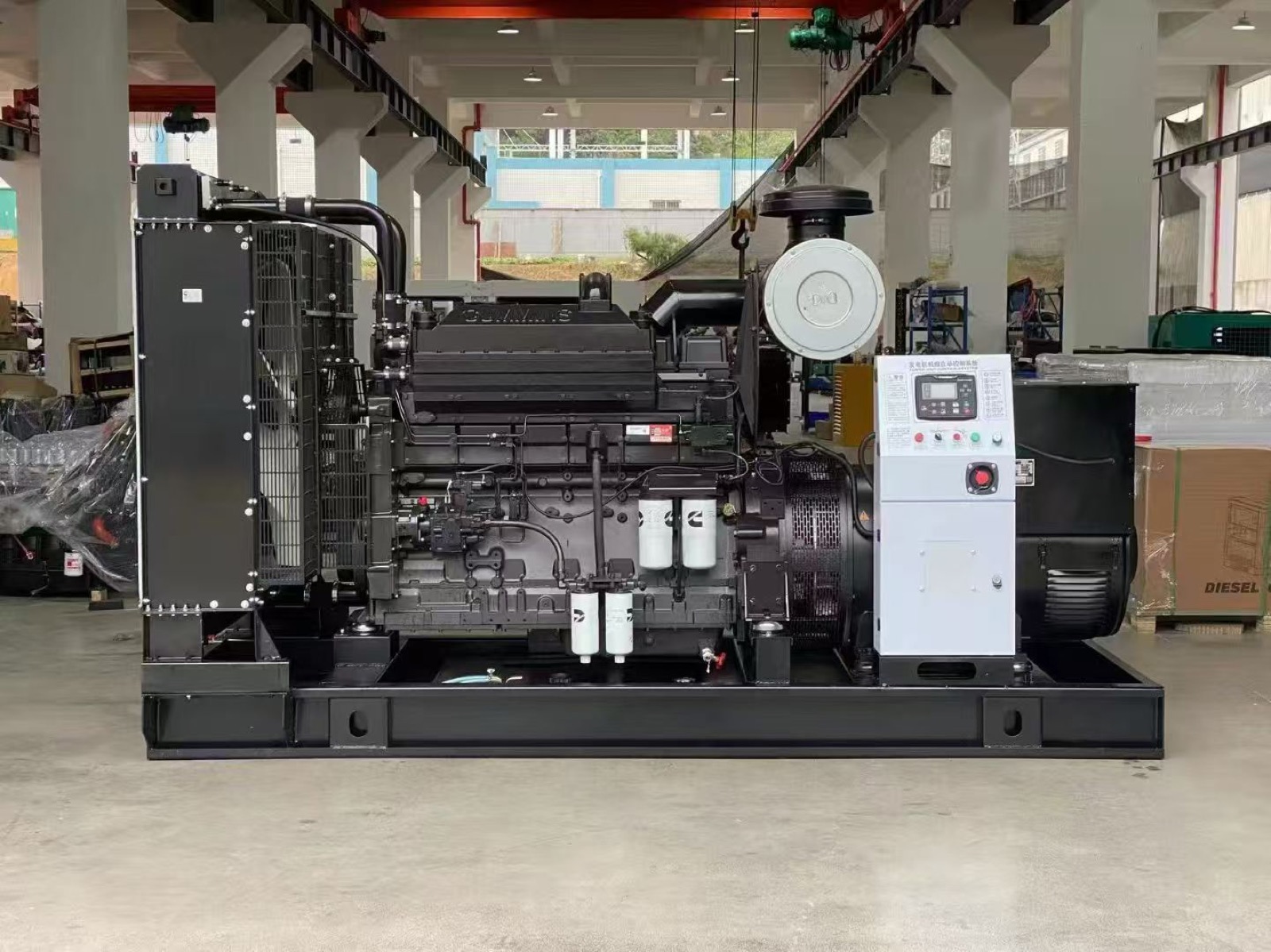
Add up the running load, then add the starting margin of the largest motor. The bigger of the two numbers decides the frame.
Two numbers, not one
A generator has to satisfy two different demands, and they peak at different times. The first is the continuous load: everything that is running, added together, held for hours. The second is the transient: the moment a motor is switched on and its rotor is still stationary, so the only thing limiting current is the winding resistance. That transient lasts a second or two, but it is frequently twice the continuous load and it is the number that decides whether a set holds voltage or collapses.
Almost every sizing mistake we see starts with someone adding up nameplate kilowatts and stopping there. That gives a set which runs the site comfortably and then trips the first time a compressor or a borehole pump restarts. The set is not faulty. It was specified against the wrong number.
The practical rule is to calculate both figures and take the larger: total running load, and running load minus the largest motor plus that motor's starting demand. If the second is bigger, the second wins. This page explains how to estimate it without a power analyser, and where the estimate stops being good enough.
Why starting current is a multiple of running current
An induction motor at standstill behaves almost like a short circuit on the supply. There is no back-EMF yet, because the rotor is not turning, so the impedance the supply sees is close to the locked-rotor impedance. As the rotor accelerates, back-EMF rises and current falls back towards the running value. That is the whole mechanism, and it explains why the surge is measured in multiples of rated current rather than in absolute amps.
The multiple depends on the motor design and, more importantly, on how it is started. A direct-on-line start applies full voltage immediately, so the current is at its maximum for the whole acceleration. A reduced-voltage method lowers the voltage during acceleration, and because torque falls with the square of voltage while current falls roughly linearly, the trade is always the same: less current, less starting torque, longer acceleration.
That trade matters on a loaded conveyor, a positive-displacement pump or a loaded compressor, where the motor needs torque to break away. A soft start that removes too much current can leave the motor humming without turning, which draws the surge for longer and heats the winding. Reducing starting current is not free, and a quote that promises a smaller set without asking what the motor is driving has skipped the important question.
Why the largest motor, not the total, sets the frame
Motors rarely start together. They start in sequence, and the worst case in almost every real installation is the biggest motor starting while everything else is already at full load. If you add the starting multiple to the total running load, you will buy a set far larger than the site needs and pay for it in fuel at part load for years. If you add it only to the largest motor, you get the number that matches how the site actually behaves.
There are two exceptions worth checking. The first is a plant where several large motors are started simultaneously by design, for example a control sequence that energises a group of pumps together. The second is a motor that restarts automatically after a supply interruption, because on a generator the restart can arrive while the set is still recovering from the changeover. Both cases push you back towards adding the simultaneous group rather than one motor.
The rest of the load matters too, but in a different way. Lighting, resistive heating and electronics contribute to the continuous figure and almost nothing to the transient. A site that is mostly lighting with one pump is dominated by the pump; a site that is mostly motors is dominated by whichever combination starts last.
What each starting method actually buys you
The starting method is often the cheapest lever on the generator size, and it is decided long before the generator is ordered. If the motor is already installed and starts direct-on-line, you are buying the margin in steel and copper. If the site is still being designed, the method can remove a large part of the margin at a fraction of the cost of a bigger set.
Star-delta is the traditional option: it starts the motor in star, so each winding sees phase voltage rather than line voltage, and the current falls to roughly a third. The catch is torque, which also falls to about a third, so it suits motors that start unloaded and not those that start against a load. Changeover has to happen at the right speed or the set sees a second surge.
A soft starter ramps voltage up over a settable time, which spreads the surge and reduces the mechanical shock. The current still peaks at roughly two to three times running current, but it peaks more briefly and the ramp avoids the belt and coupling damage that a direct start causes. A variable frequency drive goes further and holds current close to the running value across the whole ramp, at the cost of harmonics and a device that has to be rated for the motor and the environment.
The comparison, in one table
Read the table as a planning aid, not a specification. The multiples are typical bands for standard induction motors; a specific motor's locked-rotor current is on its nameplate or in its datasheet, and that figure always wins over a rule of thumb.
| Starting method | Typical starting current | What it means for the generator |
|---|---|---|
| Direct on line | About six to eight times rated current | Largest margin. The set is sized from the biggest motor plus the running load behind it. |
| Star-delta | About two to three times rated current | Smaller margin, but starting torque drops sharply. Suits motors that start unloaded. |
| Soft starter | About two to three times, ramped over seconds | Smaller, smoother surge. Still a surge, and still needs a margin. |
| Variable frequency drive | Close to running current | Smallest margin, but adds harmonics and a device to maintain. |
Two things the table does not show. First, the duration of the surge matters as much as its size: a set that can carry eight times current for half a second may not carry five times for four seconds. Second, the alternator's ability to absorb a surge is not the same as the engine's ability to recover from it, and a set can hold voltage while the engine droops in speed and frequency.
A worked example at 415 V
Take a small factory on a 415 V three-phase supply with a 30 kW pump starting direct-on-line, a 15 kW compressor, and 20 kW of lighting and small loads. The running total is 65 kW. At a power factor of 0.8 that is about 81 kVA of continuous demand, which already points at a set in the hundred kVA region.
Now the transient. The pump starts while the rest is running: 35 kW of other load, plus the pump's starting demand. At six times running current and a running power factor around 0.85, the pump's starting apparent power is roughly 30 divided by 0.85, multiplied by six, which is in the region of 210 kVA for the instant of start. Add the 35 kW already running, converted to kVA, and the peak the set must survive is well above the continuous figure.
That is why the same 65 kW site can need a set twice the size of its running load. It is also why a soft starter on that pump changes the answer completely: at two and a half times current the starting demand falls to something close to the continuous load, and the set is then chosen on running load with a modest margin rather than on the surge.
The numbers above are an illustration of the method, not a specification for your site. Voltage, power factor, motor efficiency and the actual locked-rotor multiple all move the result, and the arithmetic has to be redone with the real nameplate data. Our sizing calculator follows the same order, and the three-phase motor sizing page covers the current-to-kVA conversion in more detail.
What undersizing actually does to the set
The first symptom is a voltage dip at start. Lights dim, a contactor drops out, a UPS transfers to battery for no apparent reason. Operators often treat the dip as a nuisance and keep going, but every dip is the alternator being asked for more current than it can hold at rated voltage, and the winding heats each time.
The second symptom is a motor that accelerates slowly or stalls. A stalled motor draws locked-rotor current continuously, which is far worse than a normal start, and it will trip the overload or damage the winding if the protection is slow. On a borehole pump this often looks like the set "not being strong enough", when the real problem is that the set never had the starting margin.
The third is chronic part-load running. A set bought oversized for the transient then runs at a low percentage of its rating for most of the day, which is its own problem: light load leads to low combustion temperature, glazing and wet stacking on some engines. The right answer is not "buy bigger" but "match the frame to the real peak", which is why the starting method and the load profile have to be settled together.
There is also a maintenance dimension. A set that trips on overload every time a compressor restarts accumulates hours of failed starts without producing power, and the alternator, the breaker and the controller all take wear from it. The fault then gets attributed to the generator brand rather than to the sizing decision.
Why this bites harder on a Nigerian site
Three things make the margin less forgiving here. The first is that the generator is usually the only source, not a backup behind a stiff grid. On a grid connection the transformer and the network absorb part of the starting surge; on an islanded set there is nothing behind the alternator, so the surge lands entirely on it.
The second is voltage. Nigerian distribution is 230 V single-phase and 415 V three-phase at 50 Hz, and a motor nameplated for 400 V running on a set that droops to 360 V at start is already below its design voltage before the load is applied. The dip compounds: less voltage means less torque, which means longer acceleration, which means the surge lasts longer.
The third is the load mix. Sites here often combine a small continuous load with one or two large motor loads, because the pump or the compressor is the reason the generator exists. That is precisely the profile where sizing on running load fails and sizing on the largest motor succeeds.
If the site also has an automatic transfer switch, the restart after changeover deserves attention: the set picks up the whole site at once, including any motor that was running when the supply failed. The full sizing guide covers the changeover case, and the ATS page explains what the panel does and does not control.
Where this method stops being enough
The arithmetic on this page gets you to the right order of magnitude and rules out the obvious mistakes. It does not replace a load study on a site with variable-frequency drives, large single-phase loads, welding equipment or a mix of motors that start in an automated sequence. Those cases need the actual current waveform, because harmonics and simultaneous starts produce peaks that a simple multiple will miss.
It also does not settle the engine side. A set can have an alternator large enough for the surge and an engine that cannot recover speed after it, which shows up as frequency dip rather than voltage dip. If the site has a lift, a hoist or a compressor with a high breakaway torque, say so when you ask for a quote, because it changes the engine rating as well as the alternator rating.
What to send us for a real answer
Send the motor list with kW or HP, the starting method for each, which motors can run at the same time, and the largest motor's nameplate current if you have it. Add the site type and whether the set is the only source or a backup behind a supply. With those five things we can size the frame against the transient rather than the total, and tell you whether a soft starter would let you drop a frame size instead of buying one.
FAQ
Should I size a generator on running load or starting load?
Size on starting load. A motor can draw several times its running current for the first second or two, and the generator has to carry that surge without the voltage collapsing. Running load sets the continuous rating; starting load sets the frame you actually need.
How much starting current does a motor draw?
A direct-on-line motor typically draws six to eight times its rated current at the instant of start. Star-delta and soft starters reduce that to roughly two to three times, and a variable frequency drive can hold it close to running current. The method matters as much as the motor rating.
Why size from the largest motor instead of the total load?
Because the worst case is usually the largest motor starting while the rest of the load is already running. Adding the total running load tells you the continuous duty; starting the biggest motor on top of it tells you the peak the set must survive.
What happens if the generator is too small for the motor?
Voltage dips at start, the motor accelerates slowly or stalls, the set labours and the breaker or overload trips. Repeated attempts stress the alternator and the windings, and a set run at its limit for long periods wears faster than its rating suggests.
Does a soft starter remove the need to oversize?
It reduces the surge, not the duty. A soft starter can let a smaller frame start the same motor, but the set still has to carry the running load plus the starting margin of whatever starts next. Treat it as a way to shrink the margin, not to remove it.
