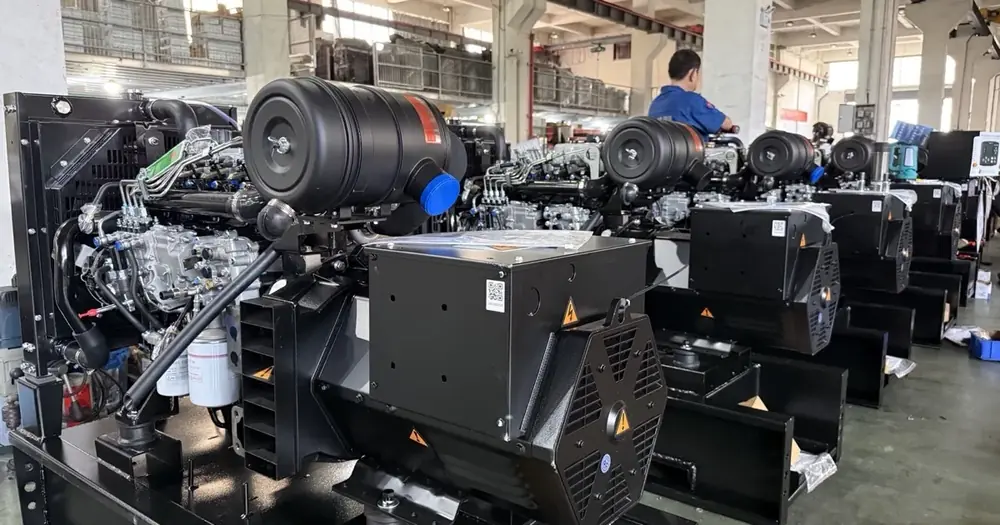
A repair fixes a failure. An overhaul restores wear. Replacement changes the machine. Confusing the three is why sites keep paying repair money on a set that has already been condemned by its own history.
Three different decisions people all call repair
When a set starts failing, the conversation on site usually begins with the same sentence: we need to repair it. That sentence hides three quite different decisions, and the money involved differs by an order of magnitude between them.
The first is a repair. Something specific has failed, the scope is limited to restoring that function, and the machine goes back into service. A repair is the right answer when the failure is isolated and the rest of the set is in known condition.
The second is an overhaul. The set still runs, but the assemblies that wear have reached the point where they no longer hold their specification. An overhaul restores compression, bearing clearances, injection performance and cooling efficiency. It is a planned intervention rather than a response to a breakdown.
The third is replacement, which changes the machine rather than restoring it. Between overhaul and replacement there is a fourth route that is often overlooked: repowering. The engine is replaced or re-manufactured while the alternator, controller and enclosure are retained. It only makes sense when those retained parts are genuinely sound, which has to be tested rather than assumed.
The reason the distinction matters is that sites routinely pay for one route and expect the outcome of another. A repair is funded and an overhaul is expected. An overhaul is funded and a new machine is expected. Getting the vocabulary right at the start is what stops that happening.
| Route | What it is meant to achieve | What it assumes | Typical trigger |
|---|---|---|---|
| Repair | Restore a specific failed function | The rest of the set is in known, acceptable condition | A breakdown, a leak, an electrical fault, a starting failure |
| Overhaul | Restore the wearing assemblies to specification | The structure and the electrical end are sound enough to carry another service life | Falling performance, rising oil use, hard starting, smoke, declining load acceptance |
| Repower | Replace the engine, keep the electrical end | Alternator, controller and enclosure have been tested and are serviceable | Engine failure or parts obsolescence on a set with a sound alternator |
| Replace | Change the machine for a new or re-manufactured unit | The remaining life of the existing set no longer justifies further spend | Repeated failures, unavailability of parts, derating, obsolescence |
The evidence to collect before anyone quotes a price
Every quote you receive will be built on whatever the person quoting could see. If they could see very little, the quote will be a guess with a number attached, and a guess is the most expensive thing you can buy in this decision.
There are six pieces of evidence worth assembling before you ask for quotations. None of them requires the set to be stripped down, and all of them change what the quotes look like.
Running hours come first, but the number on the meter is only useful if you know whether it is the original meter. A replaced hour meter turns a high-hour machine into a low-hour one on paper, and that single fact can move the whole decision.
Failure history matters more than hours in many cases. A set that has run a long time without incident is a different proposition from one that has failed three times in the same system. The pattern of failures tells you whether you have a wearing machine or a machine with a recurring defect that nobody has diagnosed.
An oil analysis is the cheapest evidence on the list and the one most often skipped. Wear metals, coolant contamination and fuel dilution each point at a different part of the engine, and together they tell you whether the wear is normal for the hours or accelerated.
Load history is the evidence owners rarely have and workshops rarely ask for. A set that has spent its life at a light load can show bore glazing and wet stacking despite modest hours, while a set that has worked hard at a sensible load may be in better condition than its hours suggest.
| Evidence | Where it comes from | What it rules in or out |
|---|---|---|
| Running hours, and whether the meter is original | Hour meter and service records | Whether the wear expectation is plausible at all |
| Failure history by system | Site log, workshop invoices | A wearing machine versus a recurring undiagnosed defect |
| Oil analysis | Laboratory sample from a running set | Accelerated wear, coolant ingress, fuel dilution |
| Load history and average load | Operating records, panel logs | Light-load damage, glazing, wet stacking |
| Electrical condition of the alternator | Insulation resistance and winding checks | Whether repowering is viable or pointless |
| Cost of the outage | Your own production or service data | How much downtime the chosen route can justify |
What an overhaul restores, and what it does not
An overhaul is a defined scope, not a general refresh. Understanding what sits inside that scope is what stops a site from buying an overhaul and expecting a new machine.
Inside the scope sit the assemblies that wear in normal service: pistons, rings and liners, valve seats and guides, bearings and their clearances, the injection system, and the cooling and lubrication paths that keep the whole thing in condition. A competent overhaul returns those to specification and can be measured against that specification afterwards.
Outside the scope sit the parts that do not wear in the same way but do degrade: the block and head castings, the crankshaft, the alternator windings, the controller, the enclosure and the fuel system upstream of the engine. An overhaul does not address any of them.
That gap is where most disappointing overhauls come from. A set with a worn engine and a tired alternator comes back with a healthy engine and the same tired alternator, and the owner concludes that the overhaul did not work. It worked. It simply addressed the engine.
The practical consequence is that an overhaul decision should always be paired with an electrical assessment. If the alternator cannot pass an insulation and winding check, the overhaul is only half a plan, and repowering or replacement should be on the table at the same time.
| Assembly | Restored by an overhaul | Not addressed by an overhaul |
|---|---|---|
| Pistons, rings and liners | Yes, returned to specification | Not applicable |
| Valve seats, guides and head work | Yes | Not applicable |
| Bearings and clearances | Yes | Not applicable |
| Injection system | Yes, within the scope quoted | Not applicable |
| Cooling and lubrication paths | Yes, cleaned and restored | Not applicable |
| Block and head castings | Inspected, not renewed | Cracks and distortion remain a risk |
| Crankshaft | Measured, machined only if specified | Fatigue life is not restored |
| Alternator windings | No | Insulation degradation continues |
| Controller and protection | No | Obsolescence and drift continue |
| Enclosure and base frame | No | Corrosion and structural fatigue continue |
| Fuel system upstream of the engine | No | Contamination returns to the new engine |
Parts availability decides more than condition
Two machines in identical condition can deserve opposite decisions, because the decision is about the next service life rather than the last one. The variable that separates them is whether the parts will be there.
For a current engine platform, an overhaul is a straightforward procurement exercise. For an older platform, it can become a scavenger hunt in which the workshop finds most of what it needs and improvises the rest. Improvised parts are where a rebuild quietly turns into a different, less reliable machine.
The question to ask is not whether parts exist, but which parts, from where, and of what quality. A genuine part, an approved equivalent and a salvaged part can all be offered under the same part number, and the difference shows up later.
It is also worth asking whether the parts are already in the country. A rebuild that stalls waiting for a component is not a rebuild schedule, it is an outage with a workshop attached.
Where the platform is obsolete and the parts are scarce, condition stops being the deciding factor. A mechanically sound machine that cannot be kept running is a replacement candidate regardless of how well it has served. The spare parts route for the offered engine is covered in more detail on the generator spare parts page.
Comparing the three routes against the same load
The comparison only means something if all three routes are assessed against the same load, the same duty and the same assumption about remaining life. Change one of those and the arithmetic changes sides.
Take the load first. If the site has grown since the set was installed, the existing machine may already be marginal, and an overhaul would restore a set that is still too small. That is not an overhaul problem, it is a sizing problem, and it should be settled before the route is chosen.
Take the duty next. A standby set that runs occasionally and a prime set that runs continuously wear differently, and the remaining life of each is different even at identical hours. A route that suits a standby machine may be poor value on a prime one.
Then take downtime. Every route has a different outage profile, and the cost of that outage belongs in the comparison. An overhaul that takes the set out of service for a long period can be more expensive than a replacement that arrives ready to run, even when the workshop invoice is smaller.
The right comparison is therefore a table rather than a number. Fill the same rows for all three routes, and the route that wins will usually be obvious before the totals are complete.
| Row to fill | Repair | Overhaul | Replace |
|---|---|---|---|
| Scope included | The failed item only | Wearing assemblies to specification | A complete unit |
| Alternator condition after the work | Unchanged | Unchanged | New or re-manufactured |
| Controller and protection after the work | Unchanged | Unchanged | New |
| Outage profile | Short, if the part is available | Long, and sensitive to parts availability | Dependent on delivery and installation, not on the workshop |
| Remaining life assumption | Until the next failure | One further service life on the engine | A full service life on the whole unit |
| Exposure to parts scarcity | Low for common items, high for the obsolete ones | High on older platforms | Low, because the platform is current |
| Effect on capacity | None | None, unless derating is corrected | Can be resized to the actual load |
When the next repair costs more than replacement
There is no universal threshold, but there are signals that reliably point the same way. When two or more of them appear together, another repair is usually buying time rather than solving anything.
The first signal is repetition. The same system failing twice within a short window means the underlying cause was never diagnosed. The second repair pays for the symptom again.
The second is scope creep. If each quotation adds items that the previous one did not mention, the machine is telling you that its condition is worse than the last assessment assumed.
The third is parts scarcity. When the workshop starts quoting alternatives because the correct part is not obtainable, the next repair will be less reliable than the last one.
The fourth is derating. A set that no longer carries the load it used to carry, at the ambient conditions it now faces, has lost capacity as well as condition. Repairing it restores neither.
The fifth is downtime cost. When the cost of the outage exceeds the value of the repair, the decision has already been made by the operation, whether or not the workshop has been told.
| Signal | What it looks like on site | What it usually means |
|---|---|---|
| Repeat failure | The same system fails twice in a short window | Root cause undiagnosed, or the assembly is beyond adjustment |
| Scope creep | Each quotation is longer than the last | Condition worse than the previous assessment assumed |
| Parts scarcity | Alternatives offered because the correct part is unavailable | The next repair will be less reliable than the last |
| Derating | The set no longer carries its old load in current conditions | Capacity has been lost alongside condition |
| Downtime cost | Outage cost exceeds the repair value | Availability, not repair price, is the real constraint |
How to specify a rebuild so the result is verifiable
If you choose an overhaul, the quotation should be written so that the finished machine can be checked against it. A scope written as a list of parts cannot be verified. A scope written as measurable outcomes can.
Instead of listing components, specify the condition the set must reach: compression within the engine maker's tolerance, oil pressure at operating temperature, fuel rate at a stated load, insulation resistance on the alternator, and a load test at the duty the site actually needs.
Ask for readings before the work starts as well as after. A before-and-after pair is what turns a claim into evidence, and it also protects the workshop, because it shows what condition the machine arrived in.
Ask how the set will be run in afterwards, and who signs the handover. A rebuild that is handed over without a running-in procedure and a recorded load test has not been handed over at all.
Finally, ask what the workmanship cover says, separately from the parts cover. The two are different commitments, and a quotation that mentions only one of them has told you which one the workshop is standing behind.
| What to specify | How it is measured | What a vague answer sounds like |
|---|---|---|
| Compression | Cylinder readings against the engine maker's tolerance | It will be fine, we always check that |
| Oil pressure | Reading at operating temperature under load | Normal once it warms up |
| Fuel rate | Consumption at a stated load, before and after | It will be more economical |
| Alternator condition | Insulation resistance and winding check | The alternator is not part of the engine |
| Load test | Run at the site's duty with readings recorded | We can start it and you can listen |
| Handover | Before-and-after sheet, signed, with settings recorded | The foreman will explain it on site |
The rule of thumb, and what it cannot answer
One figure is worth knowing before the comparison, provided it is treated as what it is. As a rule of thumb, a diesel generating set at full load consumes roughly 0.21 to 0.25 litres per kWh. Our fuel consumption guide sets out where that range comes from and why part-load running is worse per unit of energy.
It is useful for sanity-checking a fuel budget. It is not useful for this decision, and it is worth being explicit about what it cannot answer.
It cannot tell you whether your set is worth repairing, because it says nothing about condition, hours or failure history. It cannot tell you what your set actually consumes, because it describes a full-load figure rather than your load profile. It cannot price downtime, which is frequently the largest number in the comparison.
It says nothing about the alternator, the controller or the enclosure, which are exactly the parts an overhaul leaves untouched. It says nothing about remaining life. And it says nothing about the trade between fuel cost and reliability, which is the real question when a site is deciding whether to keep an ageing machine.
Use it to check a claim, not to make a decision. The decision belongs to the evidence in the earlier sections.
A decision sequence you can run in one meeting
The sequence below is deliberately short. Its purpose is to stop a site from pricing a route before it has established whether that route can work.
Work through it in order. A no at any step does not end the process, but it does change which routes remain open.
| Step | Question | If the answer is no |
|---|---|---|
| One | Is the existing set still the right size for the load? | The decision is replacement with a correct rating, not overhaul |
| Two | Is the engine platform still supported with parts? | Repair and overhaul both become unreliable; replacement moves up |
| Three | Does the alternator pass an insulation and winding check? | Repowering becomes pointless; compare overhaul against replacement only |
| Four | Is the failure pattern a wear pattern or a recurring defect? | Diagnose the defect first; no route will fix an undiagnosed cause |
| Five | Does the outage cost exceed the difference between routes? | Availability decides; choose the route with the shortest outage |
| Six | Can the chosen scope be written as measurable outcomes? | The scope is not yet specified; do not accept a quotation |
Ask for an assessment rather than a repair quotation
Send the running hours, the failure history, the load the site needs and any oil analysis you hold, and ask for the engine condition, the alternator condition and the rebuild scope to be assessed separately, so the three routes can be compared on the same evidence.
Get a written quotation
Three fields. We reply with the rating, the engine option and the delivery basis.
Repair, overhaul or replace: common questions
How do I know whether to repair or replace a generator?
Start with the evidence rather than the quotation. Running hours, failure history, an oil analysis, load history, the electrical condition of the alternator and the cost of the outage together show whether the machine has a future. If the failures repeat, the parts are scarce or the set no longer carries its load, replacement is usually the better route.
What does an overhaul actually include?
An overhaul restores the assemblies that wear in normal service: pistons, rings and liners, valve work, bearings and clearances, the injection system and the cooling and lubrication paths. It does not renew the block, the crankshaft, the alternator, the controller or the enclosure.
Why did our overhaul not solve the problem?
Most often because the problem was never in the engine. An overhaul restores the engine and leaves the alternator, controller and fuel system exactly as they were, so a fault in any of those survives the rebuild and reappears afterwards.
Can we replace only the engine and keep the alternator?
Yes, and it is a route worth pricing when the alternator and controller test sound. It only works if those parts are genuinely serviceable, which means measuring insulation resistance and winding condition rather than assuming they are fine because the set still produced power.
How long should a rebuilt generator last?
That depends on the platform, the scope of the rebuild, the duty it returns to and the quality of the parts used. A rebuild written as measurable outcomes, with before-and-after readings, gives you a basis for the claim. A rebuild written as a parts list does not.
Is it worth overhauling an older engine if parts are hard to find?
Usually not, unless the parts can be sourced reliably and to a known quality. A rebuild that stalls waiting for a component, or that substitutes an unknown equivalent, produces a machine that is less dependable than the one you started with.
What should a rebuild quotation contain?
The scope in measurable terms, the readings before and after, the alternator assessment, the load test, the running-in procedure, the handover record, and the workmanship cover stated separately from the parts cover.
Does fuel consumption tell me whether to repair or replace?
No. A full-load consumption figure is a rule of thumb for budgeting, not a condition assessment. It says nothing about hours, failure history, the alternator, the remaining life of the machine or the cost of the downtime the decision will cause.
