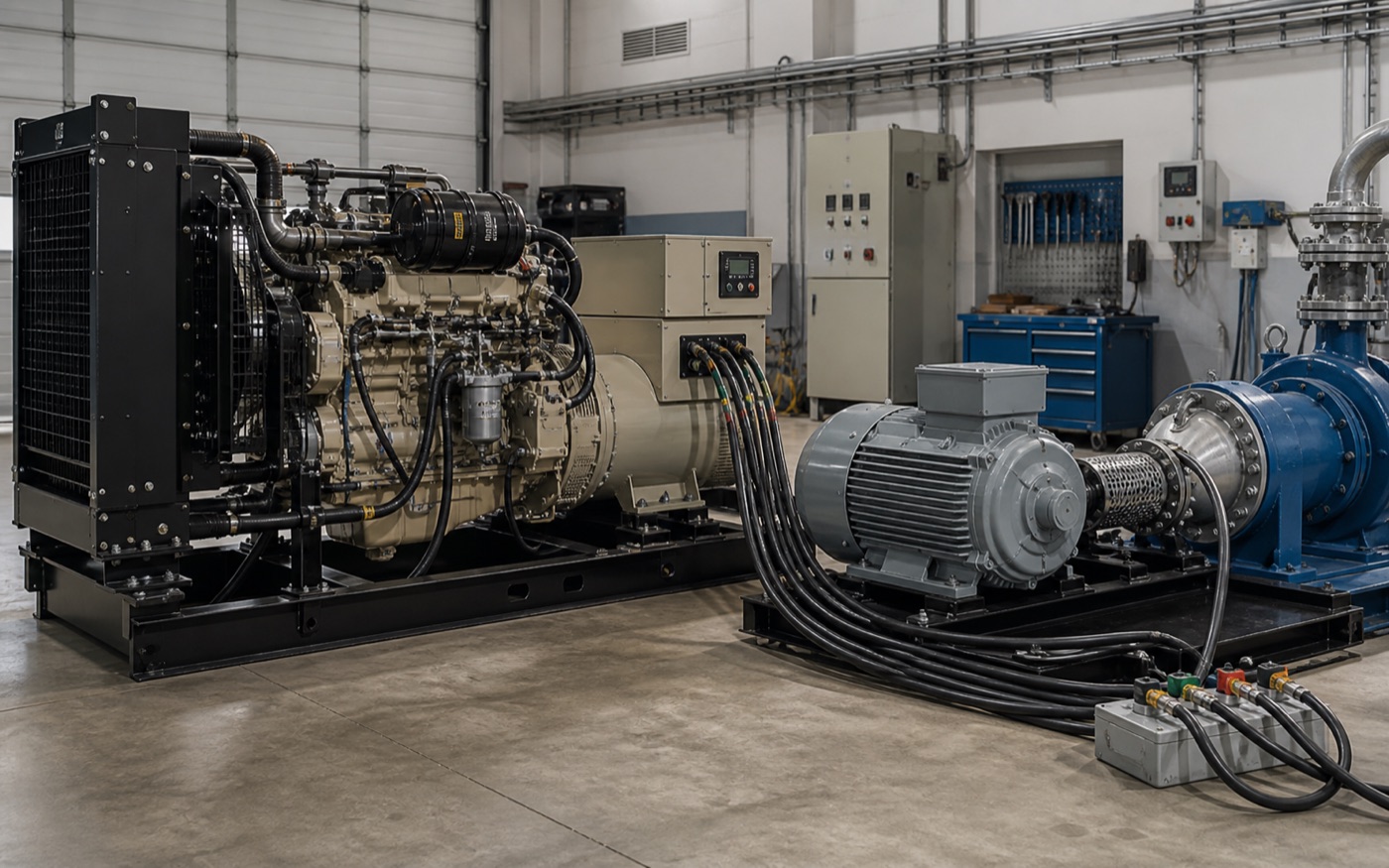
Time to trip identifies the mechanism; the per-phase clamp reading identifies the circuit. Change the arrangement before the breaker.
A breaker trips for three different reasons, and they leave different evidence
An overload heats a thermal element until it bends and releases. A short circuit or a large motor start pulls a magnetic element past its threshold and it releases in milliseconds. An earth-leakage device compares current out against current back and releases when the difference exceeds its setting. Three mechanisms, three time scales, three completely different repairs.
The time scale is the clue. A breaker that trips after several minutes of running is thermal, and the question is what is drawing too much current or what has made the breaker weaker than it was. A breaker that trips the instant something starts is magnetic, and the question is starting current. A breaker that trips with no obvious load pattern, sometimes immediately and sometimes after minutes, is often earth leakage, and the question is insulation.
Getting the mechanism wrong sends you to the wrong system. Adjusting a load that is not excessive, or replacing a breaker that is doing its job, are the two expensive versions of that mistake.
| When it trips | Mechanism | Where the answer is |
|---|---|---|
| Instantly, as a motor or compressor starts | Magnetic, from starting current | Motor starting method, and the set's ability to ride through it |
| Instantly, with no load change at all | Magnetic, from a short circuit | Insulation and cable damage, often in a wet or damaged run |
| After minutes at steady load | Thermal overload | Actual current against the breaker rating, and load balance |
| After minutes, only on hot afternoons | Thermal, derated by ambient | Breaker enclosure temperature and ventilation |
| At random, no pattern, sometimes instantly | Earth leakage | Insulation resistance, moisture, and the neutral arrangement |
| Only when running on the generator, never on the grid | Neutral or bonding arrangement | Transfer switch poles and where the neutral is bonded |
Balanced on paper, lopsided in the panel
A three-phase set shares its load across three windings, and the breaker sees the current in the phase it protects. If one phase carries most of the single-phase load, that phase reaches its limit while the other two are half empty, and the breaker trips on a set that is nowhere near its rated output.
This is the normal condition of a Nigerian installation rather than an exception. Air conditioners, sockets and lighting are distributed by whoever wired the board, and the distribution rarely survives a year without someone adding a circuit to whichever spare way was nearest.
The measurement is a clamp meter on each phase at the same moment, under the load that causes the trip. A spread of more than a modest margin between phases is a distribution problem, and the remedy is moving circuits rather than buying a larger set. Where the spread cannot be fixed, the set is effectively rated by its most loaded phase, not by its nameplate.
The trip that happens before the load has done any work
A direct-on-line induction motor draws a multiple of its running current for the second or two it takes to accelerate. The generator sees that as a sudden demand, its voltage dips, the motor draws more current for longer because it is accelerating more slowly, and the breaker opens.
That sequence explains a pattern that otherwise looks impossible: the set runs all day, a pump starts, and the breaker trips even though the pump is small. The pump is not the problem; the combination of starting method and the set's voltage recovery is.
There are three remedies and they are not interchangeable. Change the starting method so the motor draws less at start. Reduce what else is running when the motor starts. Or accept that the set cannot start that motor and change the set. The first is usually the cheapest and the third is usually chosen first, which is why so many sites end up with a set larger than their running load needs.
Why it trips on the generator and not on the grid
A fault that appears only when the site is on generator is almost always about the neutral and the earthing, because those are the two things that change when the supply changes. This is the branch that catches competent electricians, because the installation tested fine on mains.
The mechanism is the transfer switch. A switch that breaks the neutral turns the generator into a separately derived system, which must have its own neutral-to-earth bond at the generator. A switch that leaves the neutral solid keeps the set tied to the installation's single bond at the origin. Bond it in both places and neutral current has two paths back, some of it through the earthing conductor; the result is nuisance earth-leakage trips, warm earth cables, and voltages on metalwork that should be dead.
The same logic applies to the set's own earth terminal. A generator bonded to a earth electrode that is separate from the building's electrode creates a difference in potential between two earths, and an earth-leakage device will see that difference as a fault. One installation, one earthing system, bonded in one place according to how the transfer switch is built.
The breaker has to be coordinated with the set, not chosen by habit
A breaker that is too small trips on a healthy load. A breaker that is too large protects nothing and lets a cable cook. The correct choice sits between the set's rated current and the cable's capacity, and it has to tolerate the starting currents the site actually produces.
On a generator the calculation is less forgiving than on the grid, because the set cannot deliver the fault current that a transformer can. A breaker selected for grid fault levels may never trip magnetically on a generator, and a breaker selected only for thermal protection may trip on every motor start. Both errors are common where a board was designed for mains and then connected to a set.
Cable sizing follows the same discipline. A cable that is adequate on the grid may be marginal on a set that runs at a lower voltage during motor starts, because the current rises as the voltage dips. Voltage drop at the far end of a long run is worth measuring before the breaker is blamed for a fault that is really a cable.
What to measure before anything is taken apart
The sequence below is designed so that each step either eliminates a mechanism or names a component. Nothing is disconnected until the current readings have been taken, because those readings are the evidence for everything that follows.
| Step | Action | What it decides |
|---|---|---|
| 1 | Note exactly when it trips: at start, after minutes, or at random | Which of the three mechanisms is in play |
| 2 | Clamp each phase at the same moment under the faulting load | Imbalance and true current against the breaker rating |
| 3 | Read voltage on all three phases during the event | Whether a dip is driving the current up |
| 4 | Identify which device opened: main breaker, sub-main, or an earth-leakage device | Whether this is overload, short or leakage |
| 5 | Isolate circuits in groups to find the one that reproduces the trip | The circuit, rather than the set |
| 6 | Insulation-test the suspect circuit | Earth fault before any breaker is replaced |
| 7 | Confirm the neutral and bonding arrangement at the transfer switch | The fault that only appears on generator |
| 8 | Only then exchange a breaker, and only against a like-for-like rating | The last step, not the first |
Nuisance trip or real fault: the distinction that decides the spend
A nuisance trip is one where the protection operated correctly and the installation is fine; the setting or the arrangement is wrong. A real trip is one where something downstream genuinely failed. They look the same at the panel and they cost very different amounts to resolve.
The evidence that separates them is repeatability and location. A real fault repeats at the same circuit, at the same point in the load cycle, and insulation testing finds it. A nuisance trip moves around, follows the weather or the time of day, and disappears when circuits are separated.
Resist the temptation to solve a nuisance trip by fitting a larger breaker. That converts a visible problem into an invisible one: the cable becomes the weakest link and the next event is a fire rather than a trip. Where the arrangement is wrong, the arrangement is what changes.
| Evidence | Nuisance trip | Real fault |
|---|---|---|
| Repeatability | Same load point, no damaged circuit found | Same circuit, every time |
| Insulation test | Reads clear | Reads low or fails |
| Effect of splitting circuits | Trip moves or stops | Trip stays with one circuit |
| Weather dependence | Worse in humid conditions | Independent of weather unless water is entering |
| Only on generator | Neutral and bonding arrangement | A latent fault the grid's fault current masked |
| After a load was added | Coordination was never recalculated | The new load has a fault |
Where this guide stops and a protection study begins
Everything here is a rule of thumb for finding which mechanism is operating. It is not a protection coordination study, and it does not tell you what rating a breaker should be, because that depends on the set's fault contribution, the cable, the length of the run and the earth loop impedance at the far end.
The neutral and bonding guidance assumes the transfer switch arrangement can be seen and confirmed. Where the switch is sealed, or where the installation has been modified since it was tested, that assumption fails and the arrangement has to be established before any conclusion is drawn.
One warning belongs here rather than in a footnote: an earth-leakage device that trips repeatedly is doing its job until proven otherwise. Bypassing it to keep the site running removes the only protection between a person and a fault, and the fact that the trip is inconvenient is not evidence that it is wrong.
What to send us so we can tell you which mechanism is operating
The two readings that matter most are the current on each phase at the moment of the trip, and the exact timing. With those, the mechanism is usually identifiable before anyone visits site.
| What to send | Why |
|---|---|
| Timing of the trip: instant, minutes, or random | Separates magnetic, thermal and leakage |
| Clamp reading per phase at the faulting load | Shows imbalance and true current |
| Which device opened, and its rating | Tells you what the protection was trying to do |
| Whether the same fault happens on the grid supply | Points at neutral and bonding if not |
| Set rating and the largest motor on site | Decides whether starting current is the cause |
| Whether anything was added to the board recently | Coordination is rarely recalculated after an addition |
FAQ
Why does my generator breaker trip when the air conditioners start?
Starting current. A compressor draws a multiple of its running current for a second or two, and the set's voltage dips, which raises the current further. Check what else is running at that moment before changing the breaker.
The breaker trips only when we are on generator, never on mains. Why?
Usually the neutral and bonding arrangement at the transfer switch. A switch that breaks the neutral changes where the system is bonded, and bonding in two places sends current through the earthing conductor.
Is it safe to fit a bigger breaker to stop the tripping?
No. It converts a visible trip into an unprotected cable. If the trip is a nuisance caused by arrangement or coordination, fix that instead of the breaker rating.
How do I know if it is an earth fault?
Insulation-test the suspect circuit. An earth-leakage device that trips at random, or only in humid weather, is usually reporting a real insulation problem rather than a faulty device.
One phase reads much higher than the others. Is that a generator fault?
Usually a distribution fault. Single-phase loads are rarely balanced across the phases, and the set is effectively limited by its most loaded phase rather than by its nameplate rating.
Can a generator trip its breaker because it is too small?
Yes, but usually on starting current rather than on running load. A set that carries the running load comfortably can still fail to accelerate a large motor.
Should I replace the breaker after it trips a few times?
Only after the mechanism is established. A breaker that has tripped repeatedly on genuine faults may have been weakened, but replacing it without finding the cause simply resets the cycle.
