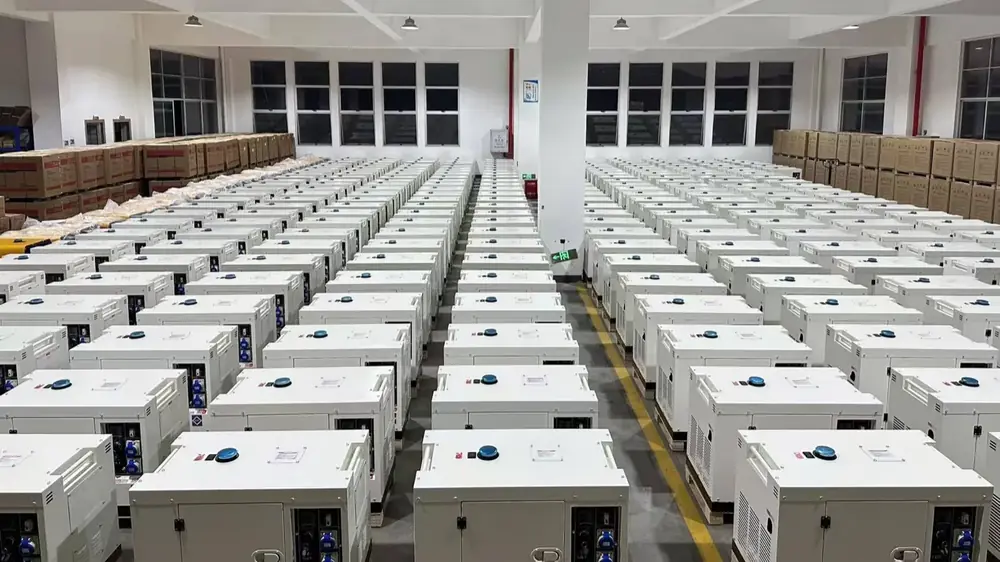
We are the direct-import side of this question. This site sells factory-direct generating sets from China into Nigeria, so we benefit when a buyer chooses the third route. The section on when direct import is not worth it is written because the route has real limits, and a buyer who discovers them after the container lands has been badly served.
Three routes to the same machine, and the buyer each one fits
A dealer buys sets, holds some of them, and sells them with a margin. What the buyer is paying for is availability and proximity: the unit is on the floor, the seller is in the same city, and if something goes wrong there is a person to visit. A dealer rarely manufactures anything, so the machine's origin is whatever the dealer chose to stock.
A stockist is a dealer who holds meaningful inventory, usually of a brand or a range, and sells both to end users and to smaller dealers. The stockist's business is working capital: units sit in a warehouse until they are sold, and that cost is built into the price. What the buyer gets in return is a short wait and, often, a wider choice of models that are physically present.
Direct import means buying from the factory and owning everything between the factory gate and the site: the build slot, the freight, the clearance, the inland haulage, the commissioning. What the buyer gets in return is the factory price without a distributor margin. What the buyer takes on is every task that margin was paying for.
Those three bundles are not interchangeable, and the mistake buyers make is comparing them on price alone. The comparison only becomes meaningful when time, warranty, spares and cash are priced in as well, which is what the rest of this page does.
Where the money goes, and the volume at which it stops being worth it
On a dealer sale, the margin covers the dealer's cost of holding the unit, the showroom or yard, the staff, the delivery, and the risk that the unit sits unsold. That margin is not waste; it is the price of the dealer being able to hand over a running set the same week. When a buyer compares a dealer price with a factory price and concludes the dealer is expensive, the comparison usually ignores what the margin bought.
On a stockist sale, a larger share of the price is inventory cost. Units that sit for a season tie up capital that could be earning elsewhere, and slow-moving models have to be carried by the fast-moving ones. A stockist with the right model in stock is genuinely worth a premium to a buyer who cannot wait; a stockist with the wrong model in stock will try to sell that one instead, which is worth knowing.
On direct import, the factory price is only the first line. Freight, insurance, duty and the destination's charges, port and terminal costs, clearance agent fees, inland haulage, offloading, and commissioning all land on the buyer. So does the cost of money: the buyer pays before the goods arrive, and that capital is unavailable for anything else in the meantime. On a single small unit, those additions can easily exceed what a local dealer's margin would have been.
The container arithmetic is a volume question before it is a money question. A 20 ft container is usually quoted at around 33 CBM of internal volume and a 40 ft at around 67 CBM, and those are the figures to divide by the packed volume of one set, carton included, not by the machine's dimensions alone. Two corrections matter: no container fills to its nominal volume, because of the space lost at the doors and around irregular loads, and the weight limit can bind before the volume does on dense items.
We do not print a units-per-container figure on this page, because it changes with the rating, the enclosure, whether the set is cartoned on a pallet, and how the load is braced. Anyone who quotes one number for all models is guessing. What can be said is the method: take the packed volume of the model, divide it into the usable volume of the container, then check the weight against the limit, and treat the answer as a range rather than a count.
The threshold in practice is not a number of units but a combination. Importing starts to make sense when the order is large enough to fill a meaningful share of a container, when the buyer has the time to wait for a build and a sailing, and when someone in the buyer's organisation can own clearance and commissioning. Remove any one of those three and the route gets worse quickly. The 100kVA price page and the 250kVA price page show how the structure changes as the rating rises, and a single 45kVA set is usually where buyers first discover that the fixed costs dominate.
That is the honest arithmetic, and it is why the answer changes with size. The fixed costs of importing do not shrink when the order shrinks, so the smaller the shipment, the worse direct import compares. The table sets the three routes against the dimensions that actually differ.
Read the table as a single question: for each item the buyer pays for, which route carries that cost, and what does the buyer receive in exchange?
| What the buyer pays for | Local dealer | Stockist | Direct import |
|---|---|---|---|
| The machine itself | Dealer margin on top of the landed cost | Margin plus the cost of carrying stock | Factory price, with no distributor margin |
| Freight and duty | Already inside the price | Already inside the price | Paid by the buyer, on top of the machine |
| Clearance | Already inside the price | Already inside the price | Buyer appoints and pays a broker |
| Inland transport and offloading | Usually included or quoted locally | Usually included or quoted locally | Buyer arranges and pays |
| Commissioning | Often included, often informal | Often included | Buyer arranges an electrician or pays for a visit |
| Capital tied up before delivery | None beyond the deposit | None beyond the deposit | The whole shipment, paid before it sails |
| Main risk to the buyer | Paying for convenience that was not needed | Being sold the model that happens to be in stock | Paying for goods that cannot be cleared or commissioned |
Lead time: what each route can honestly promise
A dealer with the unit on the floor can deliver in the time it takes to move it. That is the route's whole value, and it is worth paying for when the site is already built and the alternative is another week of outage or another week of rental.
A stockist can usually do the same, with the caveat that the model in stock is the model on offer. If the site needs a specific rating, enclosure or phase arrangement, the stockist either has it or does not, and the answer arrives immediately rather than after a quotation cycle.
Direct import has three separate waits that cannot be compressed into one. The set has to be built or allocated from the factory's schedule. It has to sail, and sailings are not daily. It has to clear, and clearance depends on documents being right the first time. Each of those is a stage the buyer does not control, which is why the only honest lead-time statement on this route is one that is dated and specific to a quotation rather than a general claim on a website.
The practical consequence is that direct import suits a project with a schedule, not a site with an emergency. A buyer who needs the set this week is not a candidate for importing, however attractive the factory price looks. The sequence from order to site is set out on the China to Nigeria lead time page, and the packing and loading stage is documented on the container loading page.
Who honours the warranty, and where the spares actually come from
This is the item buyers weigh least and lose most on. A warranty is only as good as the entity that has to act on it, the distance between that entity and the machine, and whether the entity still exists when the claim is made.
On a dealer sale, the claim goes to the dealer. If the dealer is local, that can mean a technician on site and a part from the shelf. It can also mean a dealer who has stopped selling that brand, or who has closed, in which case the buyer holds a document with nobody to present it to. The warranty's value therefore depends on the dealer's continuity, not on the wording.
On a stockist sale, the same applies with one advantage: a stockist with a service operation has staff and parts already in the country, and an interest in protecting a brand relationship. The question worth asking is not whether a warranty exists but who signs the claim and where the replacement part comes from.
On direct import, the warranty is the factory's, and the claim crosses a border. That is a real cost, not a technicality. A part shipped from the factory to Nigeria takes as long as a shipment takes, and in the meantime the site is down. What makes this route workable is not a longer warranty document; it is an agreed procedure for what happens on the first failure, settled before the order is placed: who diagnoses, who authorises, what is air-freighted and what waits, and who pays for the labour at the site.
Filters, belts, injectors, sensors and control boards are the items that decide whether a set is an asset or a liability. A machine that runs perfectly and cannot get a fuel filter in its own city is a machine with a scheduled outage attached.
A dealer or stockist who services sets will usually hold the fast-moving consumables for the brands they sell, because they need them for their own work. That is a strong practical argument in their favour, and it is worth more than a small difference in the purchase price. The test is concrete: ask for the part numbers of the oil filter, the fuel filter and the control board for the exact model, and ask whether they are on the shelf today.
On direct import, the buyer becomes the parts holder. That is manageable if it is planned: a starter kit of consumables ordered with the set costs far less than the same parts bought later against an emergency, and a documented part list means a local factor can cross-reference. It is unmanageable if it is not planned, because the alternative to a stocked filter is a set standing idle while a shipment is arranged.
The practical rule is that a direct-import buyer should treat the first spares order as part of the purchase, not as an afterthought. The consumables worth holding are listed under generator maintenance and service, and the interval structure that consumes them is on the maintenance schedule for the specific model.
The four risks that cost buyers most, and how to test for them
Buying badly is rarely a matter of paying slightly too much. The expensive failures are specific and repeatable, and each one has a check that takes minutes.
A refurbished set sold as new is the first. The tell is usually the hour meter, the condition of fasteners and paint, and whether the documentation matches the serial number. A genuinely new set has a low hour reading and untouched fixings; a refurbished one has fresh paint over worn parts and a story about a test run. Ask for the hour reading and the serial number in writing, and compare them with the documents.
An assembled set presented as a branded one is the second. The engine, the alternator and the control panel can come from three different makers, and a set assembled locally around a branded engine is not the same product as a factory build. The check is to ask for each major component by maker and model, and to confirm that the nameplate matches those answers rather than contradicting them.
A nameplate that overstates the rating is the third, and it is the one that hurts longest, because the set appears to work until the load arrives. A set rated for standby duty at one figure is not the same as one rated for continuous prime duty, and the two are often confused. The check is to ask for both figures, and to ask which one the price refers to.
Goods that do not satisfy the destination's conformity requirements are the fourth. This page does not describe those requirements, because they change and because getting them wrong on a website is worse than saying nothing: confirm the document set, the conformity position and who is responsible for clearance with your own broker and against the current regulations before the order is placed. If goods arrive without the right paperwork, the answer is not to clear them and hope. It is to stop, get the broker to state the position in writing, and work from that.
The same discipline applies when choosing who to buy from. The table below is not a personality test; every row is something a seller can either demonstrate or cannot.
The table answers one question - when you ask a seller something that matters, what does a real answer look like beside a reassuring one?
| Ask this | A verifiable answer looks like | A vague answer sounds like |
|---|---|---|
| Can I see this exact unit running under load? | Dated footage or a visit where the set runs at load with instruments connected | It is brand new, there is nothing to see |
| Which engine, alternator and controller, by model? | Maker and model for each, matching the nameplate | Original parts, high quality |
| Who honours the warranty, at what address? | A named entity, an address, and written terms including who pays site labour | Full warranty, do not worry |
| Can I buy this model's filters here, today? | Part numbers, and a supplier who answers the phone | Everything is available |
| What are the standby and prime ratings? | Two figures, with the one being sold stated clearly | It is a 100kVA machine |
| Is the set new, and what is the hour reading? | A number, in writing, with the serial number | Zero hours, trust me |
| Who clears the goods, and what documents apply? | A named broker, a document list, and responsibility assigned in writing | We handle everything |
What we recommend, including when not to buy from us
For a buyer replacing one small set that has failed, or powering a shop, a home or a small clinic with a single unit, the local dealer route is usually correct. The premium buys availability, a local point of contact and consumables on a shelf, and on a single small unit the fixed costs of importing will often match or exceed that premium. We would rather say so than sell a container slot to a buyer who needed a set this month.
For a regional dealer or a buyer who orders repeatedly but cannot carry inventory, a stockist relationship is the sensible middle. It removes the capital burden of stock and keeps a local source of parts, at the cost of a margin that is visible and negotiable.
Direct import is right for a buyer with a real project: a building or a plant that needs a specific rating, an order large enough that the fixed costs are diluted, a schedule that can absorb a build and a sailing, and someone who owns clearance and commissioning. That buyer gets the factory price and the factory's engineering, and takes on the work the margin used to pay for. It also suits the buyer who values being able to specify the build rather than take what is on the floor.
The uncomfortable part of this recommendation is deliberate. If a buyer cannot name who will clear the goods, or who will commission the set, or who will hold the first set of filters, the direct route is not cheaper. It is the same cost with the risk moved onto them. The rest of this site is written for the buyer who has answered those three questions: the product range shows what can be specified, and the used versus new comparison is the right starting point for anyone weighing a second-hand unit against either route.
Tell us the requirement and we will say which route fits
Send the rating, the quantity, the site's schedule and whether you can handle clearance and commissioning. The reply will say whether direct import is the right route for that requirement, and if it is not, it will say so rather than quote for a container you do not need.
Get a written quotation
Three fields. We reply with the rating, the engine option and the delivery basis.
Questions buyers ask before choosing a route
Is importing directly always cheaper than buying from a dealer?
No. The factory price is lower, but freight, duty, clearance, inland haulage, commissioning and the cost of paying before delivery all sit on the buyer. On a single small set those additions can match or exceed a dealer margin, and the buyer also takes on the work the margin was paying for.
How many units do I need before importing makes sense?
There is no universal count. What matters is whether the order dilutes the fixed costs of a shipment, whether the schedule can absorb a build and a sailing, and whether someone in your organisation owns clearance and commissioning. Only the first of those is about quantity.
Who honours the warranty if I import?
The factory does, and the claim crosses a border. What makes that workable is agreeing the procedure before the order: who diagnoses, who authorises, which parts are air-freighted, and who pays for labour at the site. A warranty document alone does not answer any of that.
What should I check on a dealer before paying?
That the unit can be seen running under load, that the engine, alternator and controller are named by maker and model and match the nameplate, that the standby and prime ratings are both stated, and that the warranty names an entity and an address. Each of those is either demonstrable or it is not.
What if the goods arrive without the required conformity documents?
Do not clear them and hope. Ask your broker to state the position in writing, keep the shipment where it is, and work from that answer. This page does not describe the requirements themselves, because they change; the broker and the current regulations are the authority, not a website.
How do I check whether a supplier is reliable before paying?
Ask for things that can be verified rather than assurances. See the unit running under load, in person or on a dated recording; get the engine, the alternator and the controller named by maker and model and check them against the nameplate; ask for both the standby and the prime ratings; ask which entity honours the warranty and at what address; and ask for the part numbers of the consumables for that exact model. A supplier who can answer all of those is showing a process. One who answers with adjectives is not.
