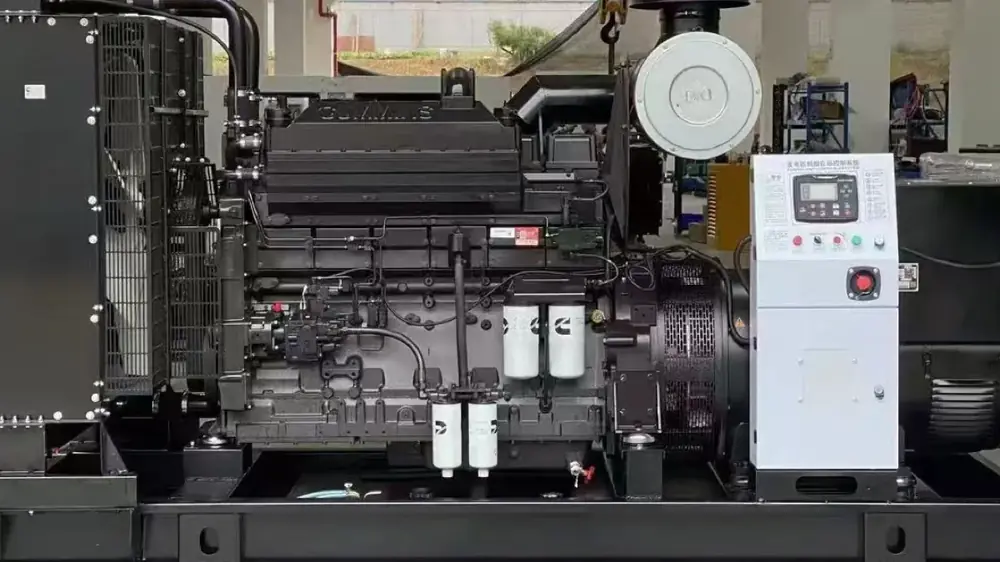
Send the borehole pump rating and depth, the high-pressure pump rating, the filling line and compressor ratings, and the number of shifts. The pump starts decide the rating; the shift pattern decides the fuel.
The plant is a chain, not a total
Walk through a sachet or bottled water plant and the electrical load describes itself as a sequence. A submersible pump in the borehole lifts raw water to a storage tank. A transfer pump moves it through sand and carbon filters, and usually a softener, into a feed tank. A high-pressure pump pushes it through the reverse osmosis membrane. The permeate is stored, sterilised by ultraviolet or ozonated, and then the filling machine fills, seals and dates the sachet or bottle before a conveyor takes it away.
Each stage has a different electrical character. The borehole pump is a deep-well motor on a long cable, and long cable runs are unkind to starting: the voltage that arrives at the motor is lower than the voltage at the panel, so the motor draws more current to produce the same torque. The high-pressure pump is a multi-stage machine that must never run dry, because the membrane and the pump both depend on the water film. The filling line is a group of small motors, heaters and a compressor, each starting and stopping many times an hour.
A quotation that adds these into one number describes a plant that does not exist. The plant spends most of its day in one of three states — filling the raw tank, making permeate, or filling sachets — and the generator has to be comfortable in all three, including the transitions between them.
| Stage | Motor duty | Start behaviour | What it decides |
|---|---|---|---|
| Borehole submersible pump | Long runs, deep well | High inrush, aggravated by cable length | The peak rating and the cable sizing |
| Transfer / feed pump | Cycling with tank levels | Standard inrush, frequent starts | Whether it can run with the RO pump |
| RO high-pressure pump | Continuous during production | High inrush; dry-run protection required | Membrane protection and controller stability |
| Dosing pumps | Continuous, small | Negligible | Chemical accuracy after a transfer |
| UV steriliser | Continuous | Resistive and electronic | Lamp hours and batch release after an outage |
| Filling and sealing machine | Batch, high cycle rate | Small motors plus heater step | Voltage stability at the filling head |
| Air compressor | Cycling, if pneumatics are used | High inrush on load | Whether filling and sealing can run together |
Why the pumps decide the rating
Pumps are usually the largest motors on a water plant, and the borehole pump is the worst of them. A submersible motor sits at the bottom of a hole, connected by a cable that may run a long way, and it starts against a column of water. The current it draws while accelerating is several times its running current, and the voltage drop in that long cable makes the acceleration slower, which extends the time the set has to carry the excess.
This is why a plant can have a comfortable total load and still trip a generator that looks large enough. The trip happens in the two or three seconds after the pump contactor closes, not during steady production. The operator experiences it as a generator that cannot run the plant, when in fact it cannot start one motor at a particular moment.
There are practical answers. Start the borehole pump when the RO train is not running — the tank gives you that freedom if it is big enough. Use a soft starter on the largest pump if the motor and duty suit it. Size the cable properly rather than accepting what is on site. And keep the pump's dry-run and low-level protection working, because a pump that hunts on a low tank will start far more often than the load calculation assumed.
| Method | Start current (rule of thumb) | Effect on the set | Where it fits |
|---|---|---|---|
| Direct on line | 5 to 7 times full-load current | Worst voltage dip, shortest equipment life | Small pumps where the set is comfortably oversized |
| Star-delta | About one third of direct on line | Lower dip, reduced starting torque | Motors with six terminals; not for high-head pumps that need torque |
| Soft starter | Adjustable ramp | Smooth dip, controlled acceleration | Borehole and transfer pumps with long cable runs |
| Variable frequency drive | Near running current | Best behaviour, adds harmonics | Plants with several pumps and a stable panel |
The multiples are a rule of thumb; the caveats are set out in the limitations section further down.
Protecting the membrane at transfer
The reverse osmosis stage is where an outage becomes expensive in a way electricity never is. The high-pressure pump is running against a membrane that expects a steady flow. When the power fails, the pump stops, the pressure falls, and the controller has to decide what to do about the water sitting against the membrane. Some controllers flush on shutdown; some do not. If the controller itself resets because the transfer was dirty, the flush may not happen at all.
The generator's contribution here is not raw power, it is stability. A set that holds voltage and frequency through the transfer keeps the controller alive long enough to complete its shutdown sequence. A set that dips hard on changeover, or that is already carrying a pump start, gives the controller a reset instead of a sequence.
Plants that understand this put the RO controller, the dosing pumps and the UV circuit on a circuit that is never allowed to see a deep dip, and they test the changeover with the RO train running rather than with the plant idle. A changeover test on an idle plant proves almost nothing.
Filling, sealing and the air compressor
The filling line is where the plant's product value is created, and it is also where voltage sags are most visible. Sealing jaws run on heaters and pneumatics; a sachet that is sealed at the wrong temperature or for the wrong dwell time leaks, and a leaking sachet is a complaint that arrives days later. Conveyor and indexing motors start and stop constantly, and each start is a small step on the set.
If the line uses pneumatic actuation, there is an air compressor in the plant, and it is a motor that starts against load. Compressors are frequently the second-largest inrush on site after the borehole pump, and they start on pressure rather than on the operator's convenience, which means they can start at the worst possible moment — during a pump start, or during a transfer.
The practical arrangement is to give the compressor a receiver large enough that it does not cycle during the filling run, and to keep its start from coinciding with the borehole pump. Neither is a generator feature, and both are cheaper than the next frame size up.
Production, cleaning and idle are three different plants
Water plants are often described by their production rate, but the generator sees three different plants across a working day. During production the load is the RO train, the filling line and the compressor, and it is steady. During cleaning the load is pumps and often a heater for hot wash, and it can rival production while looking nothing like it. During idle the load collapses to lights, a controller and maybe a chiller.
The idle state is the one that damages sets. A generator running at a small fraction of its rating for hours at a time runs below its comfortable band, the combustion temperature falls, and the machine begins to accumulate the deposits that eventually show up as smoke and poor starting. Plants that run a night shift at low load should either consolidate that load onto a smaller set or accept that the main set needs periodic loaded running.
Cleaning is the state most often left out of the sizing conversation, because it happens when the production manager is not looking. If the washdown heater and the transfer pumps can run together, that combination belongs in the load list.
| State | Dominant load | Load character | Risk if ignored |
|---|---|---|---|
| Production | RO high-pressure pump, filling line, compressor | Steady, with frequent small steps | Undersized set sags at the sealing head |
| Cleaning / washdown | Transfer pumps, heater, jet pump | Step load, often coincident | Cleaning is scheduled at the same time as production and trips the set |
| Idle / night | Lights, controller, chiller | Very light and continuous | Wet stacking, smoke, poor cold starting |
| Tank filling only | Borehole pump | One large motor, repeated starts | Pump start coincides with a transfer or a compressor start |
Sizing from the sequence
The defensible method is to list every motor with its rating and starting method, list the heaters separately, identify which items can run at the same time by design rather than by accident, and then check two cases: everything running except the largest motor starting, and everything running including the largest motor starting. The second case sizes the set.
Then check the plant against the set's comfortable band rather than its ceiling. A set that spends the production shift near its rating and the night at a tenth of it is being asked to do two different jobs. Where the plant genuinely runs both patterns, the honest options are a larger single set run at a better average load, or a two-set arrangement where the small one carries the night.
The kVA-to-kW conversion uses a power factor of about eight tenths as a first pass. That is a rule of thumb with real limitations, set out below, and it should not be the only calculation behind a plant purchase.
Where the rules of thumb stop
Three shortcuts have been used above: a direct-on-line motor draws five to seven times full-load current while accelerating; a generator delivers roughly eight tenths of its kVA as kW; and a pump start is the governing case on a water plant. Each is a starting point, not a design.
Starting current depends on the motor, the driven load and the protection settings, and cable impedance changes it on a deep well. Power factor changes with load, so a lightly loaded set has a worse effective power factor than the nameplate figure suggests, and a plant with many small electronic loads has a different profile from one with large induction motors. On some plants the governing case is not a pump but a heater step during washdown.
The honest conclusion is that a plant above a single filling line should be sized from a load list with nameplate currents and cable lengths, checked against the alternator's step-load capability, and confirmed by a load test at commissioning. Where that information is not available, the set should be chosen with margin and the start sequence written down.
Power quality is a product question
In most businesses a power dip is an inconvenience. In a water plant it can be a batch decision. Ultraviolet lamps are rated in hours; a lamp that restarts after an outage is not the same lamp, and the usual practice is to log the hours and replace on schedule rather than trust the glow. Ozone and dosing are proportional to flow, and a controller that resets mid-batch may resume at a default rather than at the ratio the batch needs.
The practical control is a batch log that records interruptions, and a rule that says what happens to a batch that was interrupted. That rule belongs to the plant's quality system, not to the generator supplier, but the generator is what makes the rule necessary, and the quotation conversation is a good time to agree how often the plant expects to be interrupted.
A plant that intends to run entirely on generator during grid hours should say so. Continuous running on a set changes the rating that should be quoted, the service interval, and the fuel plan.
Siting a set in a wet plant
Water plants are wet places, and generators dislike wet places for reasons that have nothing to do with rain. Washdown sprays, hose water and condensate all travel further than expected. The set should stand on a raised plinth, under cover, with the air intake and radiator discharge positioned so that spray cannot be drawn in, and with the exhaust turned away from doors and from any opening the plant uses for ventilation.
The electrical side matters as much. Water plant panels are often in the same room as the treatment equipment, which is convenient for the operator and hard on the equipment. Earthing should be treated as a designed system rather than a rod driven in where the cable happens to reach, and the changeover should be positioned so that the person operating it can see the set and the panel at the same time.
Fuel storage deserves a separate thought. A plant that stores diesel beside a filling line is storing two hazards in one place; a bunded tank, a lockable filler and a filling point away from the filling head cost little and remove an argument nobody wants to have after an incident.
Reading a water plant quotation
Water plant quotations are frequently compared on rating and price, and the differences that matter are usually in the scope. A set quoted without the changeover, without the cable to the borehole, or without a soft starter on the largest pump is not the same offer as one that includes them, even when the rating on the page is identical.
| Line item | Why it matters here | What to confirm |
|---|---|---|
| Rating basis | Plants often run the set as prime power, not standby | Prime or standby, and at what ambient |
| Pump starting provision | The borehole pump governs the rating | Soft starter, drive, or an oversized set |
| Dry-run and level protection | Protects pump and membrane, and stops hunting starts | Included in the panel scope or plant scope |
| Changeover type | Manual changeover means someone must be present | Manual, automatic, or none |
| Cable to the borehole | Voltage drop at the pump decides whether it starts | Sized and quoted, or left to site |
| Earthing and protection | Wet plant, metal tanks, operators | Earth system design included or excluded |
| Load test at commissioning | Proves the sequence works before a production day | Test with the RO train and filling line running |
Where a plant intends to add a second filling line, say so at quotation stage. The pump and the board are usually the parts that cannot absorb the addition quietly.
Get a written quotation
Three fields. We reply with the rating, the engine option and the delivery basis.
FAQ
How do I size a generator for a pure water factory?
List every motor with its rating and starting method, then test two cases: all running without the largest motor starting, and all running with it starting. The borehole pump is normally the governing case because of its inrush and the cable run to the well.
Why does the generator trip when the borehole pump starts?
The submersible motor draws several times its running current while accelerating, and a long cable to the well lowers the voltage at the motor, which lengthens the acceleration. A soft starter, a correctly sized cable, or starting the pump when the RO train is idle usually solves it.
Can a generator run an RO plant continuously?
It can, but it should be quoted as prime power rather than standby, and the plant should expect the set to be serviced on a running-hours basis. Continuous operation also changes the fuel plan and the rating that should be specified.
What happens to the RO membrane if the power fails?
The high-pressure pump stops and the controller should flush the membrane on shutdown. If the controller itself resets because the transfer was unstable, that flush may not complete, which is why voltage stability through changeover matters more than the set's headline rating.
Is a soft starter worth it on a water plant?
On the largest pump it often is, because it reduces the step the set has to absorb and protects the pump. It has to suit the motor and duty, and a bypass contactor is normally needed so the starter is not carrying current continuously.
Do water plants need a silent canopy?
Plants in residential or market areas usually do, both for neighbours and for the operators who work beside the set. A canopy does not remove the need for airflow and exhaust planning, and a badly sited canopy can overheat the set.
What should I send for a water plant quotation?
The borehole pump rating and depth, the high-pressure pump rating, the filling line and compressor ratings, the number of shifts and their hours, and whether a second line is planned. That is enough to quote a set, a board and a starting solution.
