Send the mill motor rating and its starting method, the brooding method and its rating, and the fan count by house. Those three numbers decide the set far more than the number of birds does.
Three loads that decide the set
Poultry farms in Nigeria are usually described by bird count, and that number is almost useless for sizing. Two farms with the same flock can differ by a factor in electrical demand depending on whether they mill their own feed, whether they brood with electricity or gas, and whether the houses are open-sided with curtains or fan-ventilated.
The useful description is a load inventory with three columns: what runs continuously, what starts and stops many times a day, and what starts with a mechanical shock. On a typical layer or broiler farm the continuous load is lights, drinkers, small pumps and the control gear. The cycling load is the pressure pump and the feed auger. The shock load is the hammer mill, and on some farms the mixer and the pellet press as well.
The shock load is what makes a farm set different from a domestic set of the same rating. A hammer mill does not start empty and free. It starts with material in the chamber, so the rotor has to accelerate a mass that is already resisting. That is why a mill that draws a modest current when running can demand several times that current for the seconds it takes to come up to speed, and why the lights on the farm dip when it does.
| Load | Duty | Start behaviour | What it decides |
|---|---|---|---|
| Hammer mill | Batch, a few hours a day | Heavy rotor, starts loaded, long acceleration | The peak rating and the alternator's short-circuit strength |
| Mixer / pellet press | Batch, follows the mill | High breakaway torque | Whether the mill and mixer can run together |
| Brooders | Continuous for the first weeks | Resistive, no inrush | Whether a long outage is survivable at all |
| Ventilation fans | Continuous, all night in hot season | Low starting current, many small motors | Fuel consumption and the overnight load floor |
| Borehole / pressure pump | Cycling | High inrush, deep-well motors worst | Whether the set can carry pumping plus fans |
| Lights and controls | Continuous | Negligible, but sensitive to voltage sag | Whether controllers and timers reset during a start |
| Feed augers | Short bursts | Small motors, frequent starts | Contactors and the control panel duty |
Feed mill starting behaviour
Ask a farm owner what the generator has to run and the answer is usually the bird count. Ask what the mill motor is and the answer is often vague. That is the number that matters. A three-phase mill motor started direct-on-line will pull several times its full-load current while it accelerates, and the voltage at the far end of the farm wiring will drop while it does. If the set is close to the mill rating, the mill may never reach full speed, the overload trips, and the operator concludes the generator is too small — when the real problem is that the set was sized for running current and the mill needs starting current.
There are three ways to deal with this, and they are not equivalent. The first is to buy a larger set so the starting current is a smaller fraction of its rating. The second is to change how the mill starts — a star-delta starter, a soft starter, or a variable frequency drive. The third is to change the operating discipline so the mill never starts while the rest of the farm is at peak: no brooder recovery, no pump cycle, no fans at full bank.
The third option is free and is the one most farms ignore. If the mill is started before the heat of the day, with the brooders already at temperature and the pressure pump idle, the same set will carry it. If the mill is started at the moment the pump is refilling the tank and the fans are at full speed, it will trip, and the farm will blame the machine.
| Starting method | Starting current (rule of thumb) | Torque available | Practical note |
|---|---|---|---|
| Direct on line | 5 to 7 times full-load current | Full | Cheapest, hardest on the set, worst voltage dip |
| Star-delta | About a third of the direct-on-line current | About a third | Only for motors designed for six terminals; a loaded mill may still stall |
| Soft starter | Reduced and adjustable | Reduced but controllable | Needs a bypass contactor or it heats in continuous duty |
| Variable frequency drive | Near running current | Full torque from zero speed | Best behaviour on the set, adds harmonics and cost |
The starting-current multiples above are a rule of thumb. Actual values depend on motor design, load inertia and the setting of the protection; the limitations are set out further down this page.
Brooding heat continuity
Brooding is the part of the farm where an outage stops being an inconvenience. Chicks in the first days cannot regulate their own body temperature, and the house is held at a set point by brooders, curtains and ventilation working together. When the power goes, three things happen at once: the heat source stops, the fans stop so the air stratifies, and the curtains stay where they were because nobody is there to open them.
A farm that broods with electric heaters is therefore buying continuity, not comfort. The brooder load is resistive and easy for a generator — no inrush, no power factor problem — which is precisely why it is tempting to put it on the same circuit as everything else and assume it will be fine. The failure mode is not electrical. It is that the set trips on the mill start, the brooder goes off with everything else, and nobody notices until the house is cold.
The practical answer is a split board. Brooders, fans, water pumps and house lights on one side; mill, mixer, workshop and outside lighting on the other. The generator can then be sized around the critical side, and the mill can be started only when the critical side is within budget. That single change often moves a farm from an unaffordable set to an affordable one without reducing what the farm can do.
Ventilation through the hot season
In the hot season the fans become the base load, and they run at night. This surprises buyers who think of a farm as a daytime operation. Ventilation is not about comfort for the birds; above a certain house temperature, feed conversion falls and mortality rises, so the fans run whenever the house is occupied, including the hours when the grid is most likely to be off and nobody is awake to start a generator.
Fan banks are made of many small motors rather than one large one, which is good news for the set: each fan starts with a modest inrush and the bank comes on in steps. It is bad news for the fuel bill, because the load is continuous and unavoidable for weeks at a time. This is where the running cost of the farm is decided, and where a set chosen for the mill alone will end up running at an inefficient fraction of its rating for most of the night.
There is a second effect worth planning for. A set running lightly loaded for long periods runs cold, and a cold diesel engine fouls. Farms that add fans house by house without revisiting the set end up with the opposite problem to the one they started with: not a set that trips on starting, but a set that never gets warm enough to be happy.
What fails first in an outage
The order of failure is predictable, and it should drive the specification. First the mill stops, which costs a batch but not the flock. Then the pumps stop, which matters within hours. Then ventilation stops, which matters within tens of minutes in a hot house. The brooders are last to show their effect but the most expensive when they do, because the loss is measured in birds rather than in hours.
That ordering suggests three defensive measures that cost little compared with the set. A high-temperature alarm on the house that works without mains power. A brooder circuit that can be fed from the set alone, separate from the mill. And an automatic start that does not depend on someone being on the farm at two in the morning.
None of these are generator features. They are installation decisions. A farm that has them can survive a modest set failing for an hour; a farm without them can lose a flock with a large set running, because nobody knew the brooder circuit had been left on the wrong side of the changeover.
Sizing from evidence rather than habit
The sizing conversation goes badly when it starts with a number someone heard. It goes well when it starts with four pieces of evidence: the mill motor rating and starting method, the brooder rating and how many houses are brooded at once, the fan count and rating per house, and the pump rating and depth. Add the running load, add the largest starting load, and apply the power factor — a generator rated in kVA delivers roughly eight tenths of that in kW, which is a rule of thumb and is treated as such below.
Then apply judgment in the other direction. A set that is exactly big enough for the worst case will spend most of its life at a low fraction of rating, which is bad for the engine and worse for fuel. A set that is comfortably above the worst case costs more up front and buys margin for the next expansion. The right answer is usually the smaller of the two options that can start the mill, plus a disciplined start sequence.
Farms that are about to add a second or third house should say so at quotation stage. The difference between a set that can grow and one that cannot is often a frame size and an alternator, not a different engine family.
Where these rules of thumb stop being true
Two rules of thumb appear on this page: a direct-on-line motor draws roughly five to seven times its full-load current while accelerating, and a generator delivers roughly eight tenths of its kVA rating in kW at a power factor of eight tenths. Both are useful for a first pass and neither is a design calculation.
The starting multiple varies with motor design, with the inertia of the driven load, and with the setting of the overload protection. A hammer mill with a heavy rotor is harder to accelerate than the same rating on a fan. A soft starter changes the multiple entirely. The power factor varies with load: a set running at a small fraction of its rating operates at a poorer power factor than the nameplate figure implies, and a farm with many small fan motors has a different profile from a farm with one large mill.
For anything larger than a single-house farm, the honest method is a load list with measured or nameplate currents, checked against the alternator's ability to absorb the largest step. Where the load list is uncertain, the set should be chosen with margin and the start sequence written down, rather than chosen on a rule of thumb and corrected later.
Fuel and the refuelling routine
A farm set runs at night, and the person who refuels it is usually the person who also collects eggs at dawn. Fuel planning therefore has to assume a tired operator. That means a tank with a gauge that can be read at a glance, a filling point that does not require a ladder, and a routine written on the wall rather than kept in someone's head.
Consumption should be tracked, not estimated. A daily note of hours run and fuel added gives a farm a real figure within a month, and that figure is what makes the next quotation comparable. Without it, every supplier's claim about economy is unfalsifiable. The site has a fuel consumption calculator for the arithmetic once the hours and the load are known.
Fuel theft on farms is rarely dramatic. It is a few litres a week, unnoticed until the monthly total looks wrong. A lockable filler, a dipstick routine and a log book solve more of it than any alarm.
Shed placement and installation
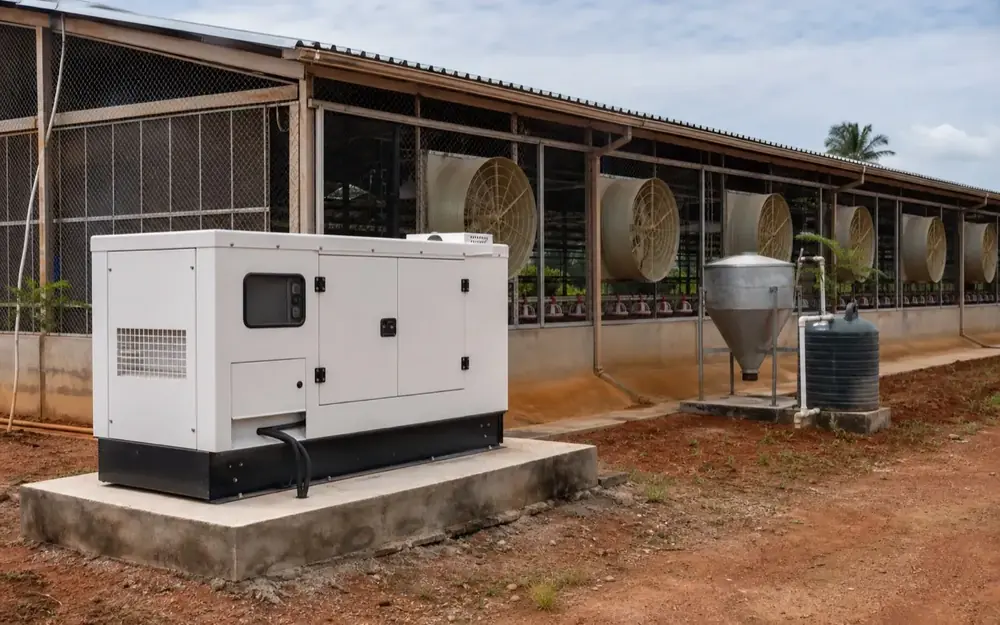
Where the set stands decides whether the farm can hear a fault. A canopy against the layer house wall is convenient for cabling and terrible for noise, exhaust and heat: the house receives the radiator discharge and the noise, and the birds react. A set placed downwind of the houses, on a concrete plinth, with the exhaust turned away and the radiator air discharged into open space, costs a little more in cable and a great deal less in settled birds and complaints.
Ventilation of the set itself is often underestimated on farms because the machine is outdoors. A canopy that is closed on three sides and shaded by a roof still needs air in and air out; a set that overheats in April will keep overheating every April. Radiator airflow should not be blocked by feed bags, drums or a stack of crates, which is exactly what tends to be stored beside it.
Cable sizing between the set and the mill matters more than on a domestic installation because the voltage dip during a mill start is what causes trips. A short, adequately sized run from the set to the changeover, and from there to the mill, is part of the starting solution and should be quoted as such rather than left to the electrician on site.
Reading the quotation
Farm quotations are usually compared on the headline rating and the price, which is the least informative comparison available. Two quotations for the same rating can differ in alternator, controller, canopy, protection and scope, and the differences show up in year two rather than on delivery day.
The table below is the checklist we use when a farm sends a competing quotation for comment. It is not a criticism of the other supplier; it is a way of making sure the two documents describe the same machine.
| Line item | Why it matters on a farm | What to ask |
|---|---|---|
| Prime or standby rating | A farm runs the set as a working machine, not an emergency machine | Which rating is quoted, and at what ambient temperature |
| Alternator | Absorbs the mill start; a weak alternator sags and trips | Make, model and short-circuit capability |
| Starting method support | Decides whether the mill can start at all | Is a soft starter or drive included, or is the set oversized instead |
| Controller | Automatic start at night without an operator | Which controller, what alarms, is remote notification possible |
| Canopy and airflow | Heat and noise next to the houses | Canopy type, airflow path, exhaust direction |
| Changeover and board split | Keeps brooders on the set when the mill trips | Is a split board quoted, or only a changeover |
| Cable and earthing | Voltage dip on mill start; safety on a wet farm | Cable sizes and earth electrode included or excluded |
| Commissioning and load test | Proves the mill starts on the set before the birds arrive | Is a load test with the mill included in scope |
Where a farm intends to add houses, say so before the quotation is issued. The honest answer to a growing farm is sometimes a larger frame now, and sometimes a second set later with the boards arranged to split the load.
Get a written quotation
Three fields. We reply with the rating, the engine option and the delivery basis.
FAQ
How do I size a generator for a poultry farm in Nigeria?
Start from the feed mill motor rating and its starting method, then add the brooder rating, the fan bank and the pump. The mill sets the peak because of its starting current; the brooders and fans set the continuous load. Bird count alone does not determine the rating.
Why does my generator trip when the feed mill starts?
A hammer mill starts with material in the chamber, so it draws several times its running current while accelerating. If the set is close to the mill rating, the voltage collapses and the overload trips. The usual fixes are a larger set, a soft starter or drive, or starting the mill when the rest of the farm is not at peak.
Can one generator run the mill and the brooders at the same time?
Often yes, but only if the set was sized for the combined step rather than for the running total. The safer arrangement is a split board that keeps brooders, fans and pumps on the generator side and the mill on a circuit that is started deliberately.
What happens to chicks if the generator fails at night?
Ventilation stops first and the house temperature climbs in a hot season; in a cool season the brooders stop and the house cools. Both are survivable for a short time and serious beyond it, which is why a high-temperature alarm that works without mains power matters more than the set's badge.
Is a silent canopy necessary on a farm?
It is less about neighbours and more about the birds and the people. A canopy reduces noise at the houses and keeps rain off the machine, but it must still breathe. A closed canopy against a house wall with blocked airflow causes more failures than noise ever does.
Do farms need a three-phase generator?
If the mill, mixer or borehole pump is three-phase, the set must be three-phase and the phases must be balanced across the farm board. A single-phase set cannot carry those motors, and a three-phase set with an unbalanced board will derate in practice.
What information should I send for a farm quotation?
The mill motor rating and starting method, the brooder rating and how many houses are brooded at once, the fan count and rating per house, the pump rating and depth, and whether more houses are planned. That is enough to quote a set and a board rather than a rating.
