This page is for buyers who have settled somewhere between 60 and 100 kVA and want to know which side of that range their site actually falls on, and what the quotation should contain.
What 75kVA delivers
At a power factor of 0.8, a 75kVA set delivers 60 kW. That is the number to plan against, because the loads on a Nigerian commercial site — split units, cassette air conditioners, freezers, pumps, lighting — are quoted in kW, BTU or horsepower rather than in kVA.
Sixty kilowatts is a meaningful amount of power, and it is easy to overestimate how far it goes. A medium office with several air conditioners, a server room and lighting can approach it during the hottest part of the day. A clinic with a steriliser, cold storage and air conditioning can reach it sooner, because medical equipment has a habit of drawing power in bursts.
The rating is prime or standby depending on how the supplier declares it, and those are different promises. A site that runs the set through a working day needs the prime figure. A site that runs it during outages needs the standby figure — and needs to accept that the higher number is not a figure for continuous running.
Single-phase or three-phase
At 75kVA, the phase question is the one that most often produces a wrong purchase. A three-phase set is the normal configuration at this rating, and it is the right answer for a building with three-phase distribution, three-phase air conditioning, pumps or any motor above a modest size.
The difficulty is that many small commercial buildings in Nigeria have a mixture: three-phase incoming supply, but a distribution board that is heavily single-phase, with the load spread across phases by whoever wired it. On a set like this, an unbalanced board can load one phase far above the others, and the generator will be at its limit while the total looks acceptable on paper.
The practical step is to have the distribution board's phase balance checked before the set is ordered, not after. If the building is genuinely single-phase, a single-phase set is simpler; if it is mixed, a three-phase set with a rebalanced board is the better answer, and the rebalancing is usually a day of an electrician's time rather than a new generator.
Where 75kVA fits
The rating suits a single building whose peak is dominated by cooling, lighting and small equipment. The table below shows the loads that typically decide it, and the point at which the site has outgrown the rating.
| Site | What dominates the load | Where 75kVA stops being enough |
|---|---|---|
| Medium office | Split and cassette air conditioning, lighting, ICT | Server room added, or cooling extended into a new floor. |
| Clinic or diagnostic centre | Air conditioning, sterilisation, cold storage, imaging | Imaging equipment with high inrush, or a second treatment room. |
| Small estate or block of flats | Pumps, common lighting, occasional lift | Pumps and lift starting together, or a second block added. |
| Workshop or light production | Machines, compressor, extraction, lighting | A compressor or machine larger than the set's transient capability. |
| Guest house | Room air conditioners, kitchen, laundry, pumps | Full occupancy coinciding with kitchen and laundry peaks. |
| Retail or supermarket | Refrigeration, freezers, HVAC, lighting | Compressors restarting while cooling load is already at peak. |
Air conditioners and pumps decide this rating
The loads that break a 75kVA installation are rarely the steady ones. They are compressors and pumps, which draw a multiple of their running current while accelerating.
As a rule of thumb, a direct-on-line motor start pulls several times its running current for a short period. On a 60 kW set, one large compressor starting while the building is already loaded is enough to drop voltage across the site — which is why lights flicker and some equipment resets when the generator picks up load.
There are three practical responses. Sequence the loads so the compressor starts before the rest of the building is reconnected after an outage. Move the largest motor onto a soft starter or a drive. Or accept the next rating up. The first is free, the second is cheap, and the third is the one buyers reach for first.
75, 80 and 100 compared
These three numbers appear together in quotations, and the difference between them is not evenly spaced. 75 and 80 are usually the same machine class declared on different rating conventions, so the step between them is a paperwork step. The step to 100 is a real increase in capability.
That matters when a buyer is choosing between a quotation that just fits and one that leaves room. If the running load is already close to 60 kW, the useful comparison is against 100kVA rather than against 80kVA.
| Rating | Output at 0.8 PF | What the step buys |
|---|---|---|
| 75kVA | 60 kW | A single commercial building with cooling-dominated load |
| 80kVA | 64 kW | Usually the same class as 75 on a different rating basis |
| 100kVA | 80 kW | Real headroom: a larger motor start, or a building that will grow |
Noise, neighbours and the enclosure
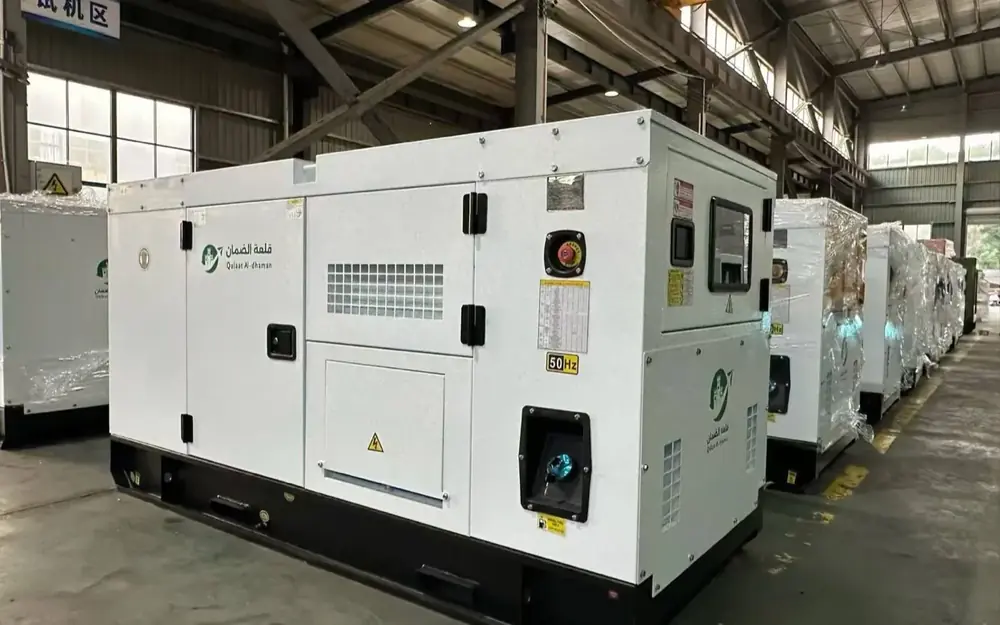
At this rating the set is usually installed close to the building it serves, which means close to people. That makes the enclosure a relationship decision as much as a technical one.
A silent canopy reduces airborne noise at the boundary, but its effectiveness depends on where it stands. A canopy against a hard wall, under a low roof, or facing a neighbouring window will be heard more than the same canopy in the open. Positioning often does more than specification.
The canopy also has to breathe. A quiet box with insufficient airflow gives a set that derates under load, and the symptom — the set seeming to lose capacity in the afternoon — is often blamed on fuel or on the engine rather than on the enclosure.
ATS and changeover at 75kVA
An automatic transfer switch at this rating usually covers the whole board, and the decision is whether the site needs full changeover or only a critical subset.
For an office, full changeover is normal, because the point of the set is to keep working. For a clinic or a guest house, a partial changeover to a critical board is often better: it keeps the essential loads on a set that has margin, instead of loading the generator with everything and running at its limit.
Confirm whether the ATS is inside the quotation, its rating relative to the site peak, whether it switches neutral, and whether the controller can drive it. Those four questions resolve most of the ambiguity between two offers.
Installation conditions
A 75kVA set is small enough to be treated casually during installation, which is how most of the avoidable problems start. It still needs a level base, real ventilation and an exhaust route that does not end under a window.
The most common installation fault at this size is a set placed in a corner with one open side and a wall close behind the radiator. Hot air leaves the radiator, hits the wall, and returns to the intake. The set then runs hotter than its design condition for its entire life.
- Radiator discharge clear of walls, with no path back to the intake.
- Combustion air supplied independently of the room's general ventilation.
- Level, drained base with anti-vibration mounts.
- Exhaust short, insulated, terminated away from windows and boundaries.
- Fuel tank bunded, with isolation and a water separator.
- Access to filters and dipstick without dismantling the canopy.
What the quotation should contain
At this rating, the difference between two offers is usually visible in the specification lines rather than in the total. The list below is the minimum for a fair comparison.
| Line | What a complete answer looks like |
|---|---|
| Declared output | Prime and standby, with the ambient condition. |
| Phase and voltage | Three-phase or single-phase, and the voltage configuration. |
| Engine | Model, displacement, fuel system. |
| Alternator | Make, model, insulation class, kW match. |
| Controller | Model, inputs, ATS output. |
| Canopy | Type, acoustic treatment, access doors, design clearance. |
| Electrical | Breaker, ATS, cabling boundary, earthing. |
| Delivery | FOB or CIF, port named. |
Acceptance follows the same pattern as any rating: a load test at stated steps with readings recorded, and nameplates photographed against the approved datasheet.
Get a written quotation
Three fields. We reply with the rating, the engine option and the delivery basis.
FAQ
How many kW is a 75kVA generator?
A 75kVA set delivers 60 kW at a power factor of 0.8. Usable output falls if the load power factor is lower than 0.8, or if the site runs hotter than the condition the rating was declared at.
Is 75kVA enough for an office?
It suits a medium office whose load is dominated by air conditioning, lighting and ICT. It stops being enough when cooling is extended, a server room is added, or the building's phase balance is poor enough to load one phase heavily.
Should I buy a single-phase or three-phase 75kVA generator?
Three-phase is the normal configuration at this rating and the right answer where the building has three-phase distribution or three-phase motors. If the board is heavily single-phase, have the phase balance checked before ordering rather than after.
Is 75kVA the same as 80kVA?
Often they are the same machine class described on different rating conventions. Ask whether the two figures come from the same set before treating them as different sizes; the genuine step up in this range is to 100kVA.
Why do lights flicker when the generator takes load?
Usually because a compressor or pump is starting while the building is already loaded, and the starting surge pulls voltage down briefly. Sequencing loads, changing the starting method or moving up a rating are the three ways to address it.
Will a silent canopy make a 75kVA generator quiet enough for a residential area?
It reduces noise at the boundary, but siting does as much work as specification. A canopy against a hard wall or facing a neighbouring window will be heard more than the same unit in the open. Ask for the acoustic target the canopy is built to.
Is ATS included in a 75kVA quotation?
Usually only if it is requested. Confirm whether the ATS, its rating and the cabling boundary are inside the price, because a changeover quoted separately changes the comparison between two offers.
