The inland leg is a separate project from the sea leg. It has its own equipment, its own permissions and its own failure modes, and it goes wrong most often because nobody agreed where one party's responsibility stopped.
Where CIF ends and your part begins
Under CIF Lagos the seller arranges and pays for cost, insurance and freight to Lagos port. Import duty, clearing, terminal charges and inland delivery normally fall to the buyer unless the quotation says otherwise in writing.
That handover point is the single most useful thing to pin down before ordering. Ask the supplier to name the exact point at which their responsibility stops, and ask whether the container will be released to your clearing agent, to a nominated forwarder, or to a depot you will collect from.
If your offer is on FOB terms instead, the boundary moves earlier, to the point where the goods are loaded on board. The FOB China versus CIF Lagos guide explains which term suits which buyer.
What each term includes, and what it does not, is set out separately in the CIF Lagos quotation inclusions page. This page assumes that boundary is already agreed and deals with what happens after the set lands.
What happens after the ship arrives
The steps below are the normal sequence for a crated or containerised set arriving at a Nigerian port. Each step can hold the next one, so the ones that need a decision from you are worth identifying in advance.
The two steps most often underestimated are the physical inspection before the container leaves the terminal, and the site access check. Both are much cheaper to fix before the truck is loaded than after.
| Step | What has to be settled |
|---|---|
| Arrival and manifest | The consignee details and the documents that must match them. |
| Clearing | Who acts, and the duty and terminal charges that fall to the buyer. |
| Release | Whether the container is released to you, your agent, or a depot. |
| Condition check | Record the crate and the set's condition before it leaves the terminal. |
| Truck selection | Flatbed, lowbed or container carrier, chosen from the crate dimensions and weight. |
| Loading and securing | Lifting points, spreader or crane, and how the load is lashed. |
| Route and permits | Whether the loaded vehicle needs a permit or an escort for its size. |
| Site access | Whether the vehicle can reach, turn and stand at the unloading position. |
| Offloading | Who provides the crane or forklift, and where the set is placed. |
| Handover record | Photographs and a signed note of the condition on arrival at site. |
What decides the truck and the lifting plan
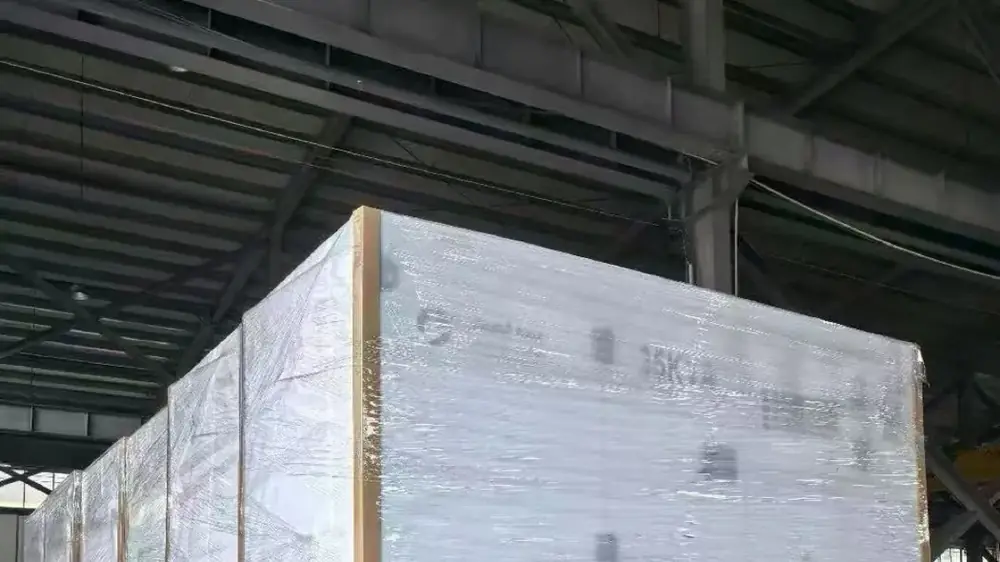
The truck is chosen from the crate, not from the rating. A set's shipping volume and mass depend on whether it travels open, in a canopy, or inside a container, and on the fuel arrangement and packing method used.
Standard container capacity is the usual starting point for planning: a 20 foot container holds roughly 33 cubic metres and a 40 foot container roughly 67 cubic metres. Whether a specific set fits is a question about its actual crate dimensions, and oversized or over-weight cargo often travels on a flat rack or on deck rather than in a closed box.
Lifting is the second half of the question. A crated set needs defined lifting points and equipment rated for the load, and the offloading method has to match what the site can actually provide. If there is no crane at the site, that is a decision to make before the truck is loaded, not after it arrives.
The container loading and export packing methods are described in the container loading guide, and the containerised configuration itself in the containerised generator page.
Planning the timing honestly
The sea leg from China to Lagos is commonly described in the industry as taking roughly thirty to forty five days, and the figure moves with the sailing, the port of loading and congestion at the destination. This site does not publish a delivery time for a specific order, because a time that depends on a sailing is not a schedule until the booking is made.
The inland leg has its own variability. Clearing and release can take days, and the truck depends on both the release and the availability of the right equipment at the port. A buyer who plans the site works, the foundations and the electrical preparation on the assumption that the set arrives on a particular day will usually be waiting.
The practical approach is to order the site preparation from the crate dimensions rather than from the arrival date. Once the dimensions and mass are known, the civil and electrical work can be planned and completed independently of the shipping schedule.
The import sequence as a whole is set out in the China to Nigeria import steps guide, and the documents that matter before shipment in the pre-shipment inspection page.
The site questions to answer before the set ships
Answer these while the order is still open. The answers determine the packing, the lifting arrangement and whether the delivery plan is possible at all.
If any answer is unknown, write that down as unknown rather than assuming the easiest case. A delivery plan built on an assumption about access is the most common cause of a set standing on a truck outside a gate.
| Question | Why it matters |
|---|---|
| What is the crate mass and volume? | Determines the truck class, the lifting equipment and whether a permit is needed. |
| Can a loaded truck reach the position? | Decides whether the set is delivered to the spot or short of it. |
| Can it turn and leave after unloading? | A site that can be entered is not always a site that can be exited. |
| Is there a crane, forklift or gantry? | Decides whether offloading equipment must be hired. |
| Is the ground firm and level at the position? | Governs where the set can stand and how it is rested. |
| Any overhead obstruction or cable? | Limits lifting height and equipment choice. |
| Who signs the handover at site? | Fixes responsibility if damage is found later. |
The paperwork that has to be complete before the container moves is covered in the SONCAP page, and the supply arrangement behind a dealer order in the distributor programme.
Ask for the inland leg to be planned with the offer
Send your destination city, the site access conditions and what lifting equipment you can provide, and ask for the crate dimensions and mass. Ask which party handles clearing and inland transport, and where the supplier's responsibility stops.
Get a written quotation
Three fields. We reply with the rating, the engine option and the delivery basis.
Lagos port to site delivery questions
Does CIF Lagos include delivery to my site?
No. CIF covers cost, insurance and freight to Lagos port. Import duty, clearing, terminal charges and inland delivery are normally separate items and should be listed individually if they are being provided.
Who arranges the truck from the port?
That has to be named in the offer. If clearing and inland transport fall to the buyer, the buyer arranges both, usually through a clearing agent or a transport contractor.
How long does the whole process take?
The sea leg is commonly described as roughly thirty to forty five days and moves with the sailing and port conditions. Clearing and the inland leg add their own variability, so this site does not publish a time for a specific order.
What if there is no crane at my site?
Then offloading equipment has to be arranged before the truck is loaded. This is one of the two questions most often left until the vehicle is already outside the gate.
Can the set travel inside a container?
Often, depending on its crate dimensions. A 20 foot container holds roughly 33 cubic metres and a 40 foot container roughly 67 cubic metres, but oversized or over-weight cargo frequently travels on a flat rack or on deck instead.
How do I protect myself if the set is damaged in transit?
Record the crate condition before it leaves the terminal, take photographs at each handover, and have someone sign for the condition at site. Insurance and the delivery term decide who bears the loss, which is why both should be in writing.
