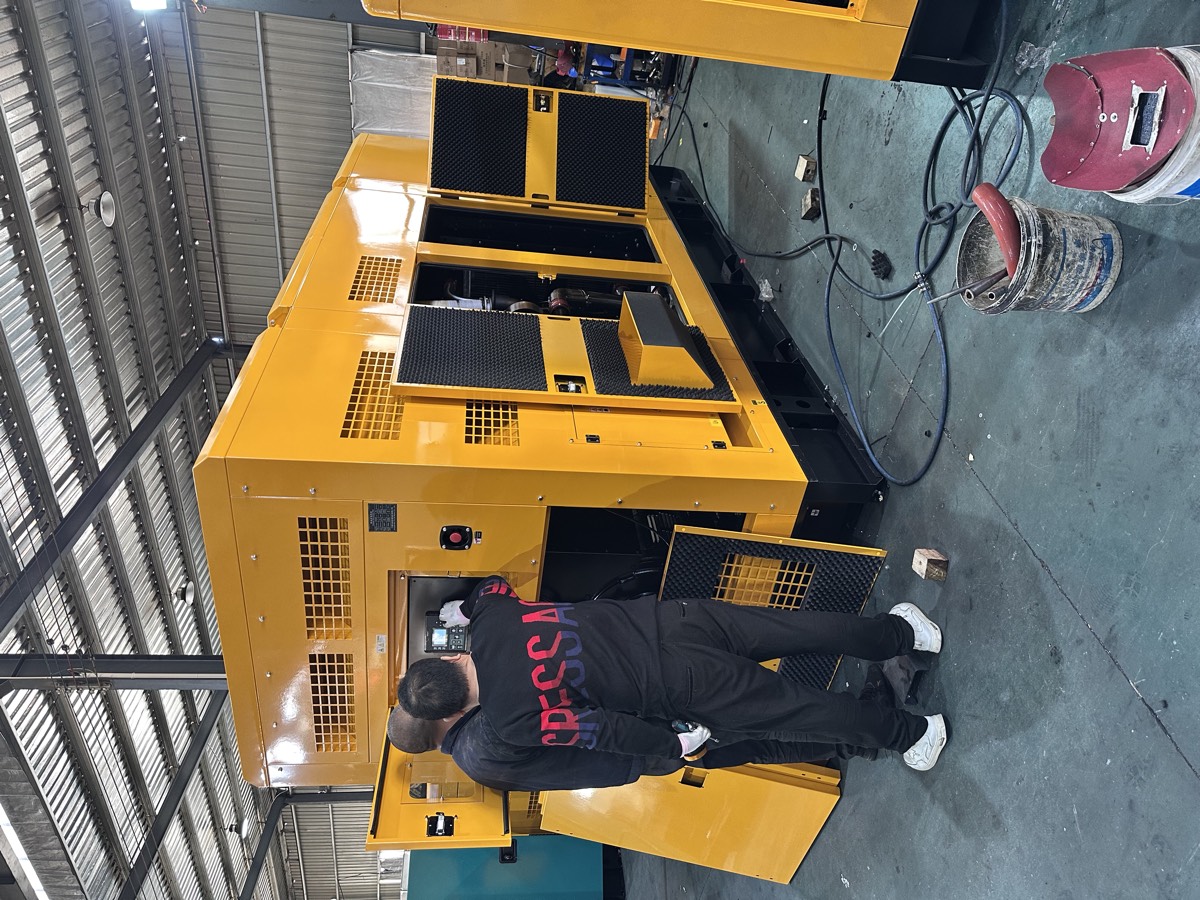
A generator room needs an air path large enough to carry away the heat the set rejects, with the intake and the discharge separated so the hot air cannot come straight back in. Undersized louvres or a short-circuited path raise the air temperature around the set, which reduces output and shortens component life.
Why the room decides what the set can do
An engine rejects a large part of its fuel energy as heat, and almost all of that heat goes into the cooling system and the exhaust. The radiator does not destroy it; it transfers it into the air passing through the core. If the room cannot get rid of that air, the air coming back into the radiator is already warm, and the set is effectively running in a hotter climate than the one it was specified for.
That is the same mechanism described in high-temperature derating, arriving from a direction the buyer controls. A set installed in a suffocating room can lose output without the ambient outside the building ever being unusual.
The consequence is not only a lower ceiling on output. A set running hotter than intended ages faster, its oil degrades sooner, and its electrical insulation is worked closer to its limit. Ventilation is therefore a reliability measure as much as a performance one.
Sizing the openings from heat rejection, not from habit
The calculation starts with the heat the set rejects to the room, which is in the set data. From that, the required air volume flow follows from the acceptable temperature rise between the incoming and outgoing air: the more rise you allow, the less air you need, and the hotter the room runs. Choosing the rise is the design decision, and it should be consistent with the rating the set is being bought at.
The free area of the openings then follows from the flow and the acceptable air velocity through them. Free area is not the same as the louvre's overall size: blades and frames block part of it, which is why a louvre is specified by free area rather than by the hole it fits in.
This is the part that should come from the set manufacturer's installation data for the specific model, because heat rejection varies with engine and cooling package. Where that data is not available, the honest position is that the openings cannot be sized properly and the figure has to be obtained rather than estimated. The consequence of getting it wrong is a set that runs hot for reasons the machine cannot fix, which is the pattern traced in overheating diagnosis.
The failure that looks like a working installation
A room can have generous openings and still overheat, because the hot air leaving the radiator finds its way straight back to the intake. That short circuit is the most common ventilation fault and the hardest to see, because the openings are the right size and the room still runs hot.
It happens when the discharge and the intake are on the same wall, when the discharge is sheltered by a wall or a fence close to it, or when the room has one large opening serving both directions. In each case the set heats a pocket of air and then draws from that pocket.
The test is physical rather than theoretical: measure the air temperature at the radiator intake while the set runs at load, and compare it with the outdoor ambient. A large difference means the room is recirculating, whatever the drawings say. The same measurement repeated with the doors open tells you whether the openings or the arrangement is at fault.
Louvres, ducts and the details that decide it
Louvres should be sized on free area, positioned so the intake is low and the discharge is high, and arranged so that the two are not adjacent on the same face. Where the room cannot be arranged that way, a duct carries the discharge away from the intake rather than trusting distance alone.
Ducts introduce their own resistance, and a duct that is too small or has too many bends reduces the flow the set can pull. Flexible duct with a corrugated bore is worse than smooth duct of the same diameter, which is a detail that gets lost when a duct is chosen from what is available.
Acoustic louvres are a common requirement in residential areas, and they trade airflow for attenuation. A louvre specified for its sound performance without checking its free area is a ventilation fault waiting to happen, and the noise side of that trade is covered in generator noise.
The symptoms of a room that is not working
The table maps what the site does against what it usually means. Each row is a physical observation, which is deliberate: the point is that a ventilation fault announces itself before any instrument is needed.
| Symptom | What it suggests | Where to look first |
|---|---|---|
| High temperature alarm only when the doors are closed | Openings too small for the heat load | Free area of intake and discharge |
| Runs hot at moderate load, fine at light load | Heat rejection exceeds what the room can remove | Airflow through the radiator core |
| Hot air felt at the intake while running | Discharge is recirculating to the intake | Relative position of the two openings |
| Overheating on still days, fine when windy | Marginal airflow relying on wind assistance | Whether the design assumes natural draught it does not have |
| Room hot after the set stops | Stored heat with no through-flow when running stops | Whether the space needs residual ventilation |
| Radiator core clogged with dust or fluff | Maintenance rather than design | Cleaning interval for the core and the louvres |
Fixing a room that is already built
The cheapest fix is usually separating the paths: moving the discharge, adding a duct, or blocking the route that lets hot air return. That changes no building work and often solves the problem entirely, which is why it should be tried before openings are enlarged.
Enlarging openings is next, and it has to be done on free area with the louvre removed from the calculation. Adding a second louvre of the same size as the first is not the same as doubling the free area if the frames and blades differ. Whatever is changed, the cleaning interval for the core and the louvres belongs in the maintenance schedule, because a blocked core produces the same symptoms as an undersized opening.
The last option is a mechanical fan, which guarantees flow regardless of wind and layout. It adds a component that can fail and must be interlocked with the set, so it belongs after the passive options have been exhausted.
Where the room is also the acoustic enclosure, the two requirements have to be designed together rather than one after the other, and the constraints on where the room can sit at all are covered in installation location.
FAQ
How do I calculate the ventilation area for a generator room?
Start from the heat the set rejects, which is in the manufacturer's data, then choose an acceptable temperature rise for the room air and derive the airflow from it. The opening size follows from the flow and the allowable velocity, measured as free area rather than louvre size.
Why does my generator only overheat when the room doors are closed?
Because the openings are not carrying the heat away. With the doors open the room borrows the whole doorway as an opening, which is not how it was designed to run. The free area of the intended openings is too small.
Can I use acoustic louvres and still get enough air?
Yes, if they are sized on free area rather than on physical size. Acoustic louvres trade airflow for attenuation, so a larger unit is usually needed to pass the same flow.
Is a fan better than bigger openings?
A fan guarantees flow regardless of wind and layout, but it adds a component that can fail and must be interlocked. Passive openings are the first choice where the layout allows them.
How can I tell whether hot air is recirculating?
Measure the air temperature at the radiator intake while the set runs at load and compare it with the outdoor ambient. A large difference means the discharge is returning to the intake, whatever the drawings show.
