Container loading is the stage where export packing, bracing and documentation all meet. It is also the last moment at which a packing problem can be corrected cheaply, because once the doors are closed and the seal is fitted the container is on its way to the port.
The shipment chain from factory to Nigerian port
A generator order leaving China for Nigeria passes through a sequence of stages, and loading is only one of them. The order is produced and tested, packed for export, loaded into a container, carried by sea, cleared at a Nigerian port, and then moved inland to site.
Each stage has its own evidence and its own failure mode. Testing failures are caught at the factory. Packing and loading failures are usually not discovered until the container is opened at the destination, which is why this stage deserves the same written detail as the test.
The document sequence around the order, from proforma invoice through to destination handling, is set out in the step-by-step import guide. This page picks up the one stage that sits between production and the sea voyage.
Export packing: pallets, stretch wrap and strapping
Generator orders travel as a mix of large equipment and a long tail of smaller items: control accessories, fittings, hoses, brackets, documentation packs and spare parts. The packing method has to keep that mix together and keep it intact through handling.
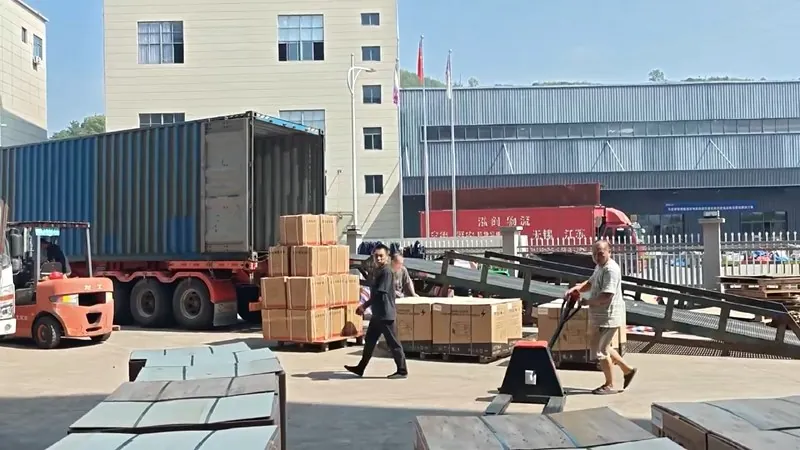
In the loading footage on this page, the visible export packing follows a common pattern. Cartons are stacked on timber pallets, the pallet load is wrapped in clear stretch film to bind the stack together and keep out dust, and strapping bands are run around the load to hold it mechanically. Goods that are too heavy or too large to palletise travel as units and are braced individually instead.
Palletising is a decision with a cost on both sides. Pallets and film add volume, which matters because container capacity is counted in cubic metres, but they also make handling at the destination faster and reduce the chance of a carton being dropped or opened in transit.
Whether palletising is the right choice for a given order depends on the goods. The trade-off between packed volume and handling protection is the same one described in the CIF Lagos quotation inclusions guide, where packing is one of the items that has to be stated rather than assumed.
Dunnage and bracing inside the container
A container is not a rigid box that holds goods in place by itself. Loads shift during road movement to the port, during lifting, and during the sea voyage, and once a load starts moving the damage is done at the far end.
Timber dunnage does the work. In the footage on this page you can see timber boards stacked in the yard, ready to be placed as packing and bracing between and under loads. Bracing is what stops a pallet walking forward under braking, and what stops a stack leaning into the container wall.
This is also where the usable capacity of a container stops being a simple volume figure. Bracing and pallets consume space that cannot then be used for cargo, so the volume available to the goods is always smaller than the nominal container volume.
The interaction between bracing, airflow and access inside a container is covered in the containerized set planning guide, and the configuration choices themselves are on the containerized generator page.
How the container is loaded
Loading is a sequence, not a single action. The container is positioned so it can be reached from the loading side, dunnage is placed, and the load is built from the far end back towards the doors so that nothing has to be moved twice.
Heavier and denser items are placed low and spread across the floor, with lighter cartons stacked above them. In the footage on this page, an orange forklift handles the pallet loads while workers move pallets on a hand pallet truck and carry individual cartons by hand, which is normal for mixed loads where the last few positions are too tight for a machine.
What the buyer should take from this is not the equipment list but the ordering logic: the sequence decides whether the final load is stable and whether anything ends up buried behind cargo it should have been placed after.
Loading is also the point at which the packing scope becomes visible. An item that was specified to travel inside the container but is not on the container floor at this stage will not be in it later. The checks that catch this are the same ones listed in the factory test and shipping proof page.
The loading footage, described
The clip below shows export packing being loaded into a container in the factory yard. It runs for about eleven seconds and is recorded in one continuous view of the loading side of the container.
To be precise about what the footage shows and what it does not:
- A 40 ft container with its doors open, standing on a flatbed trailer, being loaded from the yard side.
- Palletised cardboard cartons, wrapped in clear stretch film and secured with strapping bands, moved on pallets.
- An orange forklift working the pallet loads, a hand pallet truck, and workers carrying individual cartons.
- Timber dunnage boards laid out in the foreground, for floor packing and bracing.
- Factory buildings, a red logistics truck, flag poles and site lighting in the background.
The goods being loaded are packed cartons rather than identifiable generator sets, so the clip is evidence of the loading and packing method rather than of a specific model. If you need footage of your own order, the way to get it is to agree the evidence in writing against your order reference, model and nameplate before production finishes. The inspection and acceptance checklist lists the records worth requesting, and further factory clips are collected on the factory video page.
How much fits in a container
Buyers usually arrive at this question with a number in mind, so it is worth being direct about why we do not publish one.
As an industry rule of thumb, a 20 ft container holds roughly 33 CBM and a 40 ft container roughly 67 CBM. Those figures are a planning input, not a packing result. Real usable capacity depends on the packing method, the bracing and whether the goods are palletised, and it is further reduced by anything that cannot be stacked or that has to be kept clear for access.
How many generator sets fit into that volume then depends on how each set is packed. A set can travel assembled on its own skid, it can travel with its enclosure, and it can travel with components separated and packed individually for a better use of space. Each of those choices changes the volume one set occupies, so a units-per-container figure borrowed from another order tells you very little about yours.
The practical answer is to ask for the packing plan for the specific model. It states how the set is packed, what travels with it, and what volume that consumes. That packing plan is the same document the loading crew works to, and the containerized generator configuration options covers how the configuration decision is made in the first place.
Seal number and the checks before the doors close
When loading is finished, the container doors are closed and a seal is fitted. The seal number is then recorded on the shipping documents, and it becomes the reference by which the container is identified for the rest of the journey.
Two things follow from that. First, the seal number should reach the buyer before the vessel sails, because a container that cannot be identified by seal number is difficult to follow and awkward to query at the destination. Second, the number quoted on the arrival documents should match the number issued at loading, and that comparison is worth doing rather than assuming.
Everything that is going to be checked should therefore be checked before the doors close, while the container is still reachable in the yard. The items worth confirming at that moment are:
- That every item on the packing list is physically on the container floor.
- That the load is braced and cannot shift, with dunnage in place.
- That the quantity of pallets and cartons matches the packing list.
- That the seal number is recorded and passed on to the buyer.
These checks are the practical core of the records checklist for the packed order. After the seal is fitted the same conversation becomes a claim instead of a correction.
Request a packing plan and quotation
Send the model or rating band, the quantity, the delivery term and the destination, and ask for the packing plan alongside the quotation so that the volume, the bracing and the included accessories are stated in writing.
Get a written quotation
Three fields. We reply with the rating, the engine option and the delivery basis.
Container loading questions
How are generators shipped from China to Nigeria?
The order is produced and tested at the factory, packed for export, loaded into a container, carried by sea to a Nigerian port and then cleared and moved inland. The container loading stage described on this page sits between packing and the sea voyage.
How many generators fit in a 40 ft container?
There is no single number. As an industry rule of thumb a 20 ft container holds roughly 33 CBM and a 40 ft container roughly 67 CBM, but real usable capacity depends on the packing method, the bracing and whether the goods are palletised. How many sets fit follows from how each model is packed, so ask for the packing plan for the specific model rather than assuming a figure.
What does export packing involve for a generator order?
Cartons and loose items are palletised where the weight allows, wrapped in stretch film and secured with strapping bands. Loose accessories are bundled so they travel with the order, and timber dunnage is used to brace the load inside the container.
What is a container seal number and why does it matter?
The seal is fitted to the container doors after loading is finished. The seal number recorded on the shipping documents is what identifies the container, so it should reach the buyer before the vessel sails and should match the number quoted at the destination.
Can I watch my own order being packed and loaded?
For an active order, ask for loading photographs or a short video tied to your order reference, model and nameplate. The clip on this page shows the general packing and loading process rather than a specific customer order.
Do you hold generator stock in Nigeria?
No warehouse stock claim is made here. Availability, packing and the delivery basis are confirmed in the written China-factory quotation, and Nigeria clearance, inland delivery and installation remain separate unless they are written into it.
