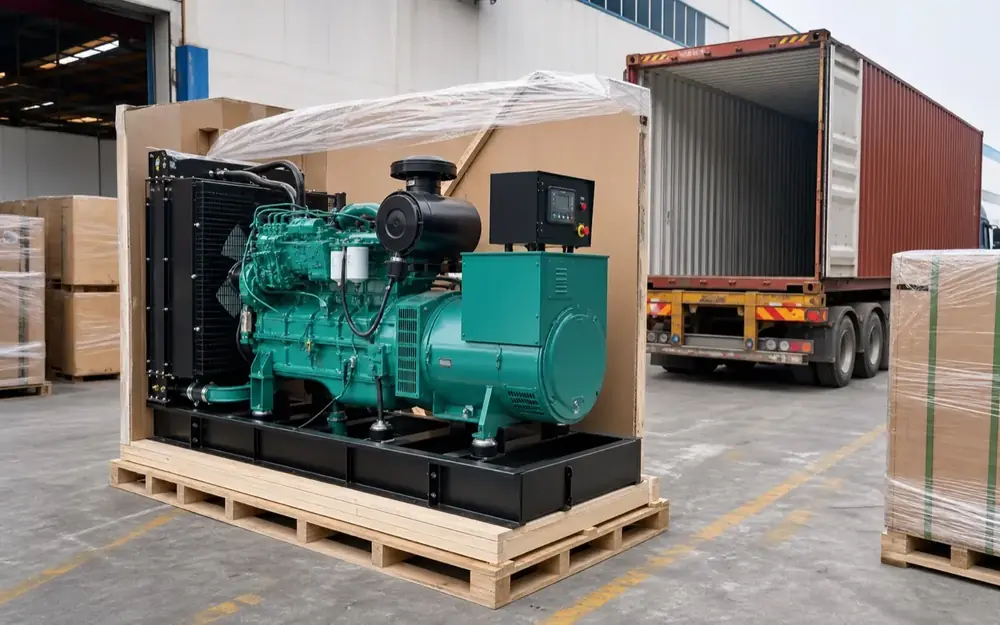
The order is not finished when the deposit is paid or when the set is built. It is finished when the machine has been inspected, shipped, cleared and delivered, so every step needs an owner before the process starts.
The six steps of a generator import order
A China to Nigeria generator order normally follows six documentary steps. The list below is the sequence, not a promise about timing, because production scheduling, sailing schedules and port congestion all move independently.
| Step | What happens | What to confirm before moving on |
|---|---|---|
| 1. Specification and quotation | Load list, rating, duty, configuration and delivery term are agreed on paper. | That the quotation states output, power factor, engine model, alternator, enclosure and delivery term. |
| 2. Proforma invoice and deposit | The supplier issues a proforma invoice and the agreed deposit is paid. | That the invoice issuer, the bank beneficiary and the supplier's legal name match. |
| 3. Production and testing | The set is built and prepared for testing. | That the test scope was defined before production, not after. |
| 4. Pre-shipment inspection | Packing, labels, accessories and nameplate data are checked before the container is sealed. | That you have received the inspection evidence you asked for. |
| 5. Booking and shipment | Space is booked, the set is loaded and the transport documents are issued. | That the shipping documents match the invoiced goods and the agreed packing standard. |
| 6. Destination clearance | Customs, terminal handling and inland transport are completed in Nigeria. | Which party handles clearance, duty and the inland leg, and under whose name. |
Documents that travel with the order
Regulatory conformity arrangements for Nigeria, including SONCAP where it applies to the product and order, sit on the destination side of the transaction and have to be confirmed with the conformity provider and the clearing agent.
A typical file includes the commercial invoice, the packing list, the bill of lading, and the certificate of origin where one is required. Regulatory conformity arrangements for Nigeria are handled through the applicable conformity assessment route, and the Scope of that route has to be confirmed for the specific product and order.
The important point is that conformity arrangements are not automatically included in a factory quotation. Whether they apply, who arranges them, and who pays for them is a per-order question that should be settled with the buyer, the conformity provider and the clearing agent before production rather than at the port.
Keep the document set together with the quotation that describes the machine. When a document and a quotation disagree, the discrepancy is cheaper to resolve before shipment than after arrival.
The packing list describes what is actually inside the container, and the checks that should be completed while the container is still open are set out on the container loading and seal number page.
Compliance is a separate document chain from the commercial ones, described in SONCAP and generator imports.
Writing responsibility down before payment
Most generator import disputes are not technical. They are boundary disputes about who was supposed to do a step. A short responsibility table in the order prevents almost all of them.
| Activity | Who should be named | Why it is worth writing down |
|---|---|---|
| Factory testing | Supplier, or a third party the buyer appoints | Decides what evidence you receive before the container is sealed. |
| Pre-shipment inspection | Buyer, supplier or an appointed inspector | Determines who pays and who reports the findings. |
| Packing standard | Supplier | Packing method affects freight and unloading requirements. |
| Booking and sea freight | Seller under CIF, buyer under FOB | The Incoterm decides this, so it must appear in the quotation. |
| Marine insurance | Seller under CIF, buyer under FOB | Confirm the cover and the insured value on the document. |
| Customs duty and clearing | Usually the buyer | Duty treatment is confirmed with a licensed clearing agent for the specific goods. |
| Inland delivery | Buyer, unless quoted | Access and offloading at the site decide what vehicle is needed. |
Why consignments sit at the port
In practice the recurring causes are documentary rather than mechanical: a bill of lading detail that does not match the invoice, a missing conformity document, an unpaid duty assessment, or a consignee name that does not match the clearing mandate.
The second group is physical access. A large set needs lifting equipment and a route wide enough for the vehicle, and a congested site entrance can hold a consignment longer than the sea leg did.
Both groups are avoided by deciding them early. Confirm the consignee details, the duty assessment route and the unloading arrangement before the vessel sails, not after it berths.
Where the sea leg itself is being compared between terms, the FOB China versus CIF Lagos guide covers the trade-off, and the CIF Lagos inclusions page lists what that term does and does not cover.
Start the order with a complete message
Send the load list or target rating, the duty and daily hours, the voltage, phase and frequency, the delivery term you want quoted, the destination city and port, and which inspection evidence you require. Say who is expected to handle clearance.
The fuller the first message, the shorter the exchange. Where the process is being run for the first time, the China to Nigeria import guide sets out the wider context, and the factory acceptance test guide covers the evidence step.
Request an import quotation
Send the specification, the delivery term you want quoted and the destination port so the reply can cover the equipment scope and the terms separately.
Get a written quotation
Three fields. We reply with the rating, the engine option and the delivery basis.
Generator import questions
How many steps are there in a China to Nigeria generator order?
Six documentary steps are typical: specification and quotation, proforma invoice and deposit, production and testing, pre-shipment inspection, booking and shipment, then destination clearance. Each step needs a named owner before the process begins.
Is conformity assessment included in the factory quotation?
Not automatically. Whether the applicable conformity route applies, who arranges it and who pays for it must be confirmed per order with the buyer, the conformity provider and the clearing agent.
Who pays import duty and clearing?
Under CIF Lagos the seller covers cost, insurance and freight to the port, while import duty, clearing, terminal charges and inland delivery normally sit with the buyer unless the quotation states otherwise in writing.
What is the difference between factory testing and pre-shipment inspection?
Factory testing confirms how the set runs and how its controller and protection behave. Pre-shipment inspection confirms packing, labels, accessories and nameplate data before the container is sealed.
How long does shipping take?
Sea transit from Chinese ports to Lagos is commonly quoted as an industry range of about 30 to 45 days depending on the port pair and the sailing schedule, and production lead time is separate. The actual figure must be confirmed against the booking for your order.
What usually delays clearance?
Documentary mismatches such as invoice and bill of lading discrepancies, missing conformity documents, unpaid duty assessment, or consignee details that do not match the clearing mandate. Physical access to the site can also hold a consignment.
