This page is written for buyers who already need a quotation and want to compare specification, delivery term and supplier scope before sending a WhatsApp inquiry.
When 1000kVA is the right buying range
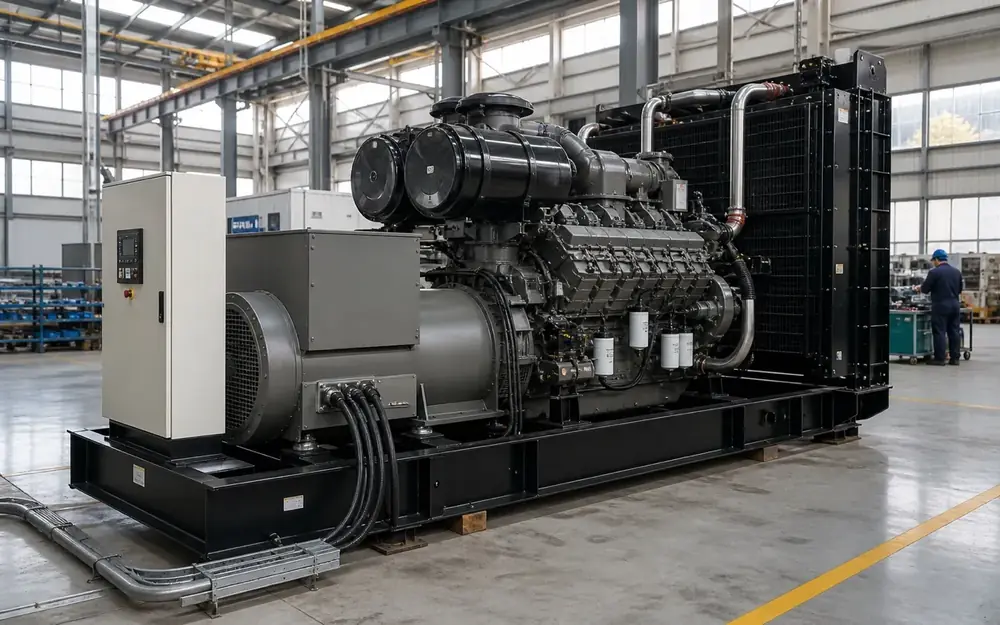
At 0.8 power factor, 1000kVA corresponds to 800kW. This is a useful conversion for comparing ratings, but it is not a final sizing answer. Typical 1000kVA inquiries come from large factories, hospitals, mining support, oil and gas sites, large hotels, data infrastructure and contractor-led projects.
The selection must be checked against the real load schedule. Motors, pumps, chillers, elevators, crushers and compressors can create starting demand above normal running load. The review should include the largest load step, acceptable voltage dip, daily runtime, ambient conditions and future expansion.
Price items that must be written in the quote
At this size, quotation comparison must be line by line. A low price may exclude important components or use a different commercial term.
| Quote item | What Nigeria buyers should confirm |
|---|---|
| Duty and rating | Confirm 1000kVA standby or prime rating, rated kW, power factor, voltage and frequency. |
| Engine and alternator | Require exact model numbers, cooling arrangement and controller specification. |
| Open, silent or container | Cooling, airflow, noise target, exhaust, access and total dimensions change the package and price. |
| Electrical scope | State breaker, ATS, synchronizing panel, protection, batteries and cable-terminal boundary. |
| Testing and documents | Request the data sheet, factory test scope, finished-unit photos, packing information and warranty terms. |
| Delivery term | Compare FOB China and CIF Lagos separately, including dimensions and shipment assumptions. |
How to avoid under-specified quotations
Send the site city, application, maximum running kW, power factor, largest motor and starting method, load sequence, daily running hours, voltage, frequency, ATS or synchronizing requirement, enclosure, quantity and delivery term. Include a one-line diagram or consultant load schedule when available.
A complete response should show the matched rating, engine and alternator models, controller, breaker, cooling and enclosure scope, test documents, production lead time, packing, warranty handling and shipping basis. Nigeria Generator Supply is a China-based factory-direct supply website. A Nigerian warehouse, installation team or local service office is included only when specifically written in the quotation.
Get a written quotation
Three fields. We reply with the rating, the engine option and the delivery basis.
800kW, and the engineering boundary that decides the offer
At a power factor of 0.8 the rating converts to 800kW, and at this size the machine stops being the main subject of the quotation. Two offers can carry the same engine and the same alternator and still describe entirely different projects, because what differs is the boundary: the point at which the supplier's responsibility ends and the buyer's begins.
That boundary is drawn around transport and lifting, around the switchgear and the protection settings, around the commissioning and the loaded test, and around the spares and the people who will operate the plant. A quotation that includes commissioning is a different product from one that stops at the factory gate, and the difference is not a mark-up on the same work; it is a different scope with different risk carried by different parties.
The practical consequence for a buyer is that this rating should be specified as a project rather than purchased as a unit. The questions to settle are who lifts it off the truck, who terminates the cables, who sets the protection, who witnesses the load test and who is on site in the first week of operation. Those five answers define the offer more than the machine does.
Getting it to site: the part that is usually underestimated
A set at this rating is heavy, long and awkward. It does not travel as general cargo, it cannot be manhandled at either end, and the route between the port and the site has to be checked before the order rather than after the ship arrives. Weight and dimensions decide whether it moves as a conventional container load, on a flat rack, or as breakbulk, and each of those is a different commercial and physical arrangement.
Lifting is the second half of the same problem. A machine of this size needs a crane with the capacity and the reach for the actual radius, at both the loading point and the site. A crane that can lift the weight at a short radius may not lift it over a wall or onto a plinth set back from the road, and the load chart rather than the headline capacity is what decides. The lift plan, the rigging and the ground bearing under the outriggers all belong in the same conversation.
Site access is the third. Gate widths, overhead cables, road surface, turning space for a low-loader and the distance from the gate to the plinth are all constraints that cannot be solved by the machine. A site survey before shipment is cheaper than a crane standing idle at a gate that is too narrow, and it is the single most common cause of a commissioning delay on an installation of this size.
Who carries each of these is a commercial decision, and it should be written into the offer rather than assumed. Delivered to port, delivered to site and delivered and positioned are three different obligations.
The scope items that sit outside the machine
The table lists the work that surrounds a set at this rating. None of it is machinery, and all of it is part of what the site actually receives. The third column is the usual arrangement, not a rule; the point is that each row has to be assigned to somebody before the order.
| Scope item | Why it enters the offer | Usually carried by |
|---|---|---|
| Transport and lifting | Weight and dimensions decide the method, and the method decides the obligation | Buyer, unless quoted delivered and positioned |
| Plinth and foundation | Load bearing, vibration isolation and drainage for the room | Buyer's civil contractor |
| Cables and busbar | Current rating, route length and termination at both ends | Buyer's electrical contractor |
| Switchgear and protection | Breaking capacity, discrimination and settings coordination | Split, and must be defined in writing |
| Fuel system and bund | Storage volume, transfer, filtration and spill containment | Buyer, sometimes supplied as an option |
| Exhaust and silencing | Route, back pressure, expansion and discharge point | Split, often supplied with the set |
| Commissioning and load test | Proof that the installation, not only the machine, performs | Supplier, if it is in the offer |
| Spares and training | What the site can fix itself and what it must wait for | Supplier, if it is in the offer |
Read the table as a checklist for the offer rather than for the machine. Two quotations that agree on the engine and disagree on rows five to eight are not comparable, however similar the rating looks at the top.
Switchgear, protection and parallel operation
At this rating the electrical interface is a project in its own right. The set has to connect to a board with adequate breaking capacity, the protection has to discriminate so that a fault downstream trips the smallest device that can clear it, and the settings have to be coordinated with whatever the site already has. A panel that is simply large enough is not the same as one whose settings have been studied.
Parallel operation adds three things: synchronising, load sharing and a control philosophy. Synchronising equipment has to bring a second machine onto a live bus without disturbance, load sharing has to divide the demand deliberately rather than by accident, and the philosophy has to say what happens when one machine trips. That last point is the one that decides whether the site stays up, because an uncontrolled loss of one set can overload the other within seconds.
Earthing and protection of the neutral deserve a mention at this size, because the arrangement chosen decides how earth fault protection behaves and whether the site can run with the neutral isolated. It is a design decision with safety consequences, and it belongs with the electrical engineer rather than with the generator supplier alone.
Where the site intends to run in parallel with a public supply rather than in isolation, the interface requirements change again and the arrangements have to be agreed with the supply authority before the equipment is ordered. That conversation takes time, and it is the one most often started too late.
Commissioning and the loaded test
A machine of this size should not be accepted on the strength of starting and running for a few minutes. The loaded test is what separates an installation that works from one that works until the first hot afternoon, and it has a defined content: a series of load steps with the readings recorded at each, governor response when a step is applied and removed, voltage stability as the load changes, and temperatures that are given time to stabilise rather than sampled once.
The safety devices belong in the test as well. Low oil pressure, high coolant temperature, over-speed and over-current protection should each be proven to operate, not merely observed to exist. A trip that has never been tested is an assumption, and the moment it matters is the moment nobody is watching.
The changeover sequence should be proven at the same time. Transfer to the set, transfer back, and the behaviour of the site's motors during each transition. A set that carries load perfectly but drops the site during changeover has not been commissioned, only started.
Who witnesses the test matters commercially as well as technically. A recorded test with signatures, load figures and readings is a document the buyer can hold against the specification; a verbal assurance is not. If the site cannot be present, the record and the witnessing arrangement should be agreed before production rather than requested afterwards.
Spares, tools and the person who will run it
An installation of this size will be operated by somebody, and the quality of that operation decides most of its life. The handover should therefore include more than a manual: a walk-through of the panel, the daily and weekly checks, the meaning of each alarm, and the actions that are permitted and forbidden. A short training session on site is worth more than a thick file that nobody opens.
The spares holding should be chosen from what actually fails rather than from a catalogue. Filters and belts are obvious. Beyond them, the items worth holding are the ones whose absence stops the plant for days: a controller module, a sensor set, perhaps an injection component. The test is simple to apply. If the part cannot be obtained locally within the time the site can survive without it, it belongs on the shelf.
The tools deserve a line of their own, because a set at this rating needs more than a spanner roll. The barring device, the filter wrench, the lifting points and the diagnostic interface should all be present and understood before the first service interval arrives.
Where the difference between two offers actually sits
Two offers at this rating can be built around the same engine family and still be separated by six things. The first is the engine itself: the design, the plant that assembled it, and whether the maker's parts and service reach the region. The second is the alternator: how it is wound, how it is excited, and the temperature rise it is built to hold rather than to approach.
The third is the control and protection package, which at this size includes the interface to the site's switchgear and the settings that make the protection discriminate. The fourth is the enclosure and the ventilation behind it: open, canopy or containerised, with an air path designed for the ambient at the site and an acoustic treatment designed for its neighbours.
The fifth is what travels with the machine beyond the machine itself, meaning the spares, the tools, the drawings, the test record and the training. The sixth, and at this rating the largest, is the commercial boundary: whether the offer ends at a port, at a gate, or at a commissioned plant with a witnessed load test.
Those six lines are the quotation. Everything else at this size is a headline, and a headline is not something a project can be built on.
FAQ
Is 1000kVA suitable for a factory in Nigeria?
It can be suitable for large factories and heavy project loads, but the final choice must be checked against running kW, power factor, motor starting, load steps and production runtime.
How many kW is a 1000kVA generator at 0.8 power factor?
At 0.8 power factor, 1000kVA corresponds to 800kW. This is a rating conversion, not a final site-sizing result.
Can you quote CIF Lagos for a 1000kVA generator?
Yes. Send the delivery basis required, and the quotation can separate FOB China and CIF Lagos if needed.
