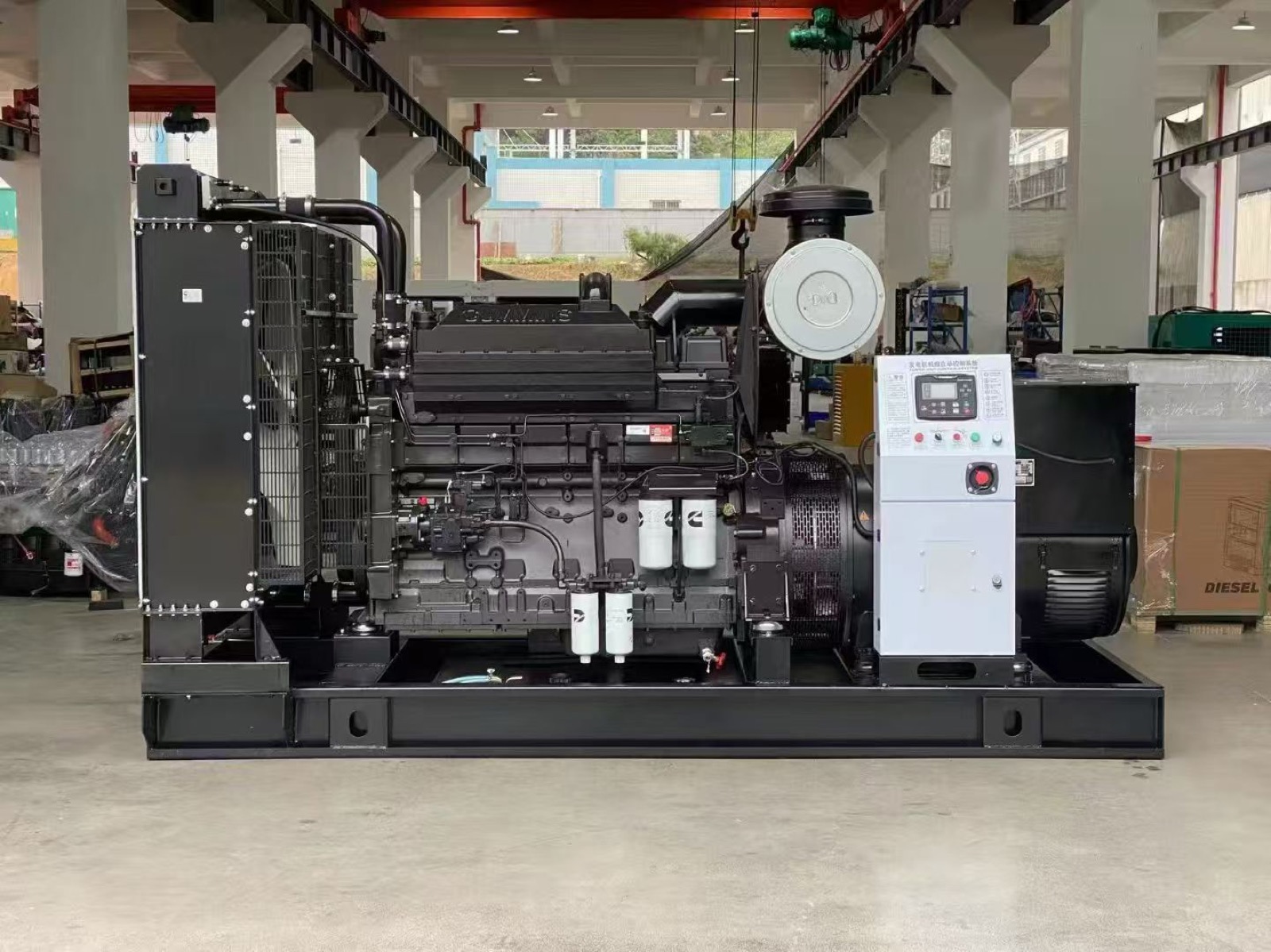
Buy the platform that matches your buyer, not the one with the better brochure. Confirm the rating basis in writing.
What a Yuchai generator actually is, and what it is not
Yuchai is an engine maker, not a generator brand. The set you buy is a Yuchai engine coupled to an alternator of someone else's manufacture, mounted on a frame and, if you choose, enclosed in a canopy. That matters because two sets advertised as Yuchai can differ in the alternator, the controller, the radiator and the canopy while carrying the same engine badge.
The engines themselves are four- and six-cylinder industrial diesels built for continuous duty in trucks, buses, construction equipment and stationary plant. The families most often seen in generator service in Nigeria are the four-cylinder units used for small and medium sets and the six-cylinder units used from the middle of the range upward, in both naturally aspirated and turbocharged forms.
What it is not: it is not a Cummins and it is not a Perkins, and treating the three as interchangeable is where most of the disappointment comes from. They are different products with different service networks, different parts paths and different second-hand values. The rest of this page is about where that difference matters and where it does not.
Yuchai against Cummins and Perkins: where each one wins
The comparison that matters to a Nigerian buyer is rarely a laboratory comparison. It is: which of these can I keep running for the next several years, with the mechanics and parts I can actually reach? That question produces a different answer in Lagos than it does in a town where the nearest authorised service point is a day away.
Cummins has the widest recognition and the deepest parts network, and it carries a price and a resale value to match. Perkins sits close to it on reputation in smaller and mid-size ratings. Yuchai's case is built on cost per kVA, on parts that can be sourced from China without a premium, and on the fact that many Nigerian mechanics already know the engine family from trucks and plant.
| Criterion | Yuchai | Cummins | Perkins |
|---|---|---|---|
| Recognition with buyers | Growing, strongest in price-led segments | Highest; a buyer may ask for it by name | High in small and mid ratings |
| Parts path in Nigeria | Good through Chinese parts channels; watch for copies | Widest, including authorised dealers | Good but thinner in remote areas |
| Cost per kVA | Usually the lowest of the three | Highest | Between the two |
| Resale value | Lower and more dependent on the local buyer | Strongest | Strong |
| Mechanic familiarity | High in transport and plant workshops | Highest overall | Good |
| Best fit | Price-sensitive dealers, rental fleets, standby duty | Projects that specify the engine | Mid-range commercial and industrial |
Torque backup is the number nobody puts on the brochure
Two sets with the same kVA rating can behave very differently the moment a pump or a compressor starts. What decides that is not the rating but the torque reserve the engine can deliver when the load steps, and how quickly the governor and the excitation respond.
A naturally aspirated engine with little reserve will dip further and recover more slowly than a turbocharged unit of the same output, and the dip is what the customer sees: lights dimming, a lift stalling, a compressor tripping on undervoltage. In a workshop with a single large motor, this is the difference between a set that works and a set that is returned.
So when comparing a Yuchai quote against a Cummins quote at the same kVA, ask for the engine model and its rating basis rather than the set rating, then ask what the largest motor on site is and how it starts. That conversation is what prevents the argument after delivery.
Fuel tolerance, injection equipment and the Nigerian reality
Mechanical injection systems are more forgiving of fuel than electronically controlled high-pressure common-rail systems, and that matters where fuel quality varies. A mechanically governed engine will usually tolerate more contamination before it stops, though it will still wear faster and it will still be damaged by water.
The engine does not exist in isolation: water and dirt in the tank reach the injection pump and the nozzles regardless of who built the engine, and the repair cost is driven by the injection equipment rather than by the badge on the canopy. This is why the fuel discipline on this site is written as a separate subject rather than as a brand comparison. The practical version is in the diesel quality and water contamination guide.
For a buyer choosing between platforms, the fair conclusion is that Yuchai does not remove the need for fuel discipline. If anything, a cheaper engine makes the parts bill relatively larger, so the same discipline protects a bigger share of the investment.
The parts question, including the counterfeit problem
Yuchai parts are widely available in Nigeria, which is the strength, and widely copied, which is the risk. Filters and injector nozzles are the usual targets: they look right, they fit, and they fail early enough to damage the engine before anyone realises what happened.
The defence is boring and effective: buy through a channel that can name the source, ask for the part number rather than the description, and keep a record of what was fitted and when. A dealer who supplies the machine should be able to say which parts they stock and where those parts come from.
For a fleet, the parts conversation also decides the engine choice. If your mechanic already keeps Yuchai filters for the trucks in the yard, adding a Yuchai generator is nearly free in support terms. If your workshop is built around Cummins, buying Yuchai to save on the unit means building a second parts path.
Reading the model code before you compare prices
Engine model codes carry the information that a set-level specification sheet usually hides: cylinder count, displacement, aspiration and, sometimes, the intended application. Comparing two quotes without reading the code is comparing two labels.
The point is not to memorise the numbering. It is to insist that the quotation states the engine model, the alternator make and model, the controller model and the rating basis, because those four lines are what make two offers comparable. Without them, a lower number is just a lower number.
| Line on the sheet | Why it changes the decision |
|---|---|
| Engine model code | Cylinder count and aspiration decide torque reserve and load acceptance |
| Rating basis (prime or standby) | The same engine is sold at different ratings depending on the duty claim |
| Alternator make and model | The alternator, not the engine, decides voltage recovery on motor starting |
| Controller model | Decides whether you get remote start, protection settings and diagnostics |
| Cooling package and ambient rating | A set rated in a cool climate will derate in a hot plant room |
| Fuel consumption at stated load points | Needed to budget running cost; a single figure at full load is not enough |
Resale value is a real cost line, even if nobody quotes it
A generator is eventually sold, replaced or traded. The price it fetches in that moment is influenced by the engine badge far more than by how well it ran, because the second buyer is judging with less information than you had.
Cummins enjoys the strongest second-hand position. Perkins is close behind in the ratings where it is well known. Yuchai's resale position is weaker and more local: in a market where buyers know the engine from trucks, it sells; in a market where the buyer only knows two Western names, it sits longer or sells at a discount.
That does not make Yuchai a bad purchase. It makes it a purchase with a different total cost shape: lower in, lower out. A dealer who works the numbers properly will see that the difference in resale roughly tracks the difference in purchase, and the case for Yuchai then rests on cash flow and on the customer's willingness to accept the badge, not on a fantasy of identical value.
Where a Yuchai set fits, and where it does not
The honest positioning is narrower than a brochure suggests. It fits best where the machine earns money by running, the buyer is price-aware, and the workshop is capable of keeping it alive.
| Situation | Fits Yuchai well | Better to specify another platform |
|---|---|---|
| Rental fleet, several identical units | Yes: lower capital per unit, easy to standardise | No strong case for the premium |
| Factory standby with a known load | Yes, if the largest motor is modest | When one large motor dominates the load |
| Project requiring a named engine | No | Yes: the specification will name Cummins or Perkins |
| Dealer stock for resale | Yes in price-led markets | Where buyers ask for a brand by name |
| Remote site with no parts access | Only with a stocked parts kit | Yes, where the network is denser |
| Continuous prime power duty | Possible, but confirm the rating basis in writing | Where the duty claim must be conservative |
Where this comparison stops being useful
The table above is a rule of thumb drawn from how enquiries usually split, not a measurement. It assumes the buyer is in Nigeria, that the machine will be serviced locally, and that the load is known. Change any of those and the conclusion can move.
It also says nothing about the specific build. A well-built Yuchai set with a good alternator and a proper canopy will outperform a cheaply built set carrying a premium badge, and that happens more often than the brand debate admits. The engine is one of four decisions; the alternator, the controller and the canopy are the other three.
Finally, this page deliberately avoids quoting prices. What a platform is worth depends on the build, the rating, the alternator and the delivery basis, and a number without those four attached is not a price, it is a rumour.
What to send us so the quote is comparable
If you want a Yuchai option priced against a Cummins or Perkins option, send the same four things for each: the load in kW, the largest motor and how it starts, the duty (standby or continuous), and the delivery basis. With those, the three quotes become comparable and the decision becomes about money and support rather than about badges.
If you are a dealer evaluating the platform for stock, send the ratings you are considering and the city you sell in. The answer will say plainly where we think Yuchai wins for you and where it does not, because a dealer who buys the wrong platform once does not come back for the second order.
FAQ
Is a Yuchai generator as good as a Cummins generator?
It is a different product at a different price. Yuchai wins on cost per kVA and on parts sourced from China; Cummins wins on recognition, network depth and resale. Which is better depends on whether your buyer asks for a brand by name.
Are Yuchai parts easy to find in Nigeria?
Yes, which is also the risk: the common parts are widely copied. Buy on part numbers through a traceable channel rather than on description, and keep a record of what was fitted.
Can a Yuchai set run continuously as prime power?
It can, provided the rating basis is confirmed in writing for the duty you intend. Do not accept a standby rating presented as a continuous one, whichever engine is fitted.
Why does the alternator matter as much as the engine?
Because voltage recovery on motor starting is mostly the alternator's job. A good engine with a weak alternator still gives dimming lights and tripping compressors.
Do you supply Yuchai in silent canopy form?
Yes, and the canopy specification matters as much as on any other platform: attenuation, ventilation and weight all change with the rating, so they should be stated on the quotation.
Will a Yuchai set hold its value?
Less well than a Cummins set in most Nigerian markets. The gap roughly tracks the lower purchase price, so the case for Yuchai rests on cash flow and buyer acceptance rather than on resale.
Can you quote Yuchai and Cummins on the same load?
Yes, and that is the most useful way to buy: same load, same duty, same delivery basis, two engine options, so the difference you are paying for is visible.
