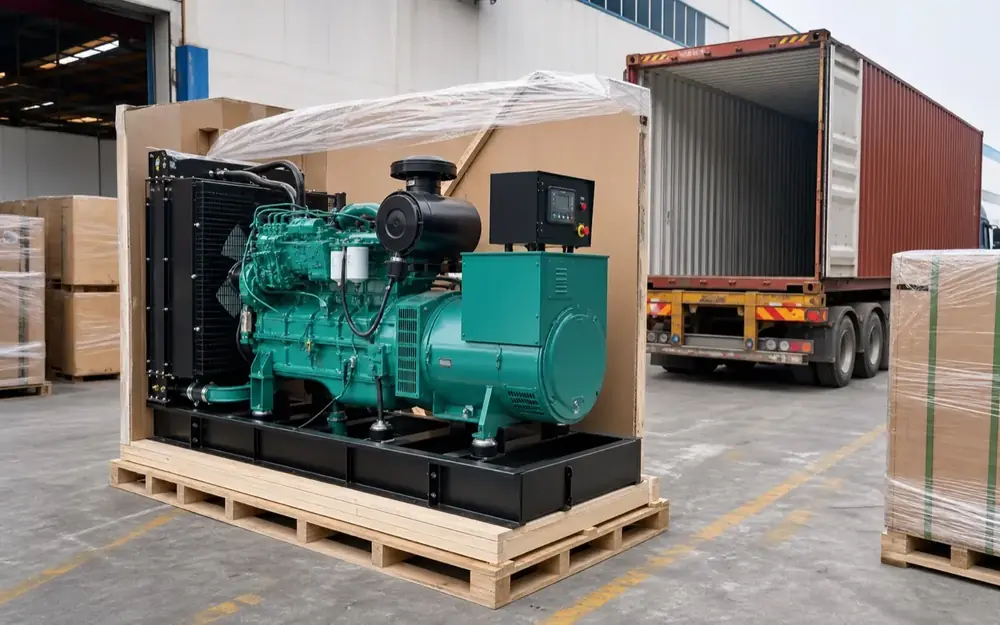
A brand name does not fix a price and it does not fix a specification. What decides the number is the scope behind the label, and that scope has to be written down on both offers before the two can be compared.
Why these two names end up in the same search
A buyer looking for a generator in Nigeria quickly meets two kinds of offer. One comes from a brand with a local manufacturing or assembly presence in the market, sold through a dealer network. The other is an imported set built around a globally recognised engine platform and brought in as a complete unit.
Both are legitimate ways to buy a generator, and both appear on the same tender shortlist. The confusion starts when the two are compared on the headline figure alone, because those figures are built from different cost stacks.
This page does not rank the two, does not publish a price for either, and does not claim to be an authorised distributor of any engine brand. It sets out the structure underneath each number so that a comparison can be made on equal terms.
Where the cost sits on each side
Two sets can carry similar names and still be built from a very different set of commercial decisions. The table below separates the lines that behave differently between a locally assembled set and an imported one.
Read it as a map of the number rather than as a set of rules. A line being different does not make either side better; it tells you where to ask the next question.
| Cost line | Locally assembled set | Imported set |
|---|---|---|
| Engine platform | Engine supplied with a kit or sourced for local build. The exact model should be named on the offer. | Engine built into the unit at the factory. Model and rating named on the offer. |
| Alternator and controller | Often sourced locally or regionally. Frame, excitation and controller functions should be stated. | Normally matched at the factory. Frame, excitation and controller functions stated. |
| Assembly and labour | Local assembly labour and workshop overhead sit inside the local price. | Assembly is inside the factory price. There is no separate local labour line. |
| Freight and duty | Applies to kits and components rather than to a complete unit, so the duty base differs. | Applies to the complete unit as imported goods, with clearing and inland transport added. |
| Margin and distribution | Local margin sits inside the dealer price and funds the local support network. | Importer margin and local distribution sit on top of the landed cost. |
| Warranty and service | Service is normally delivered locally, so the terms depend on the local organisation. | Service depends on the importer's arrangement and the engine platform's parts network. |
| Spare parts | Parts availability follows the local supply chain and the models built locally. | Parts availability follows the engine platform and the importer's stock policy. |
| Pipeline to site | The unit does not cross an ocean, so the route from build to site is shorter. | The route includes shipping, port handling and clearing before the inland leg. |
What to verify on a locally assembled offer
A local assembly offer can be a strong fit. The machine is supported in the market where it runs, and the commercial relationship is with an organisation that has a local presence. The verification work is about what was assembled and from what.
Start with the engine. Ask for the engine model and rating in writing rather than the brand family alone, and ask where that engine was manufactured. Ask which models in the range are assembled locally, because a brand with local assembly does not mean every model it sells is assembled in the country.
| What to ask | Why it matters |
|---|---|
| Engine model and rating basis | Two sets can carry the same brand and different engines. |
| Assembly location for this model | Local assembly is a per-model fact, not a brand-wide one. |
| Alternator make, frame and excitation | The electrical end decides how the set behaves on motor starting. |
| Controller functions and protection scope | Determines what the set will protect itself against. |
| Warranty terms in writing | Who performs the work, where, and what voids it. |
| Local parts availability for this model | The part that fails is model-specific, not brand-specific. |
What to verify on an imported Cummins or Perkins offer
An imported offer built around a globally recognised engine platform buys a documented engine lineage and a parts network that stretches beyond one country. It also buys a longer commercial chain, which is where the verification effort goes.
Ask for the engine model, rating and serial, the alternator details, the factory test record, and the packing and shipping documents that will travel with the unit. Ask whether the offer is for a new unit and which configuration it was built to.
| What to ask | Why it matters |
|---|---|
| Engine model, rating and serial | Links the offer to a specific engine rather than to a family. |
| Factory test record | Shows the set was run and what it produced. |
| Alternator and controller identification | Confirms the electrical scope matches the quotation. |
| Configuration and destination build | A unit built for another market may not suit the site. |
| Shipping documents and delivery term | Separates the machine from freight, duty and clearing. |
| Warranty route and who honours it | An imported warranty is only useful if someone local will act on it. |
Building a like-for-like comparison
The practical way to compare is to build one row set and fill it from both offers. Where a line is blank on one side, the comparison is not yet valid, and the blank is itself useful information about how the offer was put together.
| Line | Fill in from both offers |
|---|---|
| Rating | kVA and kW, with the power factor the kVA figure is quoted at. |
| Duty basis | Prime or standby, and the running assumption behind it. |
| Engine | Model, rating and origin, not the brand family. |
| Alternator | Make, frame and excitation arrangement. |
| Controller and protection | Functions offered and protection scope. |
| Enclosure | Open or sound-attenuated, and the treatment supplied. |
| Electrical scope | Breaker, cabling interface and changeover arrangement. |
| Fuel arrangement | Base tank or separate storage. |
| Delivery term | FOB or CIF, and what each side covers. |
| Warranty | Duration, who performs the work, and what voids it. |
| Documentation | Test record, packing list and shipping documents. |
Four comparison traps
Most bad comparisons are not dishonest. They are the result of two offers describing different things while sharing a label.
| Trap | What it looks like | How to avoid it |
|---|---|---|
| A bare set against a fully scoped one | One figure includes the canopy, changeover and tank; the other does not. | Compare the scope rows before the totals. |
| The same kVA at different power factors | Both say the same kVA but the usable kW differs. | Ask for kW and the power factor used. |
| Different warranty wording | One covers parts, the other covers parts and labour, locally. | Ask who performs the work and where. |
| Ex-works against delivered | One stops at the port, the other reaches the site. | Ask for both offers on the same delivery term. |
When each route tends to fit
Neither route is universally better. The fit depends on what the site needs from the supplier after the set arrives.
A locally assembled set tends to fit when the site needs a local service relationship, when the machine will be maintained by a local team, and when the buyer values dealing with the same organisation for the machine and its upkeep. The verification effort goes into the specification behind the brand.
An imported set tends to fit when the engine platform itself is the requirement, because the site's maintenance regime, parts practice or tender specification is built around that platform, and when the buyer is set up to manage an import or is buying through someone who is.
Both routes need the same discipline: a written specification, a named delivery term, and a warranty that names who acts on it. The warranty and after-sales page covers what those terms should say.
Turning the comparison into a quotable specification
Once the scope rows are agreed, the enquiry becomes straightforward. State the load, the largest motor and its starting method, the duty and the daily hours, the voltage, phase and frequency, the enclosure preference, the changeover scope and the delivery term.
Then ask for the same specification from both routes, priced on the same term. That is the only version of the comparison that means anything. The FOB China versus CIF Lagos guide explains what changes when the term changes, and the quotation checklist lists the lines an offer should contain.
Where the engine platform itself is the question, the Cummins page and the Perkins page describe how those platforms are specified, and the Cummins versus Perkins comparison sets the two side by side. If the rating is still open, the kW, kVA and kWh guide explains the unit conversion.
Request one specification from both routes
Send the load, the largest motor and its starting method, the duty and daily hours, the voltage and frequency, and say which delivery term you want. Ask for the same specification from each route so the two can be compared line by line.
Get a written quotation
Three fields. We reply with the rating, the engine option and the delivery basis.
Mikano and imported set questions
Is a Mikano generator cheaper than an imported Cummins or Perkins set?
This page does not publish a price for either, and a general answer would not hold. The two are built from different cost structures, so the comparison depends on the specification and the delivery term you ask for.
Does this site sell or represent Mikano?
No. No page on this site claims authorised distributorship of Mikano, Cummins, Perkins or any other engine brand. The comparison here is a buying framework, not a commercial representation.
Why compare on scope rather than on the total?
Because the total is the sum of the scope. Two offers with different enclosures, changeover scope and delivery terms are not describing the same purchase, so the difference in total may be describing the difference in work.
What is the single most useful question to ask either supplier?
Ask for the engine model and rating in writing, with the power factor the kVA figure is quoted at. That one answer separates a label from a specification.
Can both routes be quoted on the same delivery term?
Ask for it. A locally supplied set can be quoted delivered to site, and an imported set can be quoted FOB or CIF. Once both sit on the same term, the remaining differences are scope and support.
What documents should come with an imported set?
A factory test record, the engine and alternator identification, a packing list and the shipping documents for the agreed term. The pre-shipment inspection page explains what to check before the container is sealed.
