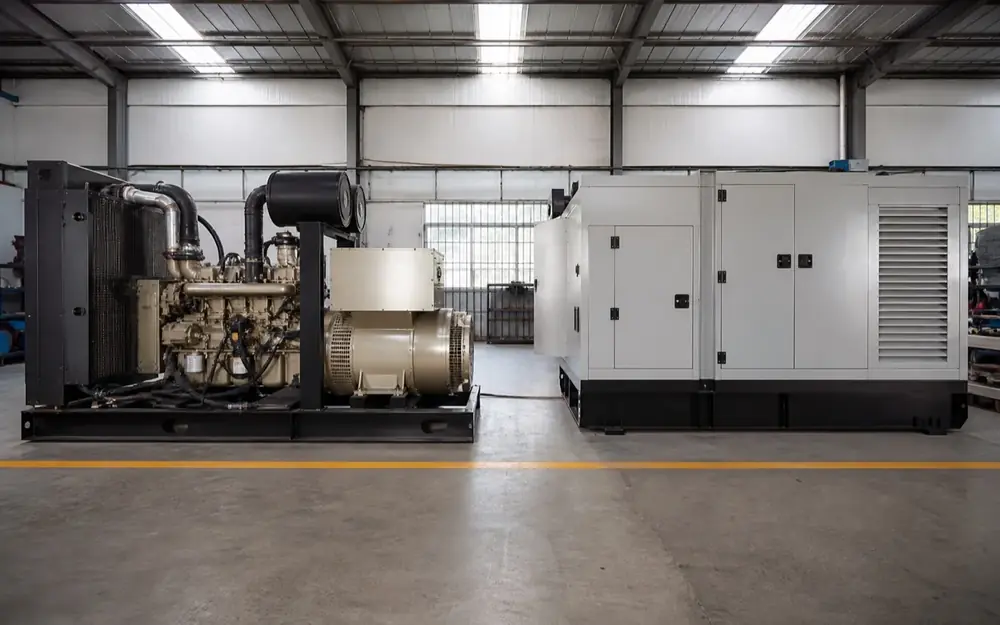
There is no best generator brand in the abstract. There is a best fit for a duty, a site and a maintenance arrangement, and the only way to reach it is to test the brand claim against the specification.
Why a brand ranking is the wrong output
A brand list answers a question the buyer did not ask. The buyer asks which machine will carry this load, in this place, with the maintenance they can actually arrange. A list answers which names appear most often.
The lists themselves are built from different things. Some rank by units sold, some by search volume, some by what the publisher distributes. A name that appears in three lists may simply be a name that appears in three lists.
There is a structural problem too. The same brand can mean different things in different offers. A brand that assembles locally and a brand whose engines are imported both put their name on a set, and the name alone does not say which engine, which alternator or which controller is inside.
The five criteria that decide fit
These are the questions that separate a brand worth shortlisting from a brand worth talking about. Notice that four of the five are about the model rather than the brand, which is the point: the brand is the wrapper and the model is the purchase.
| Criterion | What it really asks | What a good answer looks like |
|---|---|---|
| Named engine model | Is the engine identified by model and rating, or only by brand? | A model designation and rating basis on the written offer. |
| Parts availability for that model | Can the parts that wear be obtained where the set runs? | A named parts route, with the identification method used. |
| Service capability | Will the people servicing it hold the maintenance information for this model? | A provider who can show the engine's own service data. |
| Documentation | Can the unit be traced from build to delivery? | Test record, identification and shipping documents. |
| Running cost | Is the cost per unit of energy defensible at your load? | Consumption at your load point, not only at full load. |
The kinds of supplier a Nigerian buyer actually meets
Most shortlists contain a mix of three commercial shapes. They are not quality tiers, and none of them is automatically better than the others.
A buyer can end up with a good machine from any of the three and a poor one from any of the three. The shape tells you where to look, not what you will find.
| Shape | What it usually means | What to verify |
|---|---|---|
| Local assembly brand | A brand with a manufacturing or assembly presence in the market, sold through a dealer network. | Which models are assembled locally, and which engine is inside this one. |
| Importer of a global engine platform | A complete unit built around an engine family with a worldwide parts network. | The engine model and rating, and who honours the warranty locally. |
| Trader or reseller | A commercial offer without a manufacturing or assembly role. | Who provides the warranty, and who holds the parts. |
How to read a top-ten list critically
Lists are useful as a starting point and misleading as a conclusion. Four signals separate a list worth reading from one worth closing.
None of these make a list authoritative. They make it usable as a first pass, which is all a list can be.
| Signal | Why it matters |
|---|---|
| Model-level detail | A list that names engine models has done work; one that names only brands has not. |
| A stated basis | Says how the order was decided: units, installed base, or editorial judgement. |
| Disclosed commercial interest | Tells you whether the publisher sells or services what it ranks. |
| Dated content | A brand's local position changes, so an undated list describes a market that may no longer exist. |
Where the brand ends and the specification begins
Three components decide how a set behaves, and each has its own identity. The engine decides fuel use, durability and parts. The alternator decides how the set responds to motor starting and how stable the voltage stays. The controller decides what the set protects itself against and what it reports.
A brand name on the canopy says nothing about any of the three. That is why two sets from the same brand can behave differently on the same site.
Ask for all three by identification. The engine platform comparison guide covers how platforms are compared for a tender, and the Cummins versus Perkins page shows the comparison applied to two named platforms.
A sheet you can fill in
Rather than a score out of ten, mark each line as a must-have, a differentiator or a nice-to-have for your site. The classification does the work; a number would only hide the reasoning behind it.
Fill the evidence column from the written offer rather than from a conversation. A line that cannot be filled from paper is a line that has not been answered.
| Line | Must-have, differentiator or nice-to-have | Evidence you will accept |
|---|---|---|
| Engine model and rating | To be marked by the buyer | Written specification |
| Parts route for wear items | To be marked by the buyer | Named route and identification method |
| Service provider holding the engine data | To be marked by the buyer | Sample service record |
| Test record and identification | To be marked by the buyer | Factory test document |
| Warranty terms and who acts on them | To be marked by the buyer | Written warranty terms |
| Consumption at your load point | To be marked by the buyer | Consumption table for the offered engine |
| Controller functions and protection | To be marked by the buyer | Controller data sheet |
| Enclosure and site conditions | To be marked by the buyer | Build description for the offered enclosure |
Documentation to request, whatever the brand
The same document set should be asked of every shortlisted supplier so the answers can be compared. A supplier who cannot produce them is telling you something useful.
| Document | What it proves |
|---|---|
| Written specification with model designations | That the offer describes a specific machine. |
| Factory test record | That the set was run and what it produced. |
| Identification on the unit | That the delivered machine matches the offer. |
| Warranty terms in writing | Who performs the work and what voids it. |
| Packing and shipping documents | What travels with the unit and on which term. |
Bringing running cost into the brand decision
Two brands that look similar on the quotation can separate on running cost. Fuel dominates the continuing cost of a diesel set, and fuel use follows the load the set actually carries rather than the rating on the plate.
That makes consumption at your load point a brand-level question rather than a detail. A supplier who will only quote consumption at full load has not answered it.
The cost per kWh page sets out how to build the figure from fuel, maintenance and capital recovery. The load factor fuel calculator turns a rating into an hourly estimate you can price, and the diesel price page covers the fuel line itself.
Ask for the evidence behind a brand claim
Send the load, the duty and the site conditions, then ask each shortlisted supplier for the engine model, the parts route, the service arrangement and the warranty terms in writing. Compare the answers rather than the brand names.
Get a written quotation
Three fields. We reply with the rating, the engine option and the delivery basis.
Brand selection questions
Which generator brand is best in Nigeria?
No single brand is best in the abstract. Fitness depends on the duty, the site, the load profile and the maintenance arrangement you can sustain. Judge the engine model, the parts route, the service capability, the documentation and the running cost.
Are imported brands better than locally assembled ones?
Not automatically, and not the reverse. The two carry different cost structures and different support arrangements. The question is which arrangement fits your site, and that is answered by the scope rather than by the origin.
Why does this page not publish a ranking?
Because a ranking has to choose a basis, whether units, installed base, price or availability, and any basis suits some buyers while misleading others. A framework lets you apply your own basis to the offers in front of you.
What is the most useful thing to ask a supplier?
Ask for the engine model and rating in writing, and ask which parts for that model are held locally. Those two answers separate a claim from a supply arrangement.
Does a well-known brand guarantee spare parts availability?
No. Availability follows the model and the importer's stock policy rather than the brand's recognition. Ask for the parts route by name and for the identification method used to match parts.
How should a shortlist be narrowed?
Narrow on the must-have lines first, then compare the survivors on running cost. Establish the load before the shortlist is built, because a list assembled before the load is known will be organised around the wrong criterion.
