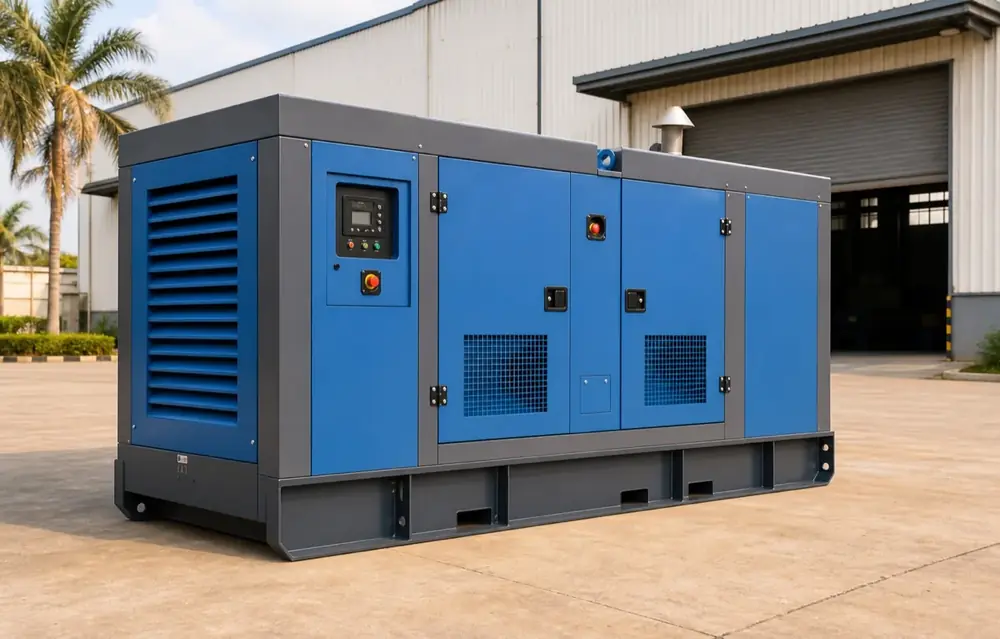
This page is for buyers who already know they need something around 200kVA and want to compare quotations properly, rather than buyers still deciding between a small set and a large one.
What 200kVA actually delivers
The nameplate figure is apparent power. At a power factor of 0.8 — the convention generator sets are rated on — a 200kVA machine delivers 160 kW of real power. That conversion is the first number a buyer should hold, because site loads are usually counted in kW and quotations are usually written in kVA.
The second number is duty. A prime-rated set is declared for continuous operation with a limited overload allowance; a standby-rated set is declared for short-term use at a higher output. If the site runs the generator through a working day, the prime figure is the one that matters, and a quotation written on the standby figure is describing a different machine to the one the site needs.
The third is ambient. Ratings are declared at a reference condition, and a set working in a hot, humid compound with restricted airflow will not hold its nameplate output. This is why the radiator specification and the canopy openings belong in the comparison, not in the installation small print.
There is also a load quality point. Motors, welders, compressors and anything with a rectifier front end pull a distorted current that heats the alternator beyond what a resistive load of the same kW would cause. A 200kVA set with a generous alternator handles that better than one running close to its alternator limit.
Where it fits, and where it runs out
Around 200kVA, the buyer is usually covering a whole facility rather than one process. That is what makes the sizing decision harder than it looks: the answer depends on which loads must run together, not on the total of every load on the premises.
The table below is a starting point for that conversation, not a substitute for a load schedule.
| Site type | What the set is usually asked to carry | Where it runs out of margin |
|---|---|---|
| Medium factory | Production line, compressors, lighting, office cooling | Several large motors starting within the same few seconds. |
| Hotel | Guest room cooling, kitchen, pumps, lifts, common areas | Peak check-in cooling load coinciding with kitchen and laundry. |
| Estate or facility block | Borehole pumps, street lighting, common buildings | Pump starts after an outage, when every controller restarts together. |
| Supermarket | Refrigeration, freezers, HVAC, lighting | Refrigeration compressors restarting while cooling load is already high. |
| School or campus block | Classroom cooling, ICT room, water pumping, lighting | Exam periods and after-hours events when occupancy is highest. |
| Clinic or diagnostic centre | Imaging, sterilisation, cold storage, HVAC | Equipment with high inrush and strict voltage tolerance. |
In every one of those cases, the honest question is not “will 200kVA carry the total”, but “will it carry the worst five seconds of the day”. A set that holds steady load and dips on motor start is a set that will eventually trip something important.
Motor starting is the constraint that decides the size
A motor draws a multiple of its running current while it accelerates. As a rule of thumb, a direct-on-line start pulls several times the running current for a brief period, a star-delta start pulls roughly a third of that, and a soft starter or a variable frequency drive pulls less again. Those figures are planning estimates, not design values.
This is why two sites with the same total kW can need different generators. A site whose largest motor is small and started gently will sit comfortably on 200kVA. A site with one large direct-on-line motor may need the next rating up, purely to survive the start.
There are ways to keep the smaller set: change the starting method, sequence the loads so the large motor starts before the cooling load is reconnected, or add a soft starter. Each has a cost and a reliability trade-off, and each is cheaper to plan before the order than to retrofit after commissioning.
| Starting method | Effect on starting current | What it means for the generator |
|---|---|---|
| Direct on line | Highest inrush of the common methods | The generator must absorb the full surge, so headroom above running load matters most here. |
| Star-delta | Reduced inrush, applied in stages | Easier on the set, but the transition can disturb voltage on a lightly loaded generator. |
| Soft starter | Ramped current, adjustable | Reduces the surge the set sees and is often the cheapest way to keep a smaller rating. |
| Variable frequency drive | Controlled acceleration | Kindest to the generator, but the drive introduces harmonics the alternator must tolerate. |
Engine platform at this rating
At 200kVA the engine is normally a six-cylinder industrial unit, and the meaningful differences between platforms show up in three places: displacement at the rating, the fuel system, and how the engine behaves when the load steps rather than ramps.
A larger displacement at the same kVA gives more rotating mass and more torque reserve, which is felt as a calmer recovery when a motor starts. A smaller, more highly rated engine can meet the same nameplate figure while having less in hand for transients. Both are legitimate engineering choices; they are not the same machine to operate.
Fuel system type matters in Nigeria specifically, because it determines how the engine copes with the fuel that actually arrives on site. Mechanical systems are more tolerant of variation and simpler to service in the field; electronic systems deliver finer control and better part-load economy but need cleaner fuel and a technician with the right diagnostic tool.
Cummins, Perkins and Yuchai all have offerings in this band, and the choice usually comes down to which one the buyer's maintenance organisation already knows, and which one has consumables on a shelf within reach of the site.
Open or silent at this rating
At 200kVA the enclosure decision carries more consequences than it does on a small set, because the engine rejects considerably more heat and the canopy has to remove it without recirculating it.
A silent canopy solves a noise problem and creates a ventilation problem. If the canopy is specified with the right openings, the right fan and the right baffling, the set holds rating. If it is a generic box, the set runs hot, derates, and eventually shortens its own life. This is one of the most common ways a 200kVA installation underperforms its datasheet.
An open set is cheaper, easier to inspect and easier to service, but it needs a plant room with its own acoustic treatment and its own ventilation design. Buyers who choose open sets to save on the enclosure often spend the difference on the room instead.
| Consideration | Open set | Silent canopy |
|---|---|---|
| Noise at the boundary | Requires a plant room or acoustic treatment to control | Handled by the enclosure, provided the canopy is properly attenuated |
| Heat removal | Depends on room ventilation design | Depends on canopy airflow design and on clearance around the unit |
| Service access | Direct access to every side | Access through doors and removable panels; some tasks are slower |
| Weather protection | Needs a roofed, drained space | Built in, which matters on exposed sites |
| Footprint | Larger once the room is counted | Larger than an open set, smaller than a room |
| Inspection | Everything visible | Requires opening panels, so it is inspected less casually |
ATS, changeover and paralleling
An automatic transfer switch decides how the building behaves during an outage, and it is the item most often left out of a generator quotation and then discovered as a separate cost.
At 200kVA, a single ATS covering the whole distribution board is the common arrangement. What matters is whether the changeover is rated for the full load, whether it switches neutral, and whether the generator controller can signal it. A controller without the right output cannot drive an ATS properly, no matter how good the switch is.
Paralleling two sets is a different decision. It buys redundancy and lets a site run one set at part load instead of two at low load, but it requires controllers designed to parallel, synchronising switchgear and a load-sharing scheme. Retrofitting that onto sets bought without it is expensive. If there is any chance the site will grow into two machines, raise it before the order.
Foundation, ventilation and exhaust
A 200kVA set is heavy enough that the base it sits on is part of the installation design. A level, rigid, drained plinth with anti-vibration mounts prevents the sort of slow misalignment that shows up later as vibration, coupling wear and exhaust leaks.
Ventilation has two jobs: supplying combustion air and removing radiator heat. Both are usually undersized when a set is installed in an existing room. The result is a machine that runs hot, derates quietly, and is blamed on the engine rather than on the room.
Exhaust routing matters for the same reason. A long run with tight bends adds back pressure the engine was not specified for, and a termination close to a window or a neighbouring wall turns a noise problem into a complaint. Route it short, insulate it, and discharge it away from occupied space.
- Level plinth, drained, with anti-vibration mounts rated for the set.
- Combustion air inlet sized for the engine, not for the room's general ventilation.
- Radiator discharge ducted so hot air cannot recirculate into the intake.
- Exhaust run as short as the layout allows, insulated, with supported hangers.
- Fuel line and tank bunded, with isolation and a water separator at the engine.
- Clear service access on the sides the technician actually needs to reach.
Acceptance and documents
The acceptance step protects the buyer more than any clause in the quotation. A set should be run under load and observed, not started and handed over.
Ask for the load test to be recorded with the load steps, the voltage and frequency at each step, the coolant temperature and the oil pressure. That record is what a technician will refer to later when something changes.
Also confirm that the engine, alternator and controller nameplates photographed at acceptance match the datasheet approved with the order. Specification drift between order and delivery is more common than buyers expect, and it is far easier to resolve before the unit leaves the yard.
- Load test record with load steps, voltage, frequency and temperatures.
- Nameplate photographs for engine, alternator and controller.
- Controller settings sheet as commissioned.
- Wiring diagram matching the build, plus the operation manual.
- Consumables list with part numbers for the first service.
- Packing list and loading photographs for consolidated shipments.
Reading a 200kVA quotation
Most of the spread between two 200kVA quotations is scope, not margin. The way to see it is to force both onto the same list and mark what is missing.
| Item | What to look for |
|---|---|
| Rating basis | Prime and standby output stated separately, with the ambient condition. |
| Engine | Model, displacement and fuel system type. |
| Alternator | Make, model, insulation class and the kW it is matched to. |
| Controller | Model, display, communications, ATS output. |
| Canopy | Type, steel gauge, acoustic treatment, access doors. |
| Cooling | Radiator specification and design ambient. |
| Fuel | Tank capacity, bunding, gauge, day tank if included. |
| Electrical | Breaker, ATS, cabling boundaries, earthing. |
| Delivery | FOB or CIF stated, with the port named. |
| Documents | Datasheet, test record, diagram, manual, packing list. |
Where a line cannot be filled in for one supplier, treat it as excluded until it is written down. That single discipline explains most of the differences buyers spend weeks trying to attribute to brand or to negotiation.
Get a written quotation
Three fields. We reply with the rating, the engine option and the delivery basis.
FAQ
How much power does a 200kVA generator actually give?
At a power factor of 0.8 a 200kVA set delivers 160 kW of real power. Usable output falls further if the load power factor is lower than that, or if the site ambient temperature is above the condition the rating was declared at.
Is 200kVA enough for a medium factory?
It can be, but the answer depends on which machines run together and on the largest motor start rather than on the total connected load. Send a load schedule with the biggest motor and its starting method, and the rating can be checked against the worst few seconds of the day.
Should I choose silent canopy or open type at 200kVA?
Silent canopy suits hotels, estates and urban sites where noise at the boundary matters, provided the canopy is properly ventilated. An open set is easier to service and cheaper, but it needs a plant room with acoustic treatment and ventilation designed for it.
Do I need an ATS with a 200kVA generator?
If the site should change over without someone throwing a switch, yes. The ATS must be rated for the load, and the generator controller must have the output to drive it. ATS is often excluded from a generator price and should be requested at the quotation stage.
Can two 200kVA generators be paralleled later?
Only if they were built for it. Paralleling needs controllers designed to synchronise, matching switchgear and a load-sharing scheme. Retrofitting that onto sets bought without it is expensive, so raise the possibility before the order rather than after.
Why do two 200kVA quotations differ so much?
Usually because the scope differs: rating basis, alternator, controller, canopy, cooling package, fuel tank, ATS, electrical boundaries and delivery term. Comparing the two line by line explains the gap faster than comparing the totals.
What should be tested before accepting a 200kVA set?
A load test at stated steps with voltage, frequency, coolant temperature and oil pressure recorded, plus nameplate photographs that match the approved datasheet, a controller settings sheet, a wiring diagram and the consumables list.
