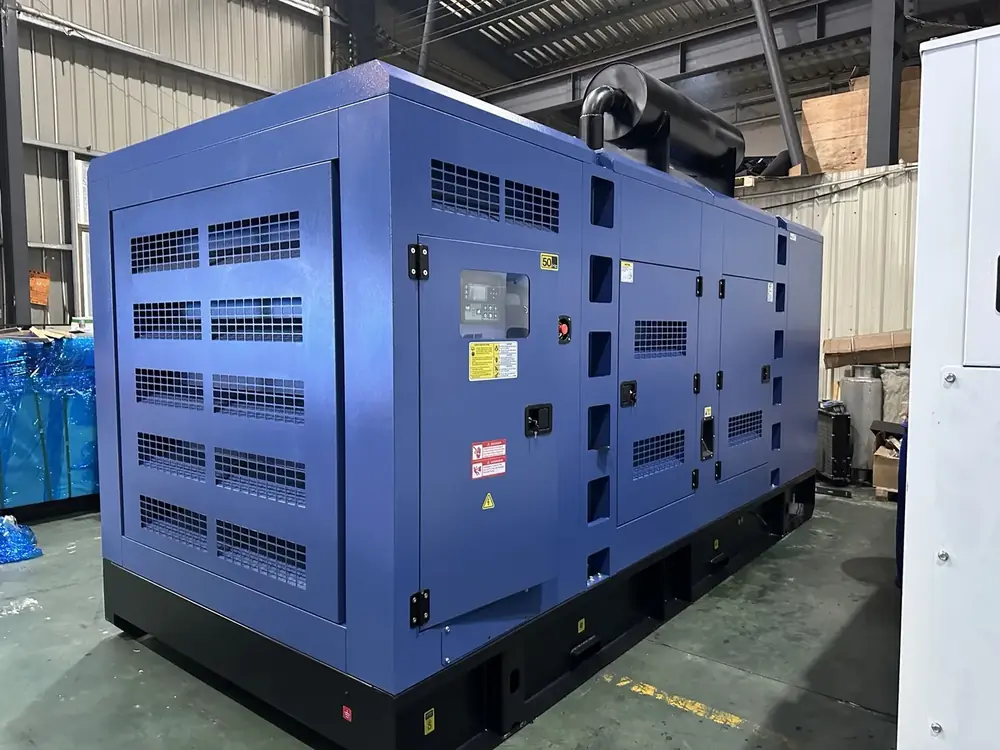
Buy a sound level at a stated distance and load, not a canopy description. The datasheet number is measured at one metre; the number that matters is the one at the boundary, and it depends on distance, barriers, ground and the direction of the exhaust.
dB(A) at one metre versus at the boundary: why the datasheet number misleads
Almost every generator datasheet quotes a sound pressure level at one metre from the set, sometimes at seven metres on larger units, measured at a stated load. That convention exists so that products can be compared with each other on a common basis. It was never intended to describe what a site sounds like, and reading it as though it did is the origin of most noise disputes.
Sound pressure falls with distance. In open air, with no reflecting surfaces, each doubling of distance takes roughly six decibels off the level. A set quoted at one metre is therefore a very different proposition at eight metres, and different again at thirty-two. The fall is not linear, so the improvement gained by moving a set from three metres to six is large, while moving it from thirty to sixty is barely perceptible.
Three things spoil the tidy calculation, and all three are present on real sites. Ground reflection adds to the level, particularly over concrete or paving. Walls and buildings either block sound or reflect it back towards a neighbour, depending on geometry. And the set is not a point source: a large canopy radiates from a surface area, so close-in figures behave differently from far-field ones.
The practical lesson is that the datasheet figure should be treated as a starting point for comparison and nothing more. What has to be specified and, ideally, measured is the level at the boundary, at the sensitive receiver, under the load the site will actually run. That is the number a neighbour experiences and the number a regulator would take an interest in.
The three paths noise takes: exhaust, casing, structure
Generator noise reaches a listener by three routes, and treating one while ignoring the others is the commonest way to spend money without buying quiet. The three are worth separating because each responds to a different remedy.
The exhaust path is usually dominant on an open set and often still dominant after an acoustic canopy is fitted. Hot gas leaves the engine in pulses, and the note that carries across a compound is largely that pulsation. It is reduced by a proper silencer of adequate volume, by correct pipe diameter, and by routing the outlet away from the sensitive side and above head height.
The casing path is the noise radiated from the engine block, the alternator and the radiator surfaces through the canopy panels. This is the path an acoustic enclosure is designed for, and where the canopy is well lined and well sealed it responds very well. Where the canopy is thin, or where the air path is short and direct, the radiated noise escapes largely untreated.
The structure path is the one most often missed. Vibration travels from the engine and alternator through the base frame into the plinth and the building structure, and then radiates from walls and floors as sound well away from the set. A canopy cannot address this at all. Isolators between the base frame and the plinth, and a plinth that is separate from the building slab, are what reduce it.
The table answers the question that decides where the money goes: which path is producing the noise at the boundary, and what actually reduces it?
| Path | Where it starts | What reduces it | What does not help |
|---|---|---|---|
| Exhaust | Engine exhaust outlet | Critical or residential silencer, correct pipe size, outlet aimed away | A canopy on its own |
| Casing / radiated | Engine, alternator and radiator surfaces | Lined acoustic enclosure with sealed panels | Moving the set a couple of metres |
| Structure-borne | Base frame into plinth and slab | Vibration isolators, separate plinth | Thicker canopy walls |
What an acoustic enclosure changes, and what it cannot
An acoustic canopy works by absorbing and blocking the sound that leaves the machine surfaces. Its performance depends on the lining, the mass of the panels, how well the joints and cable entries are sealed, and above all on the air path. Every canopy must let cooling air in and hot air out, and those openings are the weak points that decide the real figure.
A canopy cannot make an exhaust quiet. If the note that carries is the exhaust pulse, a canopy reduces what is heard around the engine but leaves the characteristic report at the pipe. This is why a site can fit a well-made silent canopy and still receive complaints, and why the exhaust silencer and its routing deserve as much attention as the enclosure.
A canopy also cannot escape the trade-off between sound and cooling. Closing up the air path reduces noise and reduces airflow at the same time, and an enclosure starved of air will derate the set or shut it down on over-temperature. The figures that matter here are the air-on and air-off areas, the clearance to walls, and whether the canopy was designed for the ambient temperature of the site rather than a European one.
Where a site needs a very low figure at the boundary, the honest answer may be a combination rather than a better canopy: an enclosure for the radiated path, a critical silencer for the exhaust, isolators for the structure, a barrier wall for the geometry, and enough distance to let the physics do the rest. Each of those has a cost, and the cheapest order to try them in is set out below.
Reading a sound-level figure: distance, load and measurement standard
A sound figure without three pieces of information attached is not usable. The first is distance: one metre, seven metres, or a boundary. The second is load: a set at no load is quieter than a set at full load, and a figure quoted at part load flatters the product. The third is the standard the measurement followed.
For generating sets the usual reference is the measurement method set out for sound pressure levels on reciprocating engine driven generating sets, which specifies microphone positions and the conditions of the test. A supplier who can name the standard being followed, and the load and distance at which the figure applies, is giving a specification. A supplier who gives a single number with no qualifiers is giving a marketing line.
The A-weighting in dB(A) also deserves a word, because it explains why two sets with similar figures can sound different. A-weighting approximates how the ear responds across the frequency range, discounting very low frequencies heavily. A set with strong low-frequency content can therefore measure modestly in dB(A) and still be described as a deep, penetrating noise by the people who live near it. Where the complaint is about a thump rather than a whine, the dB(A) figure is not capturing the problem.
Finally, ask whether the figure is a guaranteed value or a typical one. Guaranteed figures carry a consequence if the delivered set does not meet them; typical figures do not. Where the site has a boundary requirement to satisfy, the specification should say what happens if the measured level on delivery is higher than the quoted one.
Siting, walls and barriers: the cheap wins before an enclosure
Before a more expensive canopy is considered, five cheap decisions are worth taking, and in most projects they deliver more decibels per naira than any hardware change.
Distance is the first. Since each doubling of distance removes roughly six decibels, moving the set from beside the boundary to the far side of the compound is often the single largest improvement available, and it costs nothing but a longer cable run and a longer fuel line. The second is orientation: aim the exhaust outlet away from the nearest occupied building, and if the outlet must point towards a wall, expect a reflection rather than an absorbed sound.
The third is the barrier. A solid wall between the set and the receiver, tall enough to break the line of sight and close enough to the set to matter, reduces the direct path substantially. A wall with a gap under it, or one that stops below the height of the canopy, does much less. The fourth is the plinth: separating it from the building slab and fitting isolators prevents the structure from becoming a loudspeaker.
The fifth is the operating pattern. A set that runs during the day and is shut down at night is a different neighbour from one that runs continuously, and some sites can solve a noise problem almost entirely by moving load rather than moving machinery. This is worth examining before any hardware is bought, because it is reversible and free.
What to settle with neighbours and estate management before installation
Noise is a relationship as much as a measurement. A set that measures within a limit but runs at hours nobody agreed to will still generate complaints, and a complaint that reaches an estate management committee or a local authority is far more expensive than the enclosure that might have prevented it.
The first thing to settle is the hours of operation, in writing, with whoever has authority over the site: estate management, the landlord, or the facility committee. Agreeing a window in advance is easier than negotiating one after the first sleepless night, and it gives the site a defensible position if a new neighbour moves in later.
The second is information. People tolerate a noise they understand far better than an unexplained one. Telling neighbours what is being installed, when it will run, and how to reach someone if it becomes a problem costs nothing and removes most of the friction. A contact number on the canopy is a small thing that changes the conversation from anonymous to accountable.
The third is the local requirement. Rules on permitted noise levels and permitted hours vary between states and between local government areas, and secondary sources quoting specific limits should not be relied on. Where the site is in a residential or mixed area, the current requirement should be confirmed with the relevant local authority, and the specification written to that requirement rather than to a number found online.
Finally, if the site already has a set and is replacing it, measure the existing level before the change and measure again after. That comparison is the evidence that the money was well spent, and it is also the answer to any neighbour who says nothing has improved.
What to specify in the RFQ
A noise specification should be written as a requirement at a place, not as an adjective in a product description. The difference between asking for a silent generator and asking for a stated level at a stated point is the difference between a hope and a contract.
State the distance from the proposed set position to the nearest boundary and to the nearest occupied building, and what separates them: a wall, a fence, open ground. State the load the set will run at, since the figure moves with load. State the hours of operation. State any limit that applies, and where it comes from.
Then require the supplier to respond in the same terms: the sound level at that distance, at that load, measured to a named standard, with a statement of whether the figure is guaranteed or typical. Ask what the enclosure's contribution is separately from the exhaust silencing, because a supplier who can separate the two understands the problem and one who cannot is quoting a canopy from a catalogue.
Ask also about the cooling margin at site ambient temperature, since a canopy chosen for quiet will be chosen for restricted airflow, and the two requirements pull against each other. And ask who measures after installation. A supplier willing to measure at the boundary after commissioning is offering a very different level of commitment from one who quotes a number from a datasheet. Installation scope and its exclusions are set out in generator installation cost, the canopy range is described on the silent diesel generator page, engine platforms are compared in diesel generator brands, and current models are listed on the price list.
Request a sound level at your boundary, not a canopy description
Send the distance from the set position to the nearest boundary and to the nearest occupied building, the load the set will carry, and the hours it will run. The quotation will then state a sound level at that distance and load, name the measurement standard, and say whether the figure is guaranteed, instead of describing the set as silent.
Get a written quotation
Three fields. We reply with the rating, the engine option and the delivery basis.
Generator noise questions
What does the dB(A) figure on a generator datasheet actually measure?
It is a sound pressure level, A-weighted to approximate how the ear responds, normally measured at one metre or seven metres from the set at a stated load. It is a comparison figure for products, not a prediction of what the set will sound like at your fence.
How much quieter is a generator at the boundary than at one metre?
It depends on distance and surroundings, but in open air each doubling of distance removes roughly six decibels. Walls, ground reflection and the direction of the exhaust all change the result, so the boundary figure should be calculated or measured for the actual site rather than assumed.
Will a silent canopy solve a noise complaint?
Not on its own. A canopy reduces noise radiated from the engine, alternator and radiator surfaces, but it does very little for the exhaust note unless the exhaust is separately silenced, and nothing at all for vibration transmitted through the plinth. Complaints usually involve one of those two paths.
Can I add an enclosure to an existing generator later?
Often yes, but it is worth checking the cooling margin first. A canopy restricts airflow, and a set that was designed for open installation may not have enough radiator capacity to run inside one at site ambient temperature. The plinth and isolators are also easier to fit during installation than afterwards.
What noise limit applies to my site in Nigeria?
Requirements vary between states and local government areas, and figures circulating online are secondary and often unverified. Confirm the current requirement with the relevant local authority, and specify the generator against that requirement at the boundary distance that applies to your site.
