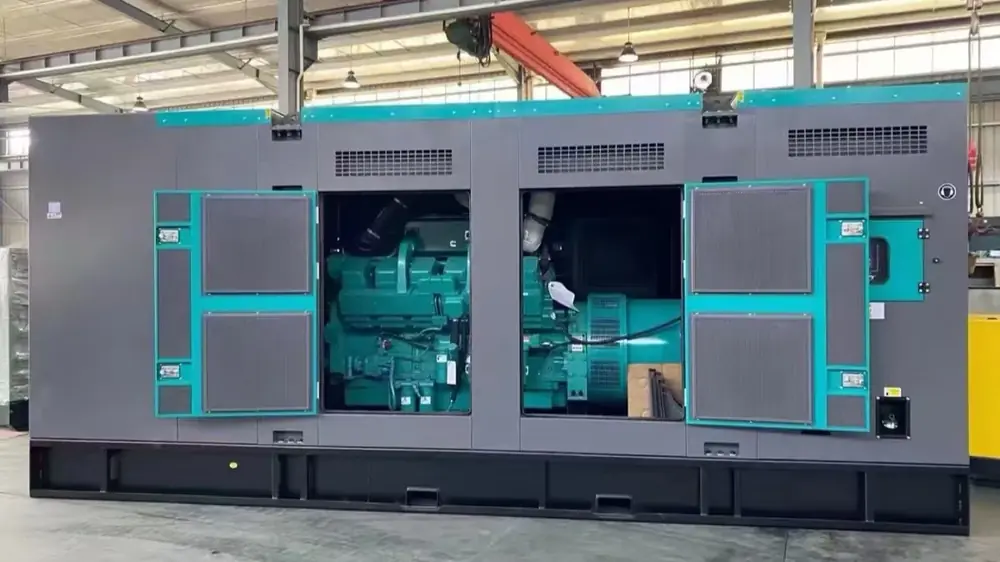
Rice-mill sizing depends on whether the machines start together or in sequence. Sequential starting allows a smaller generator than simultaneous starting, and that difference is usually larger than the difference between neighbouring kVA ratings.
The paddy line as a sequence of motor loads
Paddy moves through intake, cleaning and destoning, hulling and separation, several polishing passes, grading and finally bagging. Between those stages, bucket elevators lift the grain and extraction fans pull dust away.
The motors fall into two behavioural groups. Conveying, elevation and extraction run whenever the line runs, forming a steady baseline. Hulling, polishing and any main drive motor load and unload as grain moves through, forming the peaks.
Both groups belong in the load list. Leaving the extraction fans and elevators out because they look minor is a common way to produce a figure that the site then exceeds every shift.
Why the starting sequence decides the rating
Fans and blowers are motor loads, and they are subject to the same starting effect as pumps and compressors: a motor started direct-on-line draws several times its running current before the rotor reaches speed.
That means a mill that switches the extraction system, the huller and the polisher on together presents several hard starts at the same moment, while a mill that brings them on one at a time presents one hard start on top of a running baseline. The second arrangement frequently allows a smaller set for the same equipment, and the saving comes from the start sequence rather than from a discount.
The starting method interacts with this as well. A drive started through a soft starter or a variable frequency drive draws far less than a direct-on-line motor, so the same mill can sometimes be powered by a smaller set purely because of how its motors start.
Because the available multipliers differ by method, the ratio used for planning should come from the motor's own data. The motor starting and sizing guide sets out the methods and the planning rule that follows from them.
Continuous operation and the duty question
Agro-processing sites often run long hours, so prime-rated rather than standby-rated sets should be considered when daily runtime is high. A set that supports a production shift is a different purchase from one kept for occasional outages, and the loading limits and maintenance expectations differ accordingly.
It is worth saying plainly which of the two you are buying. A standby-only assumption attached to a machine that runs every working day leads to disputes about load and about service intervals that neither party needs.
Fuel planning also follows from duty rather than from the rating alone. The fuel consumption calculator covers the consumption method, and the spare parts guide covers what a long-shift machine consumes over time.
Building an estimate you can defend
Start from the equipment list rather than from a target rating. Write each motor with its rating and starting method, mark the largest drive, group the continuous loads separately from the intermittent ones, and then state how the line is started.
Add the non-motor load such as lighting and office demand, and state the duty and daily hours. That package can be answered with a specification, and it is also the package an engineer can check later if the site is expanded.
Where the mill shares a site with a water treatment plant, a cold room or a workshop, include those loads from the start. They are often continuous, and they change the recommendation more than a small difference in the headline figure.
Related reading: the rice mill generator page, the cassava processing guide and the feed mill guide.
Sending a mill request that can be sized
Give the paddy line equipment list with motor ratings, the starting method for the largest drive, whether the machines start together or in sequence, the extraction and elevation loads, the daily hours and the duty.
If the line is not yet built, say so. A planned line can be specified with more freedom than an expansion that has to match switchgear and cabling that already exist.
Request a rice mill quotation
Send the paddy line equipment list with motor ratings, the starting method for the largest drive and the intended starting sequence, together with the daily hours and the duty.
Get a written quotation
Three fields. We reply with the rating, the engine option and the delivery basis.
Rice mill power questions
Does the starting sequence change the generator size?
Yes, and often substantially. Machines started together present several hard starts at the same moment, while machines started in sequence present one heavy start on top of a running baseline, which can allow a smaller set for the same equipment.
Do blowers and elevators matter for sizing?
They do, because they run whenever the line runs and form a steady baseline the set must carry before any hulling or polishing motor starts. Leaving them out of the load list understates the real demand.
Should a rice mill generator be prime or standby rated?
Sites that run long daily hours should be quoted with a prime rating. A set supporting a production shift carries different loading limits and maintenance expectations from one kept for occasional outages.
What information should I send first?
The equipment list with motor ratings, the starting method for the largest drive, whether machines start together or in sequence, the continuous loads such as extraction and elevation, the daily hours and the intended duty.
Can the extraction fans be started after the main drives?
That depends on the process and the panel design. What matters is that the intended order is written down and given to the panel supplier, because the control logic has to match it.
What if the mill is not built yet?
A planned line can be specified with more freedom than an expansion that must match existing switchgear and cabling, so state that the line is new and give the intended equipment list.
