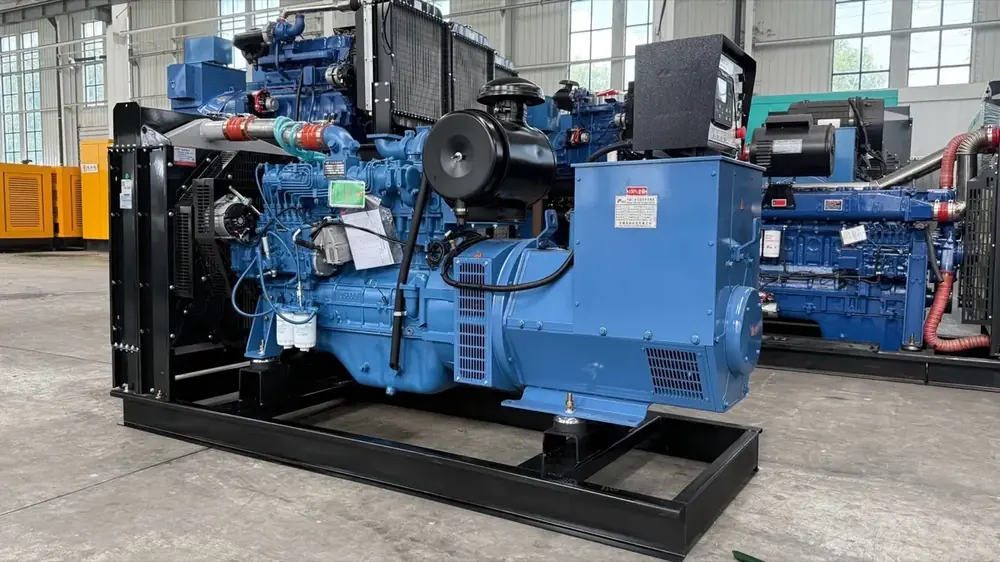
This page is for feed millers who want the quotation to match the plant rather than a single target kVA copied from another site.
The hammer mill is usually what sets the floor
A hammer mill behaves like a large flywheel. Until the rotor reaches speed, the motor draws far more than its nameplate current, and the set has to supply that inrush without dropping frequency enough to trip the mill's own protection.
Many Nigerian feed mills run the hammer mill, mixer, pellet press, conveyors and a bagging line from one panel. The mixer and conveyors are comparatively gentle; the press and the mill are not. If the panel starts them in the wrong order, the set sees two heavy inrushes at once and the plant ends up with a generator larger than the real process needs.
That is the practical reason a load schedule with a start sequence usually produces a better number than a nameplate sum.
Feed mill load list, in the order the plant runs
Give the ratings stage by stage. Direct-on-line, star-delta and soft-start arrangements change the inrush the set must absorb, so record the starter type where it is known.
| Mill stage | What to record |
|---|---|
| Intake and conveyors | Motor ratings and whether they run continuously. |
| Hammer mill or grinder | Rated motor power, starter type and start method. |
| Mixer | Drive rating, batch or continuous operation. |
| Pellet press and conditioner | Press drive, conditioner motor, steam or water addition. |
| Cooler and blower | Continuous fan load for the whole shift. |
| Bagging and sewing line | Small but continuous motors plus dust extraction. |
| Plant lighting and office | Small steady load that should still be listed. |
Mill loads that start together are analysed in sequential versus simultaneous starting for mill loads.
On a farm that runs its own mill, the mill load and the irrigation load often share one set; the combined case is set out in farm power planning.
Turning the plant description into a comparable quotation
Ask for the offered rating in both prime and standby terms, the engine and alternator identification, the enclosure type, the ATS and changeover scope, the fuel tank arrangement and the shipping term. Two quotations that agree on kVA but disagree on enclosure or ATS are not the same offer.
For a mill that runs a full production shift, say so. Continuous operation sits closer to a prime rating discussion than to a standby backup discussion, and it changes both the set and the maintenance interval you should plan for.
Related pages: rice mill generator guide, cassava processing generator guide, and the 250kVA diesel generator page.
Get a written quotation
Three fields. We reply with the rating, the engine option and the delivery basis.
Feed lines are often quoted around a 75kVA for a feed mill line when the hammer mill and conveyor motors are listed with their starting method. Adjacent food-processing loads are covered by the bakery and food-processing power guide.
Send this RFQ on WhatsAppFeed mill generator questions
Why is the hammer mill so important to generator sizing?
Because its motor has to accelerate a heavy rotor before it does useful work. That starting current can be several times the running current, and a set chosen only on running load may not hold the mill through every start.
Can one generator run the mill, mixer and bagging line together?
Yes, provided the heaviest drives are not started at the same instant. The set is chosen for the worst acceptable combination of running load plus the largest single inrush, and that combination is defined by the plant's startup sequence.
What should a feed mill quotation state about duty?
Whether the offered rating is prime or standby, how many hours a day the set is expected to run, and what maintenance interval follows from that use. A mill on a full shift should not be quoted as a standby-only backup set.
