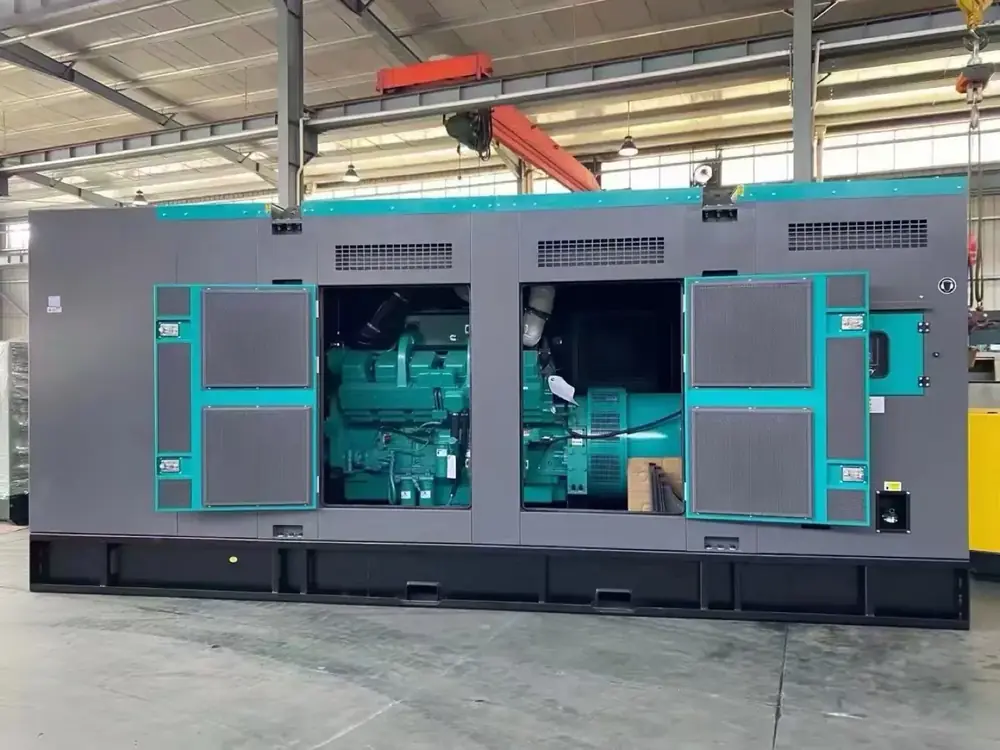
Capacity answers how much the set can carry. Duty answers how long it can carry it, how often it must be serviced and what it will drink. Both numbers come from the same site survey, and the hours figure is the one buyers most often leave out.
Why the hour meter matters more than the number on the plate
A generator has two independent specifications and buyers habitually read only one. The first is capacity, expressed in kVA or kW, which says how much load the set can carry at a moment in time. The second is duty, which says how long it can carry that load, how often it needs servicing, and what the manufacturer is prepared to stand behind when it is used that way.
Capacity is easy to compare because every quotation has a number. Duty is harder because it is a description rather than a figure, and because it is derived from how the site actually behaves rather than from what the site contains. Two buildings with identical connected load can need different sets if one runs the machine eight hours a day and the other runs it twice a month.
The consequence is practical. A set chosen purely on capacity, but used in a pattern the rating was never intended for, will run hotter, consume more per unit delivered, and reach its service intervals sooner than the buyer's mental model predicts. None of that shows up on the day of purchase. It shows up in the second year, in the form of a set that seems to need attention constantly.
Reading the hours first also changes what you ask a supplier. Instead of asking what a set costs, you ask what pattern of use the rating is intended for, what the service interval is in running hours, and what the fuel consumption is at the load the site will actually present, not at full load.
Counting your own hours before you talk to anyone
The number to establish is not an average over the year. It is a description of the pattern, and it has four parts: the hours in a typical run, the number of runs in a typical week, the longest single run the site will ever demand, and whether the set runs through the night.
The first two are easy for a site that already has a set, because the hour meter holds the answer and the difference between two readings across a known period gives the real figure rather than the remembered one. Sites replacing a failed set usually discover the old machine ran more than anyone thought, which is a useful correction to make before ordering rather than after.
A new site has to be estimated from the operating pattern rather than measured. What matters is the shape of the working day, the seasonality of the business, and whether the set is the primary source or the fallback. A workshop that opens every weekday and closes on Sunday has a different pattern from a cold store that must hold temperature continuously, and both differ from an office that only notices the grid when it fails.
The longest single run deserves its own note. A set that normally runs two hours but must occasionally run a full night is not a two-hour set. The oil and coolant temperatures reached in a long continuous run are the ones that matter for wear, and a rating chosen for short bursts is the wrong choice for a site with an occasional all-night requirement.
Standby, prime and continuous: what the three patterns demand
The industry divides use into a small number of duty patterns, and the divisions are about hours and continuity rather than about size. The labels matter because a set's rating is stated against one of them, and a rating quoted for one pattern is not interchangeable with another.
Standby describes a set that exists to cover an outage and spends most of its life stopped. What matters here is reliable starting after long idle periods, a battery and charging arrangement that survives the idleness, and a capacity sized for the starting surge of the load rather than its running average. The service cycle is driven as much by calendar time as by hours, because oil and coolant deteriorate whether or not the engine turns.
Prime describes a set that is the working source for a defined number of hours, day after day. Here the rating must be a prime rating, the service cycle is driven by the hour meter, and the fuel budget becomes a real operating cost rather than an occasional purchase. This is the pattern most Nigerian commercial sites actually run, and it is the pattern most often under-specified at purchase.
Continuous describes a set that carries load around the clock, following it up and down. It places the most demand on the machine and the most demand on whoever maintains it, because there is no natural window in which to service anything. A site with this pattern needs a set specified for it and a maintenance arrangement built around it, not a standby set pressed into a role it was not designed for.
The table sets the patterns against what each one changes in practice. It deliberately does not give hour thresholds, because the boundary between standby and prime is a property of the specific model's rating definition rather than a universal number, and a supplier who quotes one is more precise than the engineering allows.
| Use pattern | What the set is doing | What it changes about the purchase |
|---|---|---|
| Outage cover only | Stopped most of the time, started in an emergency | Starting reliability and battery care matter as much as capacity; service follows calendar time too |
| A defined working day | Runs the length of the shift, most working days | Needs a prime rating, an hour-meter service cycle and a fuel budget built on those hours |
| Around the clock | Carries load continuously, following it up and down | Needs a continuous-duty specification and a service plan with no natural downtime |
| Long seasonal runs, then idle | Heavy use in season, weeks standing between | Preservation between runs matters as much as the running itself |
| Mixed: light base, occasional long run | Short runs normally, the odd all-night requirement | Must be sized for the longest run, not the typical one |
How the hours decide the maintenance cycle
Once a set runs a defined number of hours, the maintenance calendar is set by the hour meter rather than by the wall calendar. That is the single most useful management consequence of counting hours first, because it converts maintenance from a vague intention into a scheduled cost.
The intervals themselves come from the engine's own maintenance information for the specific model, and they differ between engines, so this page does not print them as universal figures. What is universal is the structure: a short interval for consumables, a longer interval for inspection and adjustment, and an annual review for the items that deteriorate with time rather than with use.
A site running few hours needs both calendars running at once. The hour meter may not reach the service interval for a year, but the oil still ages, the coolant still loses its properties and the battery still self-discharges. A site running many hours reaches the interval quickly and may never reach the annual review on schedule. Neither can be managed with only one of the two clocks.
The practical step is to record the hour reading at every service and at every fuel delivery. Two numbers written down each time turn an assumption into a trend, and the trend is what tells you whether the next interval is approaching and whether consumption is drifting. The hour-based schedule itself is set out on the hour-based maintenance schedule page, and the consumables it depends on are covered under generator maintenance and service.
How the hours set the fuel bill, and why part load is the expensive part
Fuel spend is hours multiplied by consumption per hour, and consumption per hour is not a constant. It depends on the load the set is carrying at the time, and the relationship is not linear in the direction buyers expect.
A set carrying a high proportion of its rating converts fuel efficiently, because a larger share of each litre goes into useful work rather than into overcoming the engine's own friction and pumping losses. A set carrying a small proportion of its rating still has to keep those losses supplied, so the fuel burned per unit of electricity delivered rises. The litres per hour fall as load falls, but the litres per kWh rise.
That is why a badly oversized set can cost more to run than the load justifies: it spends its life in the band where each kWh is most expensive to produce. It is also why the temptation to build in a large margin for growth has a running cost attached, and why the sizing exercise is worth doing properly rather than rounding up twice.
This page will not give consumption figures for a specific model, because consumption is a property of the engine and the supplier publishes it as a curve rather than a single number. What can be given is the shape of the calculation and a rule of thumb for sanity-checking a supplier's claim, which is set out on the cost per kWh page and applied to the whole site's economics in the generator versus inverter comparison.
Buying the rating that matches the hours, not the other way round
The buying decision follows from the pattern, and it is worth stating as a sequence. Establish the hours pattern, decide which duty it corresponds to, and only then choose the rating that the load requires at that duty. Choosing the rating first and hoping the duty follows is how sites end up with a machine that is technically adequate and operationally wrong.
In practice the sequence changes the question asked of a supplier. Rather than asking for a price at a rating, the buyer asks for the rating that suits a described pattern, and asks for the standby and prime figures separately so that the two are not conflated. A set sold on its standby figure and used as a prime machine is being used outside the terms it was sold under, which is a commercial problem before it is a technical one.
The sequence also changes the specification. A standby set benefits from battery maintenance and a starting check routine. A prime set benefits from an hour-meter-driven service plan and a fuel arrangement that does not interrupt the working day. A continuous set benefits from an installed spare or a defined plan for what happens when the machine must stop, because stopping is the one thing the site cannot tolerate.
The power-based exercise is still necessary; it is simply not sufficient. It is set out in full in the generator sizing guide, and the two should be done together, with the hour count deciding the duty and the load calculation deciding the capacity within it.
Five habits that quietly shorten a set's life
Most of the damage done to generators in service is not caused by overload. It is caused by the pattern of use drifting away from what the set was specified for, without anyone noticing that it has.
Running short bursts repeatedly is the first. A set that starts, carries a heavy load for twenty minutes and stops never reaches stable operating temperature, and the condensation and incomplete combustion that result do more harm than the hours suggest. Where the pattern is genuinely bursty, the answer is a different set or a different operating routine, not a longer warranty.
Leaving a standby set idle for months is the second. Batteries discharge, fuel ages, seals dry and the first start after a long idle is the hardest the machine will ever make. A regular no-load run and a battery check cost little and prevent the failure that happens at the worst moment.
Running at a small fraction of rating is the third, for the reason set out above: it is the least efficient way to produce a kWh, and it can also lead to low-load operation the engine was not designed for. The fix is correct sizing, not a workaround.
Skipping the hour-meter record is the fourth, and it is the cheapest to fix. A set without an hour log has no service history, which matters at resale and matters more when a failure has to be diagnosed. Ignoring the annual items on a low-hour set is the fifth: a machine that has run very few hours still has coolant, hoses and a battery that age on the calendar.
None of these are exotic. They are the ordinary ways a correctly chosen set becomes an expensive one, and all of them are visible in the hours record if anyone is keeping it.
Send the hours pattern and we will size the duty with you
Tell us the hours in a typical run, the runs per week, the longest single run and the load the site presents. The reply will state the duty class that pattern implies, the standby and prime figures separately, and the service interval in running hours for the model proposed.
Get a written quotation
Three fields. We reply with the rating, the engine option and the delivery basis.
Questions about duty and running hours
Should I size a generator by kVA or by running hours?
Both, in that order of derivation: the hours decide the duty class, and the load decides the capacity within that class. Sizing on kVA alone gets the capacity right and the duty wrong, which shows up later as a set that needs attention more often than expected.
How many hours a day should a generator run?
There is no universal number, and any page that prints one is guessing. What matters is the pattern: hours per run, runs per week, the longest single run, and whether it runs overnight. That pattern selects the duty class, and the duty class selects the rating.
What is the difference between standby and prime rating?
A standby rating describes a set used to cover outages, and a prime rating describes a set that is the working source for defined hours. They are different figures for the same machine, and a set sold on its standby figure but used as a prime machine is being used outside the terms it was sold under.
Does a low-hour set still need servicing?
Yes. Oil, coolant, hoses and batteries deteriorate with calendar time as well as with running hours, so a low-hour set needs the annual items even when the hour meter has not reached the interval. Both clocks have to be watched.
Why does fuel consumption per kWh rise when the load is small?
Because the engine's own friction and pumping losses still have to be supplied. At high load a larger share of each litre becomes useful work; at low load that share falls, so the litres needed for each kWh delivered rise even though the litres per hour fall.
