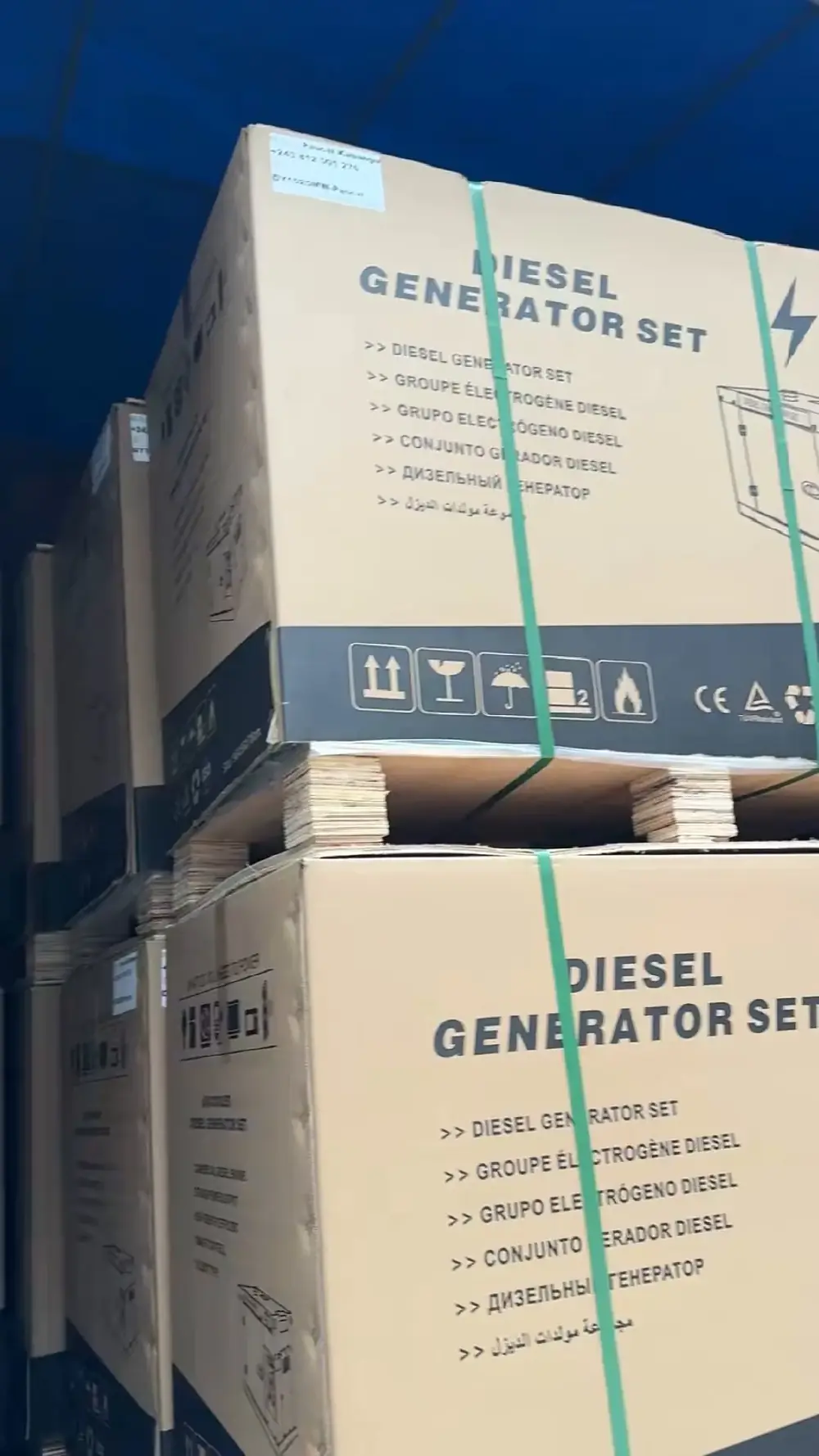
This is evidence of a packing and loading step, and it is worth exactly that. Use it to see how the set was protected for the journey, then use the load table and the arrival checks below to judge whether a 10kW set is right for your own site.
What the loading video actually shows
The clip runs for fourteen seconds and is shot in portrait, close to the truck rather than from a distance. It opens on the loaded bed and moves along it. There is no commentary, no caption and no title card, which is why this page describes what is visible rather than what a caption might have claimed.
The set is packed in a printed carton on a timber pallet. The carton face reads DIESEL GENERATOR SET in large type, and beneath it the same product name appears in French, Spanish, Russian and Arabic alongside the English line. That is a packaging decision rather than a claim about any particular country: a carton that has to work across several export markets carries all of the languages at once.
The side panel carries the handling pictograms a shipper looks for first: this way up, keep dry, fragile, a stacking limit, and a warning to keep the package away from fire. The same panel carries a CE mark among the printed symbols, a UKCA mark, and a mark identifying the carton material as recyclable. Below the pictograms there is a line drawing of the set, which lets someone identify the contents without opening the box.
The pallet is timber and carries the ISPM-15 marking on its blocks, which is the international standard for heat-treated or fumigated wood packaging and is the detail that most often stops a consignment at a border when it is missing. Green polypropylene strapping runs around the carton and the pallet together. The whole pallet is then loaded through the side opening of a red truck under a black tarpaulin cover. There is a handwritten shipping label on one carton corner, and it is out of focus to the point of being unreadable: no destination, port or consignee can be taken from it, and none is stated on this page.
Why 10kW is the working size for small businesses in the DRC
In a market where the grid is unreliable and the cost of a larger set is out of reach for a small operator, 10kW sits at a useful point. It is large enough to carry a shop's lighting, refrigeration, fans and a few small motors, and small enough to be fuelled and serviced on a modest budget. Above it, the fuel bill and the physical size start to change what kind of business can afford to run the machine at all.
It is also the size that matches how small enterprises actually use power. A boutique, a barber's chair, a tailoring workshop, a pharmacy fridge, a small clinic's vaccine cold chain, a workshop with hand tools and a grinder: none of these demand a large block load, but most of them have one motor that decides everything. That single motor is the reason a 10kW set is bought rather than a 6kW one, and the reason a 15kW set is sometimes bought rather than a 10kW one.
There is a second reason the size recurs. A 10kW set is portable enough to be moved, enclosed in a canopy that a small compound can accommodate, and connected by an electrician without a substation. Where a site has no dedicated plant room, that practicality matters as much as the rating does.
None of that makes 10kW a universal answer. It is a common size because it fits a common pattern of use, not because it is the correct rating for every small site. The next section is the test that decides it.
What a 10kW set actually carries
The mistake buyers make is to add up the wattage of everything on the premises and compare it with the rating. That number is almost always larger than the set and almost never the number that matters, because the loads that decide the rating are the ones that start, not the ones that run.
A motor at standstill draws a multiple of its running current for the moment it takes to accelerate, and that multiple depends on the motor design and on how it is started. A set sized on running load alone will start everything on the list one by one and then trip when two things ask at once. Sizing on the worst combination is what the table below is for.
Read the third column as a limit rather than a guarantee. Whether a particular pump starts on a particular set depends on the pump, the starting method, the alternator's ability to absorb a short overload, and how much else is running at that moment. What the table gives is the shape of the decision.
The table answers the question buyers actually ask: what will this set start, and what will it not?
| Load | How it starts | What it means for a 10kW set |
|---|---|---|
| Lighting, phone chargers, router, point-of-sale terminal | No starting surge | Runs comfortably alongside everything else |
| Fridge, chest freezer, display chiller | Compressor start draws a multiple of running current | Fine on its own, but do not start it at the same moment as a pump |
| One or two split air conditioners | Compressor start, then a steady running load | One at a time, with the starts staggered, keeps it inside rating |
| Borehole or booster pump | Direct-on-line motor start, the heaviest single event on a small site | This is usually the load that decides whether 10kW is enough |
| Angle grinder, drill, small compressor | Motor start, short and sharp | Fine individually, but not while a pump is also starting |
| Welding set | Very high intermittent demand with a poor power factor | Beyond a 10kW set in most cases and needs a larger frame |
| Clippers, sewing machines, mixers, small grinders | Many small motor starts, often together | This is where a 10kW set earns its keep in a workshop |
Single phase or three phase: how to decide before you order
The question is not which is better but what the site's equipment expects. A three-phase set will not feed a single-phase installation without a transformer or a reconnection, and a single-phase set cannot run three-phase motors at all. Getting this wrong is one of the few mistakes that cannot be fixed with a setting.
Single phase is the usual choice where the load is domestic or small commercial: lighting, sockets, fridges, air conditioners, a small pump. Three phase becomes necessary when the site has three-phase motors, a lift, a larger pump, or a distribution board built around three-phase supply. A workshop with a three-phase welder or a three-phase compressor has already answered the question.
There is a middle case worth knowing about. Some premises have a three-phase supply but most of their load is single phase, and a three-phase set is chosen so that the load can be spread across phases and so that a future three-phase machine can be added. That is a design decision, and it should be made by whoever is going to connect the set, not by whoever is going to sell it.
The comparison between the two arrangements, and what each one means for a small set, is set out on the single phase versus three phase page. A 10kW set is available in both configurations, and the choice should be made from the site's distribution board rather than from the price list.
Local fuel quality and what it does to your running cost
Fuel is where a small set's real operating cost is decided, and it is also where the least visible damage happens. Diesel that has been stored in a warm tank for a long time, or decanted through a dirty container, carries water and particulate into a fuel system that was built for clean fuel. The first symptom is usually a filter that blocks early, then hard starting, then a pump or an injector that has to be replaced.
The practical defences are unglamorous and cheap. Store fuel in a tank that water can settle to the bottom of, and drain that water rather than drawing it through. Fit a water separator before the fine filter rather than relying on the filter alone. Keep the fuel path clean when decanting, and do not use a container that has held something else. Where fuel sits for long periods, have it polished or at least circulated and filtered.
On the cost side, the arithmetic is a formula rather than a number, and it is worth doing properly because the answer changes with load. Fuel burned per hour rises with load but not in proportion: a set running at a light load burns more per unit of output than one running at a comfortable load. So the cost per unit of electricity depends on how the site is operated, not only on the price of fuel.
The full method, including how to measure consumption rather than guess it, is on the fuel consumption calculator page, and the specific figures for this frame size are on the 10kW fuel consumption page. Consumption, not price, is the part a buyer can control by choosing the right rating and running it properly.
Heat, humidity and derating
A set is rated at a standard reference condition, and a site in a hot climate does not match it. The engine loses a little output as intake air temperature rises, and the alternator loses a little as its windings run hotter. Humidity adds to the problem for the electrical side, and it also accelerates corrosion on terminals and connections that are not sealed.
Where the site is at altitude, there is a second effect: the air is thinner, so each intake stroke draws less oxygen and the engine can burn less fuel. A site that is both hot and high loses more than one that is only hot. This is not a reason to avoid a set of this size; it is a reason to ask what the rating becomes at the site's own conditions rather than at the reference condition.
In practice, the site can do a great deal about this. An enclosure needs clear air paths on both sides and enough clearance from walls that hot air is not drawn straight back in. The set should not be sited in a corner where heat accumulates, and it should not be boxed in with stored goods. Where the canopy was chosen for quiet, the restricted airflow that comes with it makes this more important rather than less.
The honest way to handle derating in an enquiry is to state the site's ambient temperature and altitude and ask for the rating at those conditions. A supplier who answers only with the reference rating has not answered the question the site asked.
What the export packing protects, and what to inspect on arrival
The packing in the video is doing four separate jobs, and it is worth naming them because each one fails in a different way. The carton keeps dust and water off the machine. The strapping holds the carton and pallet together so that the load does not shift in transit. The pallet lets a forklift move the whole package without touching the machine and keeps it off a wet floor. The timber itself is treated and marked, which is what allows the package to cross a border at all.
The tarpaulin over the truck bed is the fourth protection and the one most easily lost in the handover between road and sea. A carton that leaves a factory dry can arrive damp if it sits in a container with a leaking hatch or in a yard through a storm. That is why the inspection on arrival should start with the outside of the package, before anyone opens it.
The table answers one question: on the day the vehicle arrives, what has to be checked, and what is each check looking for?
| Check | What to look for | Why it matters |
|---|---|---|
| Carton exterior | Crushing, punctures, water staining, a torn or re-taped panel | Damage to the carton is the first evidence of damage to the contents |
| Strapping | Bands present, tight, not cut or heat-damaged | Loose strapping means the load has moved, and movement is what cracks canopies and bends frames |
| Pallet and marking | Blocks intact, ISPM-15 mark legible, no fresh untreated wood | Untreated or unmarked wood packaging can be refused or fumigated at the border |
| Moisture | Damp carton base, condensation inside, rust bloom on bright metal | Water inside a sealed carton does not evaporate, it corrodes |
| Machine and accessories | Canopy panels, control panel, battery, fuel lines, tool kit and manual | Missing accessories are far harder to resolve after the container is empty |
| Nameplate and paperwork | Rating, frequency, phase and serial number matching the documents | A mismatch found on arrival can be corrected; one found after installation usually cannot |
Commissioning checklist for the first day on site
The first start is the moment when a transport problem becomes a warranty conversation, so it is worth doing slowly and in order rather than filling the tank and pressing the button. Everything below is a check that costs nothing and can prevent an argument later.
Before fuel goes in, confirm the set is on a level, hard surface that will not settle, with the air paths clear and the exhaust pointed away from occupied space. Check the earth connection and the cable size against the load, and confirm that the changeover or ATS is installed and tested with the set isolated. Confirm the battery is charged and correctly connected, and that the coolant and oil are at the marks rather than merely present.
Then start it without load and let it settle. Watch for abnormal noise, smoke or vibration, confirm the frequency and voltage at the panel, and let it run long enough to reach temperature before load is applied. Apply load in steps, starting with the non-motor loads and adding the largest motor last, and watch the frequency dip as each one starts. A dip that recovers quickly is normal; a dip that does not recover is the site telling you the load is beyond the set.
Record the readings at each step: voltage, frequency, oil pressure, coolant temperature and the hour meter. That record is the baseline for every service afterwards, and it is the evidence that the set was working when it was handed over. The interval structure for what comes next is on the maintenance schedule page, and the consumables worth holding on site are listed under generator spare parts.
Documents and freight: what to confirm with your forwarder
This page does not state a document set for the DRC, because the requirement depends on the destination, the importer's registration and the routing, and it changes. What can be said usefully is which documents a shipment of this kind normally involves and which questions a buyer should put to the forwarder before the set leaves.
The commercial documents are the invoice and the packing list, which have to agree with each other and with what is physically in the truck. The transport document is the bill of lading or its equivalent for the mode used. A certificate of origin is commonly required to support the duty position. Depending on the destination, there may be additional conformity or pre-shipment requirements, and these are exactly the items that should never be assumed from a website.
The questions worth asking are straightforward. Which documents does the destination require, and in what form: original, copy or electronic. Who is the consignee of record, and does the invoice match that entity exactly. What is the HS classification being used, and does the importer agree with it. Who clears the goods, and has that party seen the packing list. What, if anything, has to be arranged before the set is loaded rather than after it arrives.
Packing detail for a larger consignment is described on the container loading page, and the broader sequence from order to site is set out in the generator sizing guide. Confirm the commercial and customs position with your own forwarder and broker: that is the party who will be accountable if a document is wrong.
Ask whether 10kW suits your load, not just the price
Send the list of loads you need to run and the largest motor you need to start, together with the site's ambient conditions and phase arrangement. The reply will say whether a 10kW set covers that duty, what happens at the largest start, and which documents apply to your destination.
Get a written quotation
Three fields. We reply with the rating, the engine option and the delivery basis.
Questions about this shipment and this size
Does this page show the price or the quantity shipped?
No. The page states neither, and neither can be read from the video. Quantity cannot be inferred from the number of cartons visible either, because a carton is not necessarily one machine and the frame does not show the full load.
Which port or city in the DRC was this sent to?
It is not stated. The handwritten label on the carton is out of focus in the footage and cannot be read, so no destination is claimed here. The customer is in the DRC; anything more specific would be invented.
Is a 10kW set enough for a shop with a fridge and one air conditioner?
Usually yes, provided the compressor and the air conditioner do not start at the same moment as a pump. The deciding load is normally the largest motor, not the total wattage, so the answer depends on what that motor is and how it starts.
Can the set run on local diesel without problems?
It can, but fuel quality decides how long the fuel system lasts. Water and particulate are the common problems, and a water separator, a settling tank and clean decanting practice do more for reliability than any additive. Expect filters to need attention sooner than a temperate-climate service schedule would suggest.
What should I check before signing for the delivery?
The outside of the package first: carton damage, strapping, pallet condition and any sign of moisture. Then the machine and accessories against the packing list, and the nameplate against the documents. Damage found and recorded before signing is a transport claim; damage found after is much harder to attribute.
Does the CE mark on the carton mean the set is certified for my country?
It is a mark printed on the packaging, and this page does not treat it as evidence of conformity to any particular directive or as a substitute for the destination's own requirements. Confirm what your market requires with your importer or broker rather than relying on a carton marking.
