WhatsApp: +86 157 0593 2345Email: miu@taiyudapu.comCall the factory: +86 157 0593 2345
Generator product range

Custom Generator Solutions for Nigeria

Match the machine to the job: custom diesel gensets, multi-fuel gasoline options, diesel welding generators, ATS, enclosure, testing and export packing by written quotation.

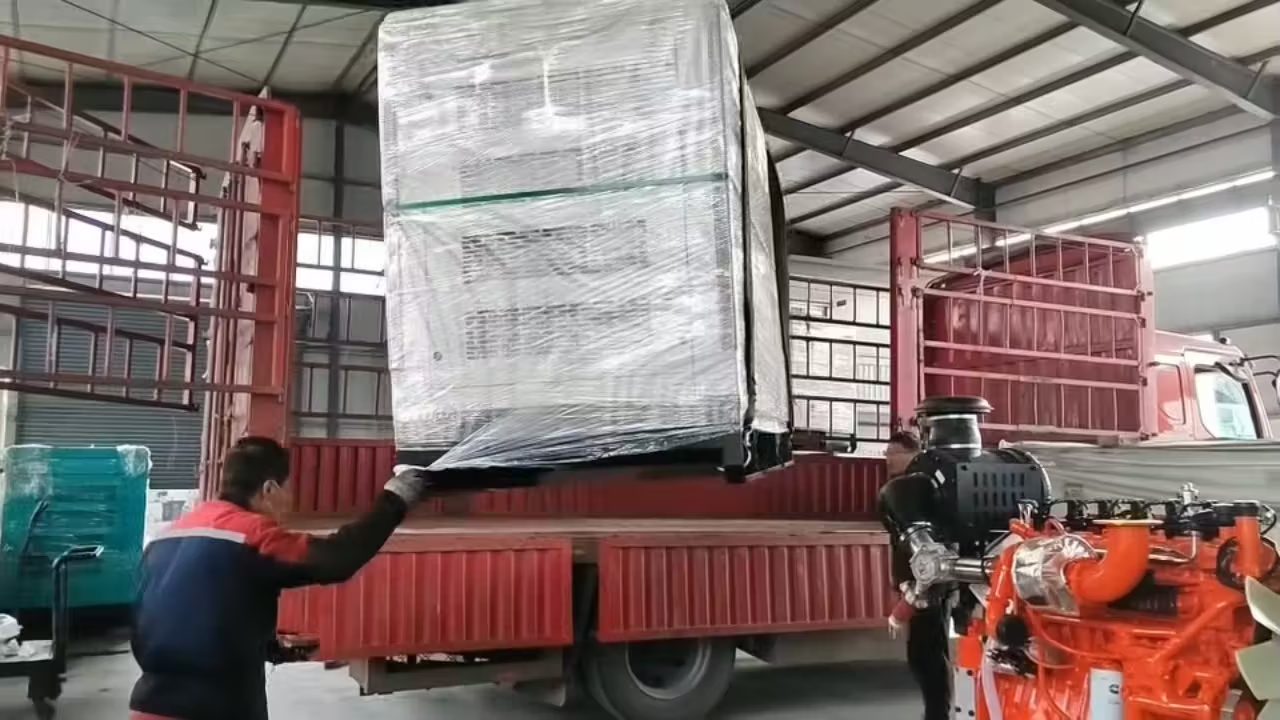
Generator set wrapped and moved for factory dispatch
Original factory video frame showing a wrapped generator set being moved for dispatch preparation.
What this page proves

The media below comes from the website's original factory and product videos. It demonstrates available production and test activity; it is not presented as proof of an unnamed customer's order.

Buyer rule: before payment, request evidence tied to your own model, signed specification and order reference.

Factory-demonstrated configuration 01

Custom multi-fuel gasoline generator

This option is for buyers who need a compact petrol, gas-option or multi-fuel configuration for dealer orders, shops, farms or light backup. The final fuel system and rated output must be confirmed in the quotation.

  • State the required fuel combination and local fuel availability.
  • Confirm rated kW or kVA, 50Hz output, phase, sockets and start method.
  • Request a model video, nameplate and agreed functional test before shipment.
View full multi-fuel video page
Factory-demonstrated configuration 02

Diesel welding and auxiliary power generator

A diesel welding generator combines welding output with auxiliary AC power for repair teams, workshops and field service. Selection depends on welding current, duty cycle, electrode size and the auxiliary tools that may run at the same time.

  • Send the welding current range and common electrode diameter.
  • List auxiliary AC loads and whether welding and AC output run together.
  • Confirm mobility, socket, cable, protection and export packing requirements.
View full welding generator video page
Factory-demonstrated configuration 03

Customer-customized open industrial diesel generator

This original factory video shows a real open industrial generator assembly with its engine, intake, exhaust, cooling system, alternator, skid and control cabinet visible. The exact rating and component models must be tied to the written quotation.

  • Send the load schedule and largest starting motor or compressor.
  • Define standby or prime duty, daily runtime, voltage, frequency and phase.
  • State silent, open or container type, ATS, spare parts and test requirements.
Watch full video and build RFQ

Custom generator decisions to confirm

Customisation decisions, the information to send, and what the quotation should state
DecisionInformation to sendWhat the quotation should state
Power and dutyLoad list, largest motor, daily hoursPrime and standby rating, derating assumptions
Electrical outputVoltage, frequency, phase, socketsAlternator and output arrangement
Engine or fuelBrand preference or fuel combinationExact engine and approved fuel scope
AutomationATS, manual start or synchronizing needController, breaker, ATS or panel boundary
EnvironmentIndoor or outdoor, noise, heat and dustOpen, silent or container enclosure and cooling
Delivery proofTest points, documents and IncotermInspection, packing and FOB or CIF scope

Build your custom generator quotation request

Complete the known requirements. The form prepares a structured WhatsApp message without sending data to another system.

Your entries are used only to build the WhatsApp message.

Verify the supplier evidence

Custom generator FAQ

What generator features can be customized?

Depending on the model, a quotation can define rating, voltage, frequency, phase, engine, alternator, controller, enclosure, ATS, fuel option, sockets, spare parts, testing, packing and delivery scope.

What information is needed before a quotation?

Send the load or target rating, largest motor, application, runtime, voltage and frequency, preferred fuel or engine, enclosure, ATS, quantity, project city and delivery term.

Do these videos prove a specific Nigeria delivery?

No. They show factory-demonstrated products and export processes. Request order-specific photos, nameplates, test evidence and documents tied to your signed quotation.

Where the boundary of custom work actually sits

A generating set is a system assembled from an engine, an alternator, a cooling package, a control system and an enclosure. Custom work is possible at the level of the package and almost never at the level of the platform: an engine and alternator pairing is fixed by the manufacturer's ratings and cannot be redefined for one order, while the enclosure, the tank, the control logic, the paint, the socket arrangement and the documentation can be built to a specification.

Knowing which side of that line a requirement falls on decides whether it is a configuration or a project. A buyer who wants a different control sequence is asking for engineering; a buyer who wants a higher socket or a different access door is asking for configuration. Both are legitimate, and they cost different amounts and take different times.

The most expensive custom requests are the ones that arrive after the drawing is approved. A change to the enclosure at that point means new drawings, new material and a new slot on the line, which is why the approval step is the real commitment point rather than the order date.

Every custom item costs something specific

A useful way to read any custom request is to ask what it consumes: engineering time, material, tooling, testing, or certification. A non-standard paint colour consumes material and a line change. A modified control sequence consumes engineering and a re-test. A special enclosure consumes engineering, drawings and a longer build. A set that must be documented to a particular standard consumes test and paperwork.

That framing lets a buyer prioritise. If three changes are wanted and the budget allows one, the one that consumes least for the greatest operational benefit is the one to keep. The others can be deferred to a later unit without compromising the first.

The table sets out the common custom categories against what each really asks for. It is a way to structure the conversation rather than a list of what is available, because availability depends on the platform being configured.

Custom generator categories, what each consumes, and what the quotation should state about it
Custom categoryWhat it consumesWhat the quotation should state
Enclosure and accessEngineering, sheet metal, drawingsDimensioned drawing, door positions, lifting points
Control sequence and logicEngineering, re-test, documentationThe sequence in writing, and the test that proves it
Tank and fuel arrangementFabrication, and the set's footprintCapacity basis, filling point, drain and venting
Paint, marking and brandingMaterial and a line changeColour reference and where marking appears
Socket and distribution arrangementPanel build, protection coordinationOutlets, ratings and protection per outlet
Documentation and languageTranslation, formatting, reviewWhich documents, in which language

Drawings, approval and change control

A custom order runs on drawings. The general arrangement shows the footprint, the door positions, the lifting points and the connections; the electrical drawing shows the panel, the protection and the interface. Approval means the buyer has checked those drawings against what the site can accept, not that the buyer has glanced at them.

Change control is what keeps the process honest. Any change after approval should be recorded with its effect on the build and on the delivery date, in writing, and accepted by both sides before work continues. Without that discipline, a series of small verbal adjustments accumulates into a machine that matches nobody's expectation and a schedule that nobody can explain.

The site dimensions are the buyer's contribution to this process, and they are the ones most often skipped. A doorway measured approximately, a plinth built before the drawing was issued, or a cable route decided by an electrician who never saw the arrangement will each produce a change that could have been avoided.

Why custom work needs more testing, not less

A standard set has been built many times and its behaviour is known. A custom set is the first of its kind in the configuration ordered, so the acceptance test is the only evidence that the combination works. That makes the test more important rather than a formality, and it should cover the custom items explicitly rather than only the standard ones.

The control sequence is the item most in need of this. A sequence written in prose and implemented by an engineer can differ in the details that matter, and the only way to establish agreement is to watch it run through each mode. The same applies to protection settings that were changed to suit a custom distribution arrangement.

The test record then becomes the reference for the life of the machine, because there is no standard sheet to fall back on. The items worth insisting on are described in factory acceptance test.

The errors that recur in custom projects

The first is scope creep disguised as clarification: a series of small requests, each reasonable, that together exceed the engineering the order was priced for. The second is a requirement expressed as a preference rather than a specification, which leaves the supplier to interpret and the buyer to be disappointed.

The third is a custom feature that solves a problem the site does not have, usually introduced because it was seen on another installation. The fourth is the omission that matters most: nobody checks that the custom enclosure still allows the cooling air path and the service access, which are the two things an enclosure most easily destroys.

The corrective is a written requirement list at the start, each line stating what the site needs and why, plus an explicit statement of what is not included. A custom project with a clear exclusion list is easier to deliver than one with an ambitious inclusion list, because the boundary is where the arguments happen.