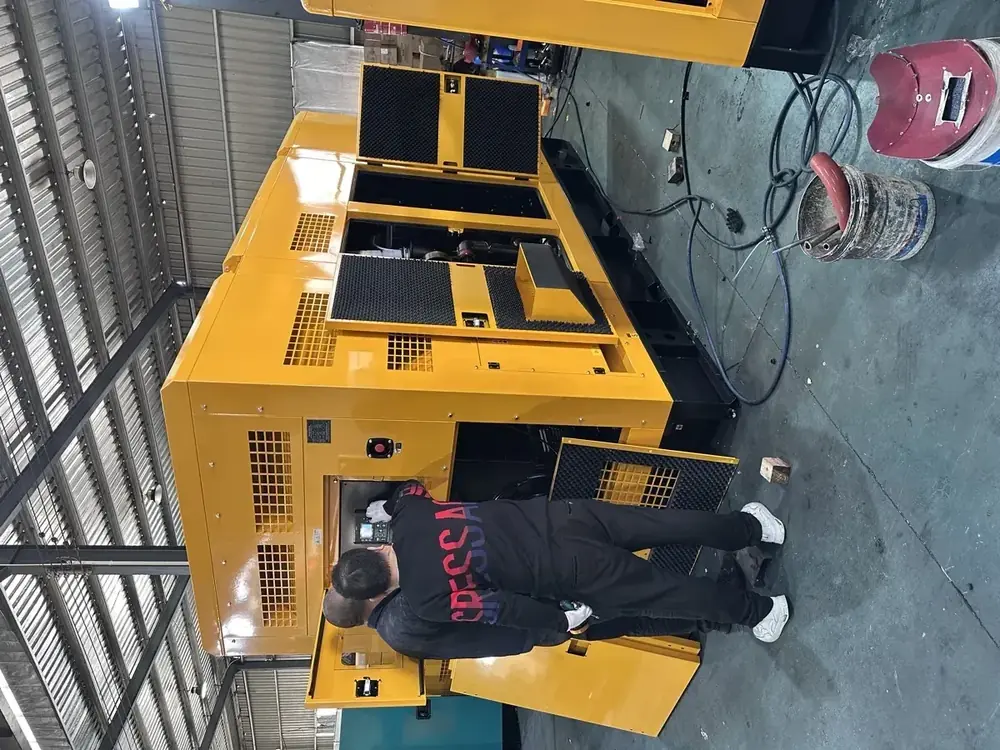
Real factory strength is not one large building photograph. Buyers should look for the ability to define the specification, integrate the engine and alternator package, build a serviceable enclosure, inspect the electrical controls, provide agreed test evidence and pack the finished unit for shipment.
What is visibly supported by this production photo?
The photograph provides useful context because it shows equipment and production activity together. The following observations stay within what is visible.
Large silent enclosure
The generator has a full metal enclosure with multiple access doors, ventilation openings and a skid base. This indicates an enclosed generator configuration rather than an open frame.
Service access
Several enclosure doors are open, allowing access to internal components. Service access should be reviewed together with the actual installation plan.
Sound-absorbing treatment
Dark sound-absorbing material is visible on the inside of opened doors. A photograph does not prove a final noise rating, so any dB target should be written and tested separately.
Controller-area inspection
Workers are positioned at the control-panel area during production. The exact test stage is not claimed, but the scene supports active inspection or assembly work.
The photo does not independently prove generator kVA, exact engine or alternator model, load-test result, noise level, certification, daily production capacity or ownership by an unnamed customer. Those claims require separate documents and order-specific evidence.
Five factory capabilities serious generator buyers should verify
| Capability | What the buyer should request | Why it affects the order |
|---|---|---|
| Specification engineering | Matched kVA, duty, voltage, phase, frequency and starting-load assumptions | Prevents an attractive enclosure from hiding an incorrectly sized generator |
| Component integration | Exact engine, alternator, controller, breaker and radiator models | Determines performance, service planning and quotation value |
| Enclosure construction | Silent or open type, access doors, base tank, lifting and ventilation scope | Affects noise, maintenance, installation and shipping dimensions |
| Inspection and testing | Agreed FAT points, protection checks and available results tied to the unit | Connects the written order to the finished generator |
| Export preparation | Accessories list, packing method, dimensions, weight and loading evidence | Reduces shipment surprises and missing-item disputes |
What this workshop can actually build
These are photographs of our own production floor — canopy lines, open-type assembly and dispatch staging. No customer names or order details are involved, so nothing here depends on anyone's permission.
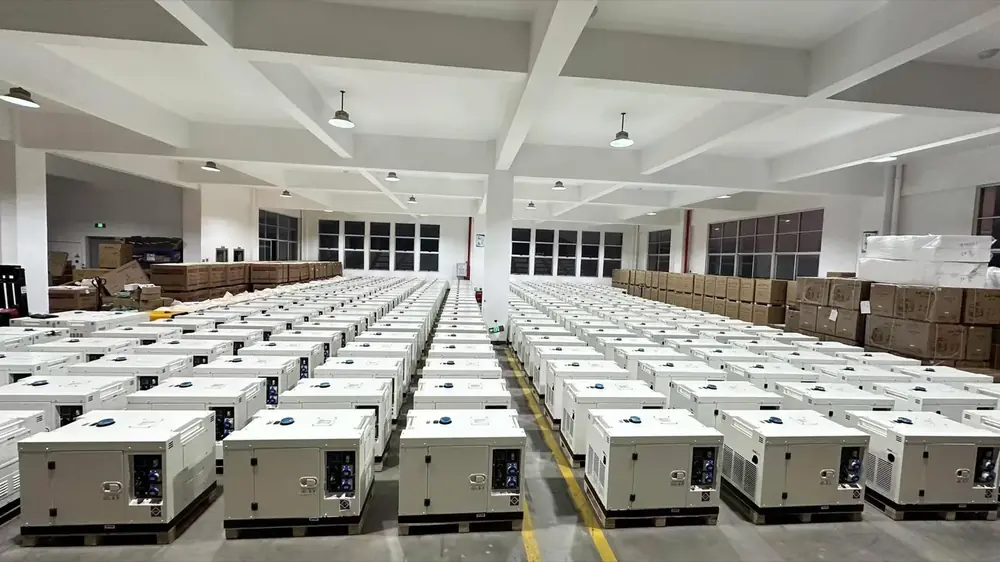
Silent canopy batch production
Rows of canopy-set enclosures on pallets inside the production hall, staged before dispatch. This is the line that supplies the 10–500 kVA canopy sets quoted for Nigerian sites.
/assets/factory-photo-01.jpg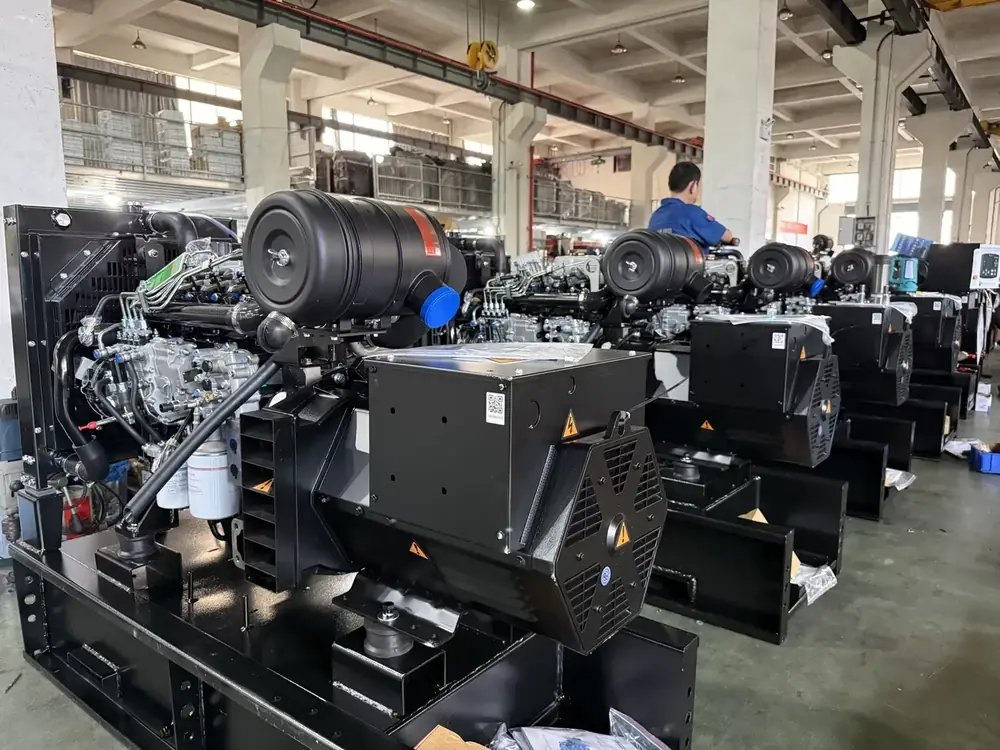
Open-type assembly line
Open sets on skid bases with radiators, air filters and QR-labelled control boxes in sequence along the line. Open type is the configuration most industrial and yard buyers in Nigeria specify.
/assets/factory-photo-03.jpg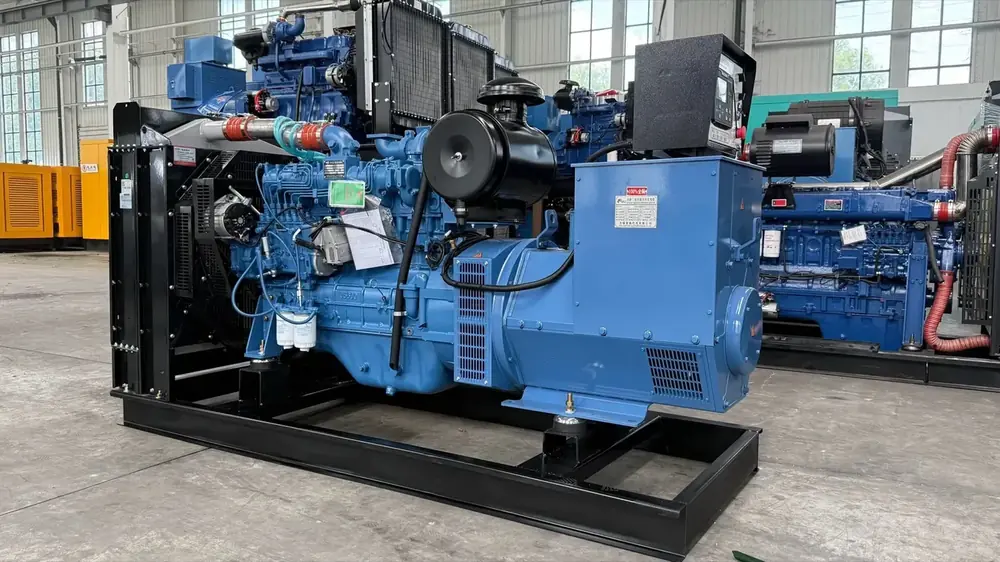
Large open-type industrial sets
A large open-type unit with its radiator, air cleaner and side-mounted control panel assembled on the skid. This is the frame class used for high-kVA industrial and marine-support loads.
/assets/factory-photo-05.jpg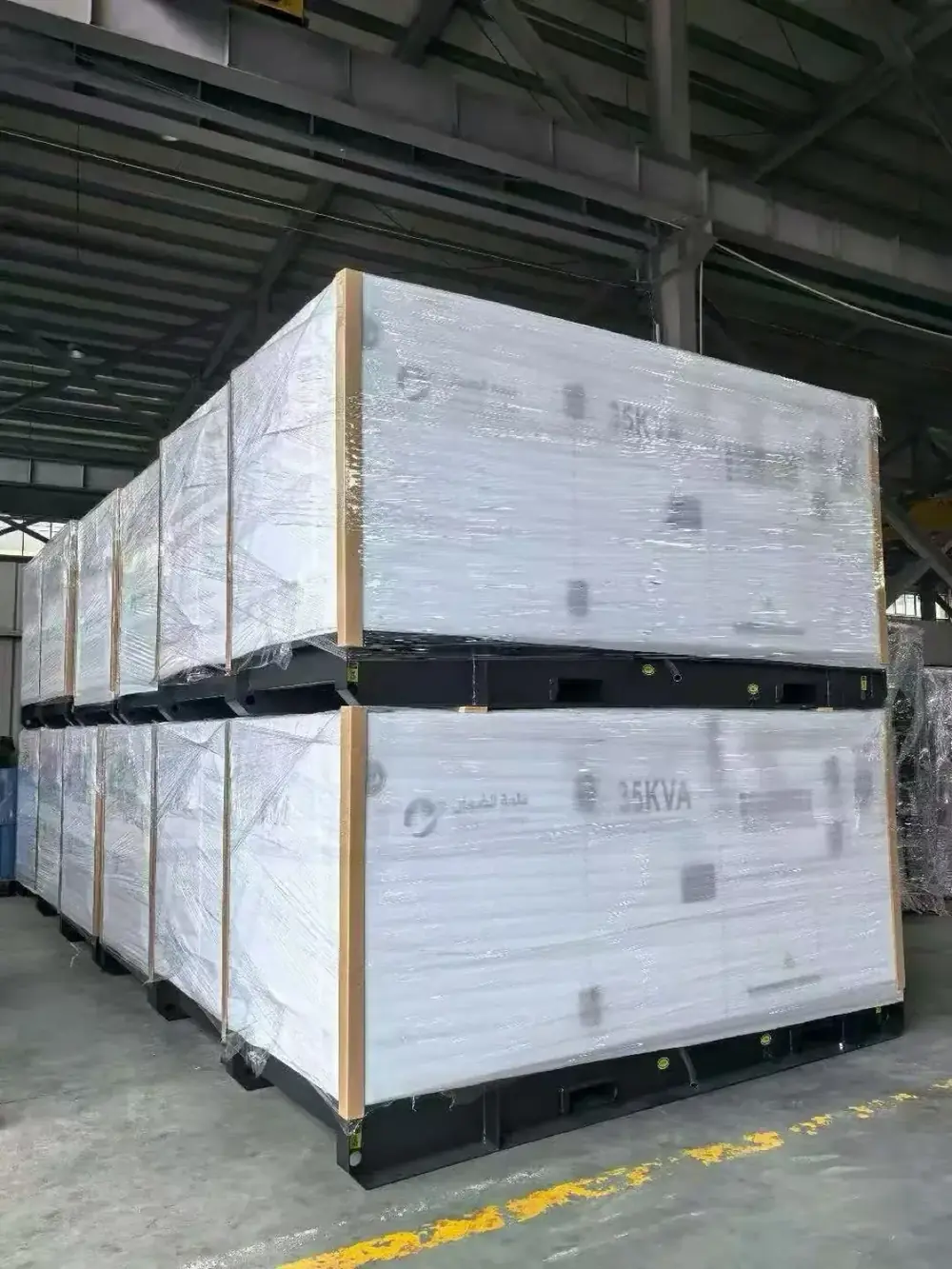
Packing and dispatch staging
Completed sets stretch-wrapped on their skids and staged for packing, with the canopy sets and open sets prepared differently for sea freight.
/assets/packed-gensets.jpg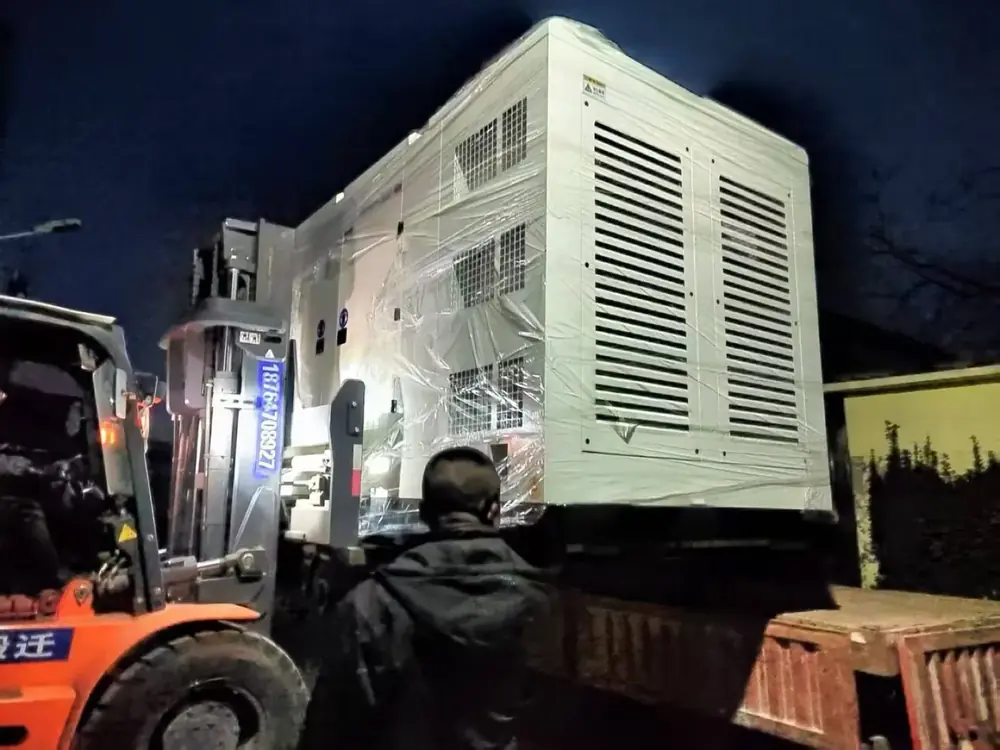
Loading onto transport
A wrapped canopy set being lifted onto the vehicle that takes it to the port. Loading is done with plant equipment, not by hand — this matters once a set passes roughly 1 tonne.
/assets/factory-photo-02.jpg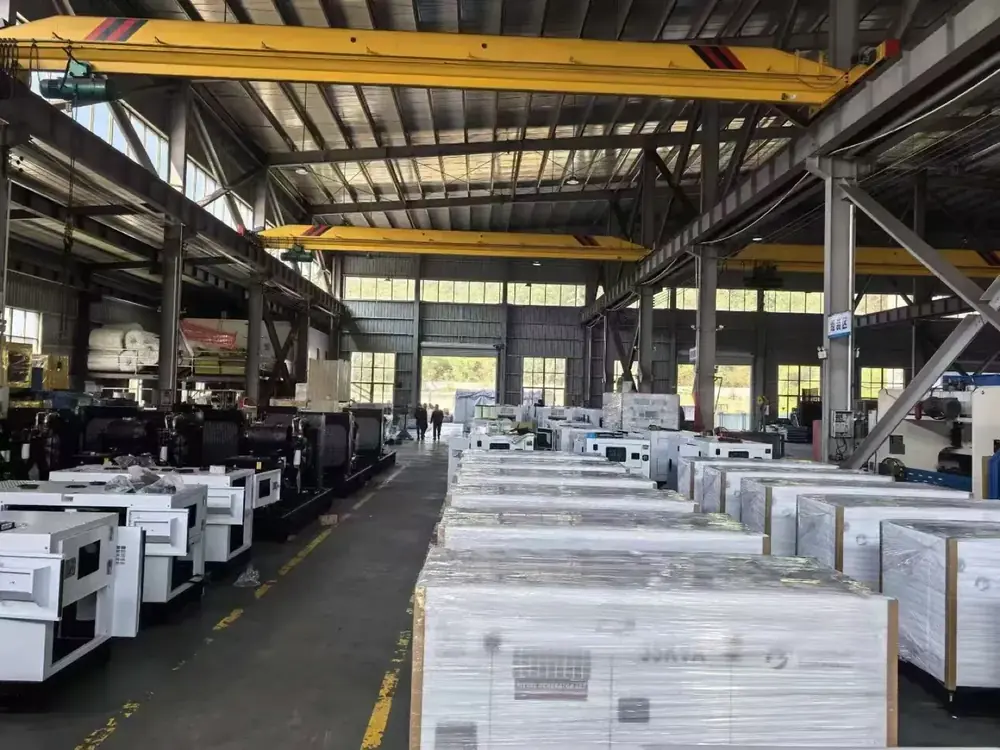
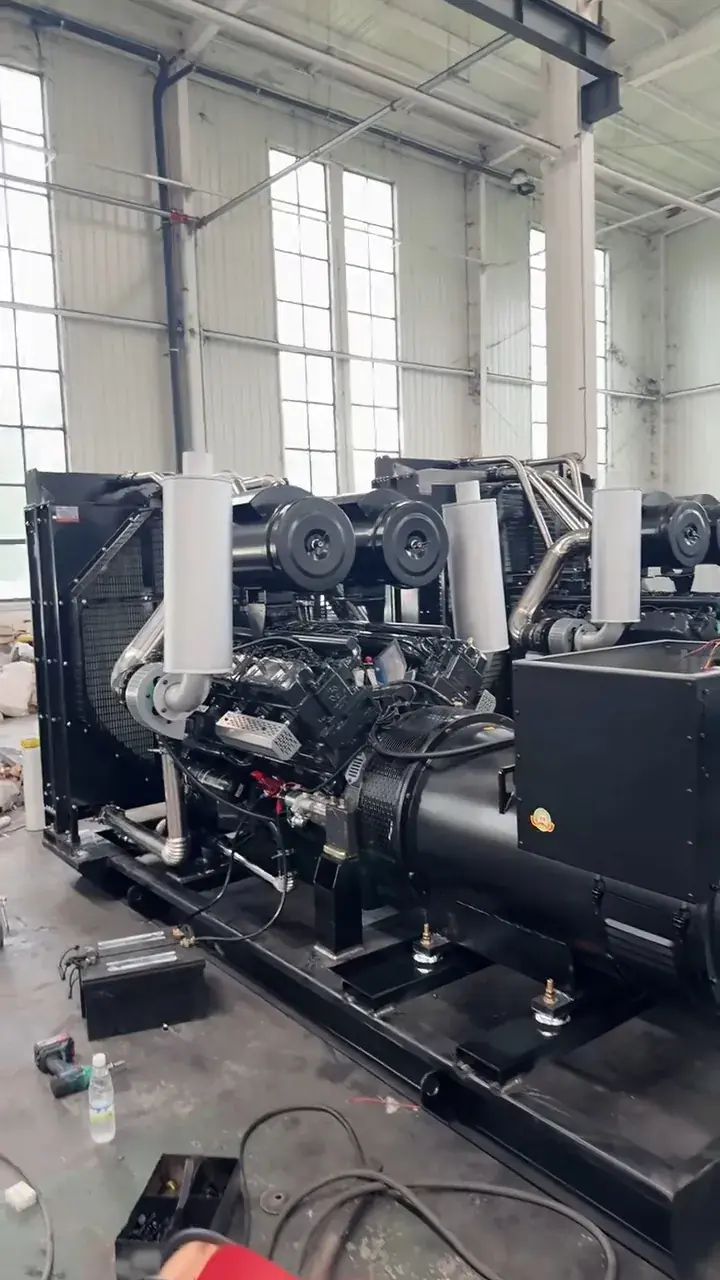
Overhead crane capacity
The main hall carries overhead bridge cranes, which is what makes larger frames and containerised builds handleable indoors. Sets in various build stages line the bays.
/assets/workshop-batch.jpgCertificates on file, with the numbers you can check
For each certificate we show who it is registered to, the certificate number, the product scope exactly as written on the certificate, and the scan itself. Where a certificate carries a limitation, we print that limitation rather than leaving it out.
| Certificate | Registered to | Certificate no. | Scope as stated on the certificate | Dated | Scan |
|---|---|---|---|---|---|
| CE — diesel generator sets Machinery 2006/42/EC · LVD 2014/35/EU · EMC 2014/30/EU |
Fu'an Taiyu Motor Co., Ltd | WUX202210254450MDC | DH-series diesel generator sets, DH6500 5 kW through DH500000 500 kW | 2022-11-07 | View scan (PDF) |
| Model-table discrepancy — DH10500. The CE certificate's model table lists DH10500 as 10 kW. Our own model page states that its rated output is 8 kW and explains that the DH10500 figure should not be read as a power rating. Where the certificate scan and the model page differ, follow the model page: DH10500 model page (8 kW rated, not 10 kW). | |||||
| CE — gasoline generators Machinery 2006/42/EC · LVD 2014/35/EU · EMC 2014/30/EU |
Fu'an Taiyu Motor Co., Ltd | WUX202210254449MDC | PR-series gasoline generators, PR950 0.65 kW through PR23000 20 kW | 2022-11-07 | View scan (PDF) |
| CE — inverter generators Machinery 2006/42/EC · LVD 2014/35/EU · EMC 2014/30/EU |
Fu'an Taiyu Motor Co., Ltd | WUX202212075019MDC | INV / T / PR inverter generator models, 1 kW through 9 kW | 2022-12-13 | View scan (PDF) |
What the CE certificates actually say — including the limitation. The CE certificates cover the DH-series diesel generator sets and the PR-series gasoline and inverter generators listed above. They were assessed under Machinery Directive 2006/42/EC, Low Voltage Directive 2014/35/EU and EMC Directive 2014/30/EU, against Annex I of 2006/42/EC, EN ISO 12100:2010 and EN 60204-1:2018. The certificates state that CE marking may be affixed on the product after preparation of the necessary conformity documentation, as stipulated in Article 10 of Council Directive 93/68/EEC. We are printing that condition rather than omitting it, because it is part of what the document says. If a model you are considering is not in the scope lists above, ask us in writing whether it is covered — we will tell you either way.
About SONCAP. Nigeria's Standards Organisation of Nigeria (SON) administers a conformity assessment programme for certain regulated imports, which may require product and SONCAP certification before customs clearance. Whether a given generator model falls under the regulated list, which assessment route applies, which conformity assessment body handles it, what it costs and how long it takes — all of that must be confirmed against SON's current official requirements for your specific order; the rules and fees are revised from time to time. We will state, in writing and before shipment, exactly what documentation we provide and which parts are the buyer's or the clearing agent's responsibility. Official sources: son.gov.ng · SONCAP portal (soncap.son.gov.ng)
Watch the machines, not a brochure
Five clips filmed on our own floor. Every one of them is on this site already, so you can open the full page and see the specification that goes with the footage.
 0:09
Customer-customized open industrial diesel generator set
Watch the clip →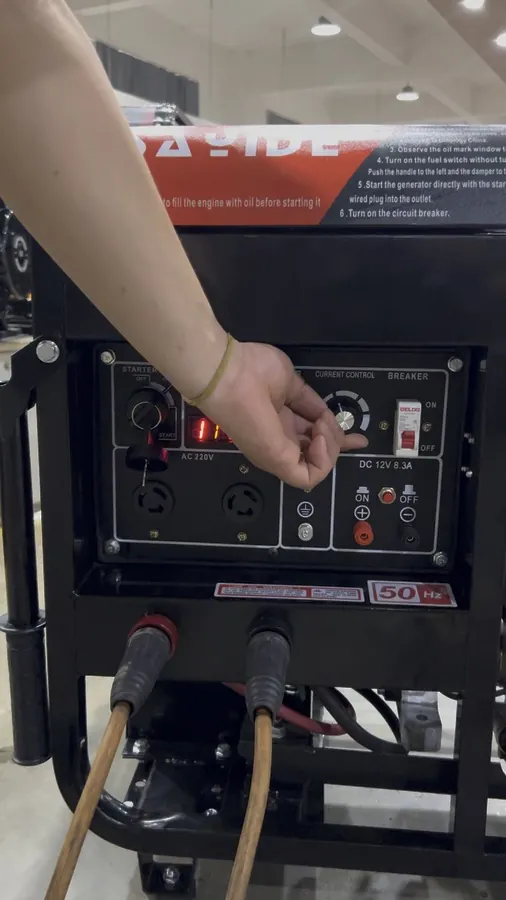 0:50
Diesel welding generator — panel and output inspection
Watch the clip →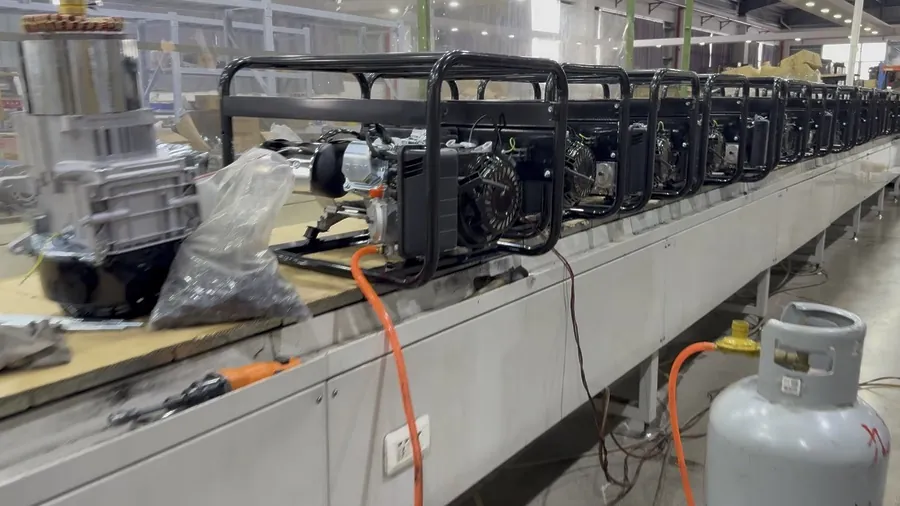 0:21
Custom multi-fuel gasoline generator
Watch the clip → 0:14
10 kW gasoline generator — factory production run
Watch the clip →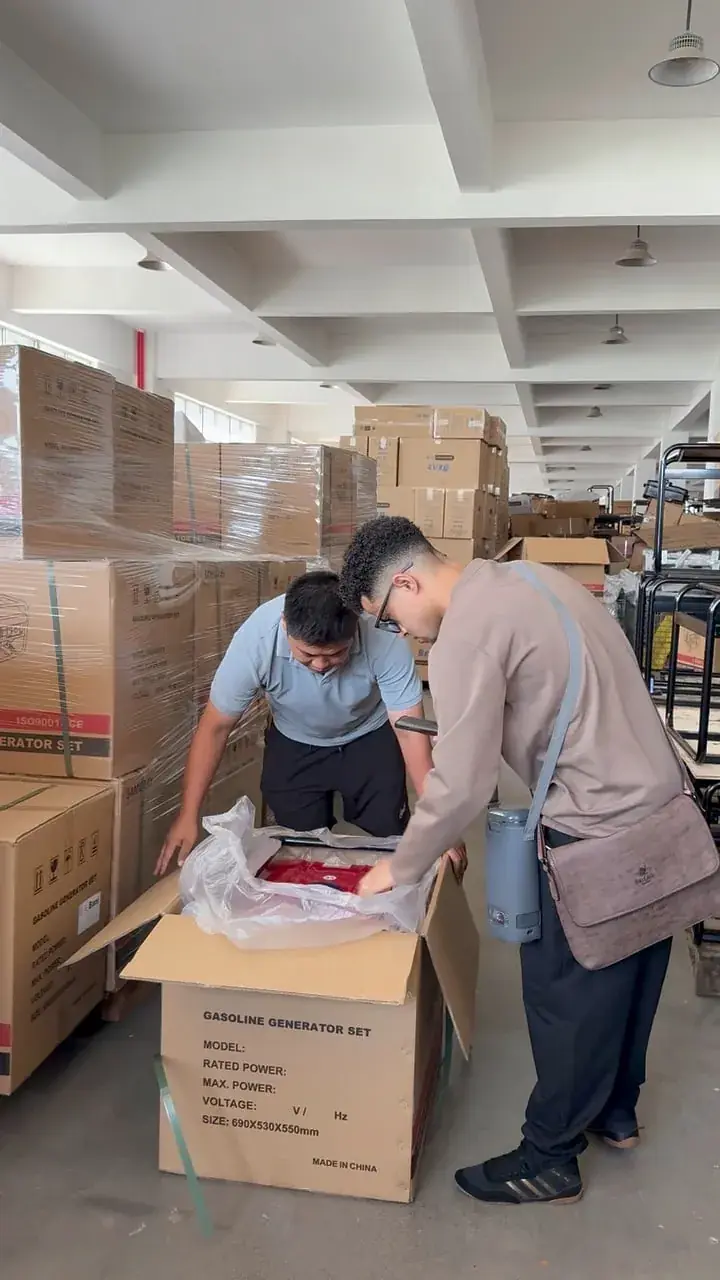 0:15
Overseas customer inspecting the factory in person
Watch the clip →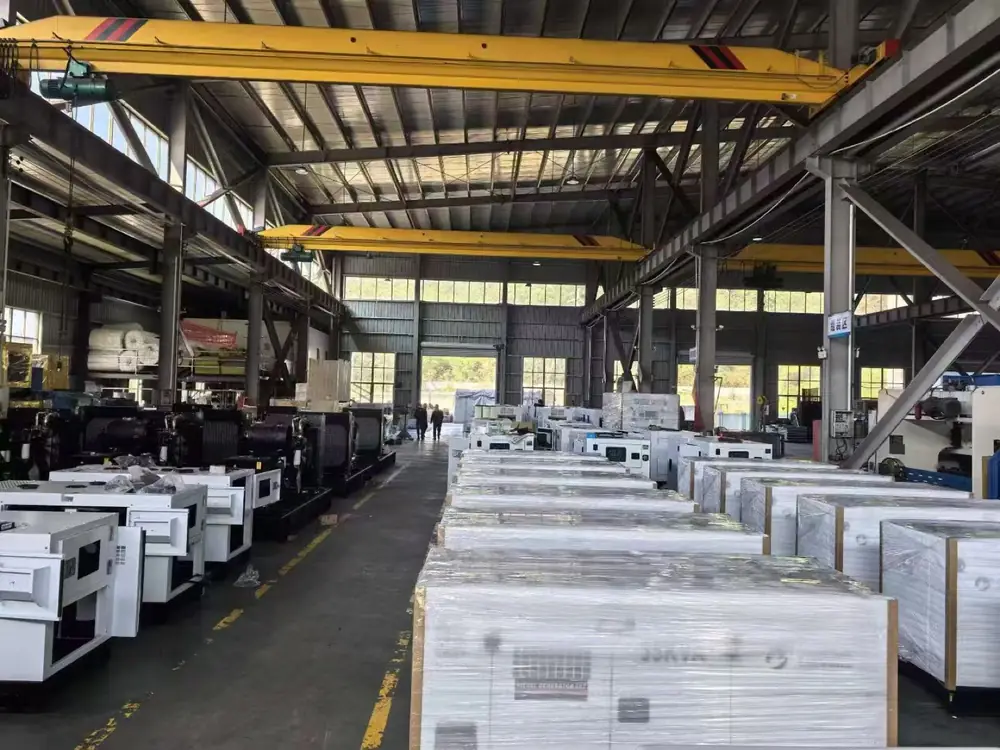
See all factory footage
Open the video library →Two things worth testing on any supplier. Ask for a specified model, and ask to see the same unit in a clip rather than only in stills — a running machine with a visible control panel is much harder to stage than a photograph. We will also take a live video call during working hours so you can ask the workshop to move the camera yourself. Request a live video call →
The stages we can show you, and what to look at in each
You do not need a past customer's order to judge a factory. These are the stages a generator passes through here, with the photographs we can send from the floor.
-
1 · Panel inspectionDuring production

Access doors open on a canopy set while the control panel and internal wiring are checked. Look for the panel being opened rather than the unit merely standing there — it shows the set is being worked on, not just photographed.
/assets/silent-diesel-generator-production-inspection-workshop.jpg -
2 · Test & acceptanceBefore packing
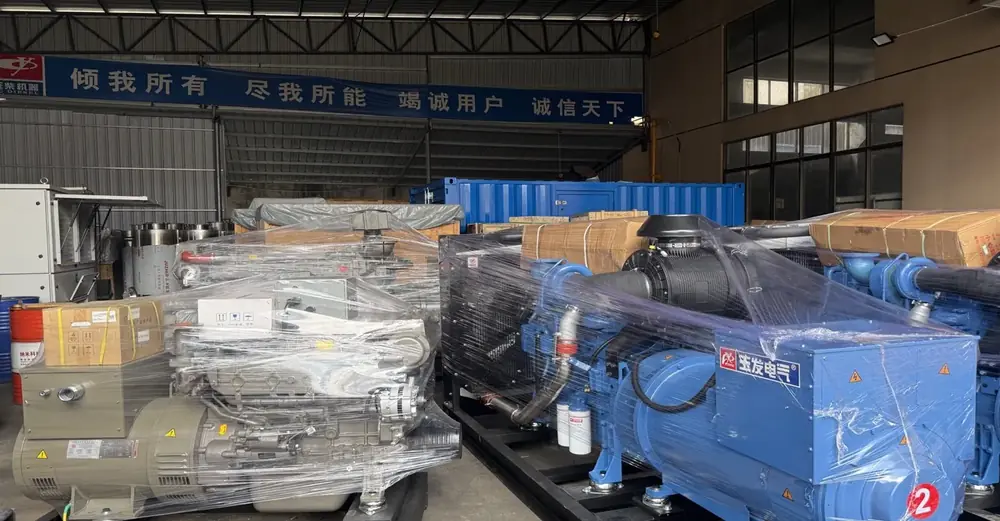
Sets staged in the yard before packing. On a real acceptance stage the readings to ask for are voltage, current and frequency on the control panel at part load and at full load, taken from the same unit you are buying — ask for those as a short clip rather than a still.
/assets/generator-factory-acceptance-test-nigeria-cover.jpg(与 factory-photo-04.jpg 为同一张照片的 1400×729 裁切版) -
3 · Loading yardVehicles and containers
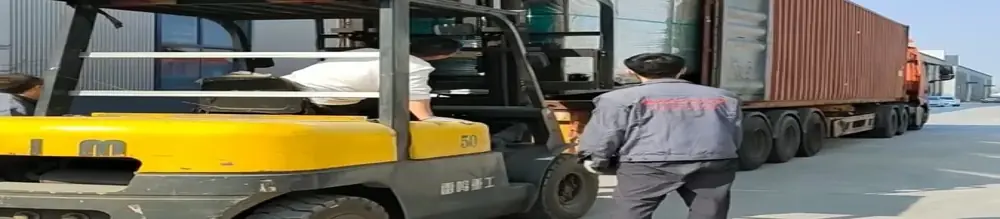
The loading yard itself, with the container trailer and plant equipment that handle the shipment. Heavy sets are moved by machine, so the yard's equipment is part of whether your unit can be loaded without damage.
/assets/diesel-generator-pre-shipment-inspection-nigeria-cover.jpg -
4 · Batch stagingReady to ship
Wrapped sets staged in the hall under the overhead cranes. Ask for the packing arrangement for your own unit: canopy sets and open sets travel differently, and the container plan changes how many fit per shipment.
/assets/workshop-batch-home.webp
Want the deeper version of this? The evidence pages go through order documentation, factory acceptance testing and pre-shipment inspection in more detail: factory test & shipping evidence · factory strength & production proof · factory acceptance test · pre-shipment inspection
Five things you can ask us for on every order
You do not have to take a supplier's word for whether cargo is real. These are the five checkpoints we can document on your own order, and you can ask for any of them before you release the balance payment.
- Production photos of your unit. Taken after build and before packing, with the nameplate and control panel visible, so the unit in the photo is identifiable as yours rather than a generic stock shot.
- Packing photos before and after. The same unit photographed before it is wrapped and after, so you can see what actually goes into the crate or onto the skid.
- Container loading photo with the seal number. The loading itself, plus a close-up of the seal. If a supplier cannot produce a container loading photo with a readable seal number, treat that as your answer about whether the cargo exists.
- Document copies. Commercial invoice, packing list and bill of lading, with any third-party or commercially sensitive entries redacted if you prefer.
- Arrival photos on request. Where you want confirmation at the destination end, we will ask the delivery party for photographs and can share them with your permission.
How to use this list. Ask for any of these five at any point before you release the balance payment. WhatsApp +86 157 0593 2345 · miu@taiyudapu.com
Where to look next
- Factory test & shipping evidence Order documentation, acceptance testing and pre-shipment inspection
- Factory strength & production proof The workshop, the lines and what the plant can handle
- Worked specification example (PDF) A full technical specification sheet, in the format you would receive for your own unit
- Factory video library Five clips filmed inside the workshop
Order-specific factory verification workflow
Approve one written specification
Define rating, duty, voltage, engine, alternator, controller, enclosure, ATS, tank, accessories and delivery term before production approval.
Connect media to the order
Request photographs showing the order reference and the proposed engine, alternator, controller and finished enclosure rather than relying only on general workshop photos.
Agree the factory test scope
State the required checks before production is complete. Ask what load, electrical, alarm, protection and ATS evidence will be available.
Check accessories and packing
Match manuals, batteries, cables, silencers, spare parts, ATS and loose accessories to the packing list before shipment.
Verify supplier and payment identity
Confirm the legal supplier, invoice issuer and bank beneficiary. The signed quotation or contract remains the final order scope.
Use the factory and shipping evidence center, generator FAT checklist and pre-shipment inspection guide to prepare the verification requirement.
Why factory strength matters for Nigeria generator projects
Nigeria buyers often purchase for sites where downtime is expensive and the supplier is overseas. The factory must therefore make the technical and commercial scope clear before shipment. A useful quotation should separate the generator package from local clearance, inland delivery, installation, fuel, cabling and commissioning responsibilities.
- Hotels and estates need noise, ATS and runtime planning
- Factories need motor-starting and prime-duty review
- Hospitals and critical sites need transfer and protection clarity
- Dealers need repeatable models, packing and spare-parts planning
- CIF Lagos and FOB China quotes must use the same technical scope
Compare the 100kVA quotation guide, 250kVA factory quote guide, 500kVA industrial generator guide and custom generator solutions.
Request a factory-backed diesel generator quotation
Complete the known requirements. The form creates a structured WhatsApp message that asks for both the generator scope and the evidence needed before shipment.
Diesel generator factory strength FAQ
What does this factory photo prove?
The original image shows a large silent diesel generator in a production workshop with service doors open while workers inspect or work at the controller area. It supports the visible production context only.
Does the photo prove the rating or engine brand?
No. The exact kVA, engine model, alternator, test result and customer order cannot be verified from this image alone. These details require written and order-specific evidence.
What evidence should a Nigeria buyer request?
Request the signed specification, engine and alternator nameplates, controller details, agreed test evidence, accessories list, packing list and loading evidence tied to the order reference.
Do you claim a local generator factory in Nigeria?
No. Nigeria Generator Supply represents a China-based supplier serving Nigeria and other export markets. It does not claim a local Nigerian factory, warehouse or service office.
Can buyers request a silent generator configuration?
Silent canopy, open type and other configurations can be discussed, subject to rating, application, engineering review, availability and written quotation.
