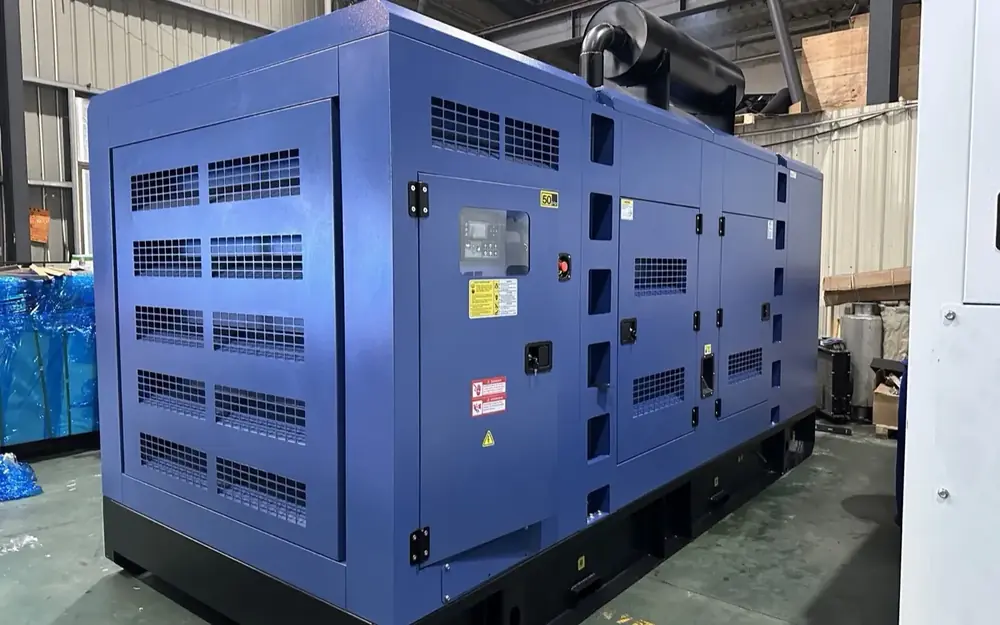
This page is for buyers who already know they are near the 300kVA range and need a quotation checklist, not a generic small-generator overview.
Where 300kVA is commonly used
300kVA is frequently reviewed for projects that have larger combined loads than a typical school or office backup set. Common inquiries include hotels with central air-conditioning loads, hospitals with critical and non-critical circuits, industrial workshops, agro-processing lines and commercial compounds that need margin for startup demand.
The correct rating still depends on the actual load list, the largest motor or chiller, whether major loads start together and whether the generator is for standby or longer daily operation.
What changes the quotation
When buyers compare different 300kVA offers, the real budget difference usually comes from technical scope and shipping basis.
| Quotation item | Why it matters |
|---|---|
| Engine and alternator option | Brand and component level affect specification, documentation and parts planning. |
| Silent or open type | Noise control, canopy steelwork and outdoor placement change the machine scope. |
| ATS requirement | ATS current rating, poles and enclosure should be stated clearly instead of assumed. |
| Standby or prime duty | Runtime expectation affects the correct recommendation and should be declared early. |
| FOB China or CIF Lagos | Delivery basis changes the commercial comparison and approval process. |
A fixed online number without these details is not a reliable procurement reference.
How to send a useful RFQ
Start with the application, load list or major equipment, largest motor, estimated daily runtime, silent or open type preference, ATS scope, quantity and shipping basis. If you are between sizes, compare this page with the 250kVA guide, the 350kVA guide and the 300-500kVA range page.
For imports, keep FOB China and CIF Lagos comparisons separate so finance and approval teams can see the exact delivery boundary.
Get a written quotation
Three fields. We reply with the rating, the engine option and the delivery basis.
240kW, and the gap between installed load and demand
At a power factor of 0.8 the rating converts to 240kW, and the useful question is how much of that the site will actually ask for. Two different numbers get confused here. The installed load is everything connected; the demand is what runs together at the busiest hour. A plant with a long list of machines may never draw more than a comfortable fraction of its installed total, because the process does not run every machine at once.
Getting the demand right matters more at this size than at any smaller one, because the consequence of being wrong is asymmetric. Oversize and the set runs light for years, with poor combustion, wet stacking on some engines and a fuel bill that looks like a fault. Undersize and the site trips at the worst moment, usually when production is behind and every machine is running.
The way through is a schedule rather than a guess: list the loads, mark which can run together, mark the largest motor and how it starts, and note the hour of the day when the coincidence is worst. That schedule is also the document a supplier needs in order to quote something other than a catalogue number.
Single set or two in parallel: the decision that is hard to reverse
At this rating the parallel option stops being theoretical. Two sets can follow a load that swings between a quiet night and a busy day, they can be maintained one at a time without shutting the site, and a failure removes part of the capacity rather than all of it. The table sets the two arrangements against each other on the points that usually decide it.
| Point | Single set | Two sets in parallel |
|---|---|---|
| Load following | Fixed capacity, efficient only near its rating | One runs light load, both run the peak |
| Redundancy | Any failure stops the site | One failure leaves partial capacity |
| Maintenance | Site must stop or accept a window | Servicing can be done one machine at a time |
| Control | Simple panel, easy to operate | Synchronising and load sharing to understand |
| Footprint | One plant room, one exhaust, one fuel line | Two of each, plus the switchgear between them |
| Growth | Another set later means a second installation | Capacity can be added in steps |
Read the table as a list of things to decide early. The parallel arrangement is easy to plan and awkward to retrofit, because the switchgear, the cabling and the control philosophy all have to exist before the second machine arrives.
The civil and electrical envelope around the machine
At this rating the machine is the smaller half of the project. It needs a base that carries its weight and absorbs its vibration, a room or compound with an air path sized for the radiator and the ambient, an exhaust route that does not put hot gas into a window or back into the inlet, and a fuel system with a bund that would hold a spill rather than spread it.
On the electrical side it needs a cable route sized for the current, a distribution arrangement that can be isolated for maintenance, and a changeover that decides what happens when the supply returns. Those items are usually the buyer's scope, and they are the reason two installations of the same machine can behave very differently.
The air path deserves its own sentence, because it is the most common cause of a set that appears underpowered. A room with a small inlet and a large set produces recirculation: the radiator draws its own heated discharge back through the core, the coolant temperature climbs, and the machine derates in a way that looks like a fuel or an overload problem. The fix is a louvre area and a discharge path decided at the drawing stage, not a larger radiator.
Who maintains it, and how far away they are
A set at this size is a fixed asset with a maintenance obligation. Nobody carries it to a workshop, so the workshop has to come to it. That turns the service arrangement into part of the specification rather than an afterthought, and it changes the value of two otherwise comparable machines.
The questions worth asking before an order are concrete. Who performs the first service, and from where. Which consumables are held locally rather than ordered per job. What the controller does when it fails, and whether a replacement can be sourced without returning the panel. Whether the documentation is in a language the site electrician can follow at two in the morning.
There is also a staffing question that buyers at this size sometimes miss: who is allowed to start and stop the set, and who is allowed to open the canopy. A site with a trained operator and a log book gets years of service out of an ordinary machine. A site where anyone can press the button and nobody records the hours will wear out a better one.
Why two quotations at this rating diverge
The same rating can be quoted against completely different content, and at this size the content is where the differences live. The engine is first: the design and the plant behind it, and whether consumables and major parts can be reached from Nigeria without a special order. The alternator is second: how it is wound, how it is excited, and what temperature rise it is built to sustain rather than merely survive.
The control and protection package is third, and it is where the cheapest-looking offers usually save. A panel that closes a contactor is not the same as one that watches oil pressure, coolant temperature, speed and current, and trips before the machine damages itself. Fourth is the enclosure and the ventilation design behind it, which decides whether the set keeps its rating in local ambient or loses it quietly.
Fifth is the documentation and spares that travel with the unit, including the test record and the drawings. Sixth is the commercial boundary: the point at which the seller stops being responsible, and whether that point is a port or a site. A written offer that answers those six can be compared with another written offer. A single number cannot be compared with anything, and it is not a quotation.
FAQ
What changes a 300kVA diesel generator quotation in Nigeria?
The quotation changes with engine and alternator brand, silent or open type enclosure, ATS scope, duty rating, cooling setup, quantity and delivery term such as FOB China or CIF Lagos.
Is one fixed online 300kVA price reliable?
No. A fixed online price usually omits technical scope and shipping basis. Serious buyers should compare a written quotation with the exact configuration.
What should I send first for a 300kVA quote?
Send the project application, load list or major motors, standby or prime duty, preferred engine option, silent or open type, ATS need, quantity and delivery basis.
