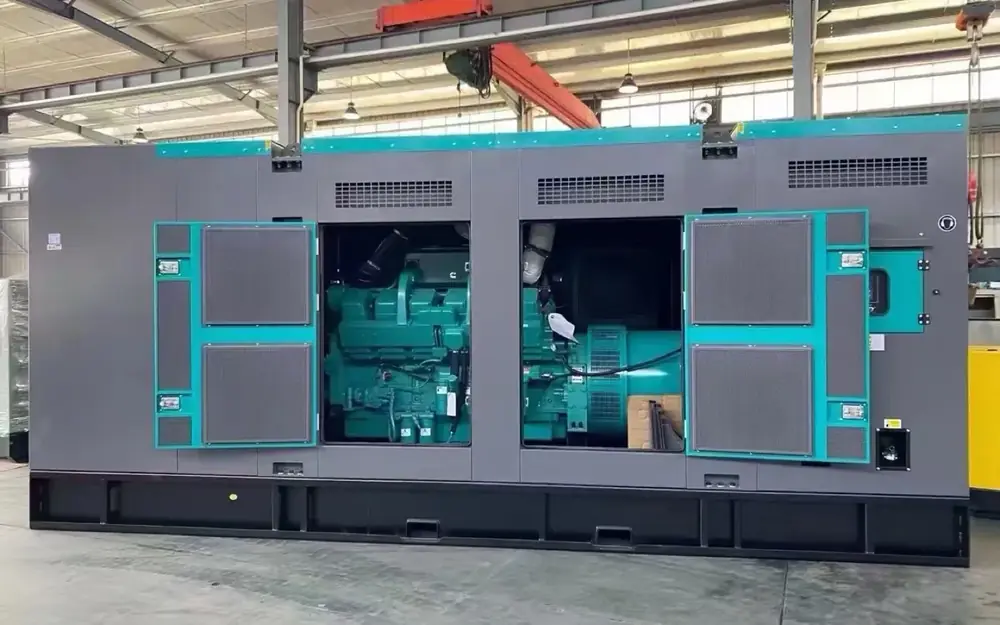
Three hundred and fifty kVA is about 280kW at a 0.8 power factor. At this level the set interacts with switchgear, cabling and site layout, so the quotation is a system decision as much as a machine purchase.
Industrial buyers ask different questions
At this rating the conversation usually turns on duty, redundancy and how the set will be operated, rather than on the appliance list. A plant that runs the set every working day is buying a different machine from one that keeps a set for outages.
It also matters whether this set is the whole solution or part of one. If the site may later run two sets in parallel, that intention should be stated now, because it changes the controller, the switchgear and the protection philosophy even if the second set comes later.
Fuel storage and refuelling logistics move up the agenda at this size as well. A large daily consumption makes tank capacity and safe fuel handling part of the design rather than an accessory.
What the load schedule should show
Write it as a table with a column for whether each load is continuous, intermittent or occasional.
| Schedule column | Why the supplier needs it |
|---|---|
| Load name and rating | Defines the connected load the set must carry. |
| Continuous or intermittent | Separates the steady base load from the peaks. |
| Largest motor and starter | The heaviest inrush the set must absorb. |
| Simultaneity | Which heavy loads can run or start at the same moment. |
| Duty and hours | Prime operation and standby backup are quoted differently. |
| Voltage and phase | The distribution the site actually uses. |
| Future expansion | Changes switchgear, controller and parallel operation planning. |
Verification at this value
The value of the order justifies formal evidence. Agree before production which items will be provided: engine and alternator identification, controller configuration, the factory test arrangement, and the packing scope for shipment.
The factory acceptance test guide, the pre-shipment inspection guide and the CIF Lagos shipping guide describe the arrangements that can be written into the order.
Related: 250kVA generator guide, 500kVA generator guide, construction site power guide.
Get a written quotation
Three fields. We reply with the rating, the engine option and the delivery basis.
280kW and the duty rating behind the number
At a power factor of 0.8 the rating converts to 280kW, and that conversion describes the machine rather than the site. The more important question at this size is duty: whether the set is specified to run continuously as the only source, or to stand by and take over when a supply fails. Those are different products with different loading limits and different maintenance expectations, and the same rating label can sit on either.
A set specified for continuous work is built to hold a high proportion of its rating for long periods, with the cooling, the lubrication and the fuel system sized for that life. A standby set is built to be available, to take load quickly and to run for shorter periods. Treating one as the other is the most common and most expensive specification error in this band, because the machine will do the work for a while and then fail in a way that looks like a manufacturing fault.
The duty also sets the maintenance calendar. A continuous set accumulates hours quickly and needs its intervals planned around production, not around convenience. A standby set needs a proving schedule, because a machine that never runs is a machine whose faults are discovered at the moment it is needed.
Parallel operation as a way to grow
Industrial sites rarely arrive at their final load. A plant that needs this much capacity today will need more after the next line is commissioned, and the decision about how to add it should be taken when the first set is specified rather than when the second is needed. A set installed with provision for a second machine, and a control philosophy that anticipates it, can be extended in a planned shutdown. A set installed without that provision forces a separate installation later.
The table compares what changes when the second machine arrives under each approach. It is written from the point of view of the plant engineer who will have to live with the result.
| Item | Prepared for a second set | Not prepared |
|---|---|---|
| Switchgear | Busbar and breaker space already provided | Board replaced or a second board added |
| Control | Load sharing designed in from the start | Retrofit of synchronising to an existing panel |
| Plant room | Space, air and exhaust allowed for | Second room, second fuel line, second exhaust |
| Shutdown | Planned, short, during a scheduled stop | Site works around a live installation |
| Fuel | One tank serving both with isolation | Second storage arrangement and bund |
The parallel arrangement also changes how the site is operated. Load has to be shared deliberately, starting sequence has to be understood, and someone has to be able to explain what the controller is doing. That is a training question as much as an engineering one.
What the plant room has to provide
At this rating the room is part of the machine's rating. It has to supply air for combustion, air through the radiator, a path for the heated discharge, and enough volume that the set is not breathing its own exhaust. It has to carry the weight on a base that does not settle differentially, and it has to keep the machine accessible on the sides where the filters, the sump and the panel sit.
The discharge path is the item that decides whether the installation keeps its rating. A set in a room with an inlet sized for the door and an outlet that turns a corner will recirculate, and recirculation shows up first as a slow temperature rise and later as a derate that nobody can explain. Ducting the discharge away from the inlet, and sizing the louvres for the airflow rather than for the wall, is cheaper at the drawing stage than at any point afterwards.
Noise belongs in the same conversation. An industrial set near a boundary or a neighbouring facility will attract attention, and the answer is a designed acoustic arrangement, not an assumption that the canopy handles it. The canopy reduces noise; whether it reduces it enough for the site is a separate question with its own answer.
The service arrangement, agreed before delivery
An industrial set is a long-term obligation, and the obligation is easier to define before the purchase order than after the first fault. Three things are worth agreeing in writing while the commercial discussion is still open: who performs scheduled service, what the response expectation is when the set stops, and which spares are held locally rather than ordered per job.
The spares list for a set at this rating is longer than buyers expect. Filters, belts, sensors, a controller module, perhaps an injection component. None of them is expensive relative to a stopped production line, and all of them are inconvenient to source in a hurry. A modest holding of the items that actually fail is a better use of budget than another increment of rating.
The staffing question completes the picture. A set at this size usually has a dedicated operator or a small team, and the quality of the record keeping decides how much of the maintenance budget is spent on prevention rather than repair. A log of hours, loads and abnormalities is the cheapest diagnostic tool on the site.
Why two quotations at this rating diverge
Offers that carry the same rating can be built around different engines, different alternators and different assumptions about who is responsible for what. The engine is the first variable, and at this size the question is not only the design but whether the maker's parts reach the region without a special order. The alternator is the second, and the relevant question is what temperature rise and insulation it is built for, because a unit that holds its rating continuously is a different article from one that approaches it.
Control and protection come third. The panel decides what the site knows about the machine, and a controller that logs and trips is worth more here than on a small set, because the consequences of an unnoticed fault are larger. The enclosure and its ventilation are fourth, and the difference between a canopy that was designed for the ambient and one that was wrapped around the machine only appears after installation.
Fifth is the documentation and spares package: the test record, the drawings, the filter set, the belts. Sixth is the commercial boundary, meaning the point where the seller's responsibility ends and the buyer's begins. Those six lines are the substance of an industrial quotation, and they are the reason a single advertised figure cannot be compared with a serious offer.
350kVA generator questions
What kind of project needs a 350kVA set?
Production plants, larger commercial complexes, hospital blocks, water and processing facilities and project sites with several load centres. The common factor is a schedule with a steady base load plus heavy intermittent starts.
Should duty be specified before the model is chosen?
Yes. Continuous daily operation and standby-only backup are different ratings with different loading limits and maintenance expectations, and the same kVA label can sit on either.
What should be agreed before production starts?
The engine and alternator identification, controller configuration, the factory test or inspection arrangement, the packing scope, and the delivery responsibilities. Agreeing these in writing before production is cheaper than resolving them afterwards.
