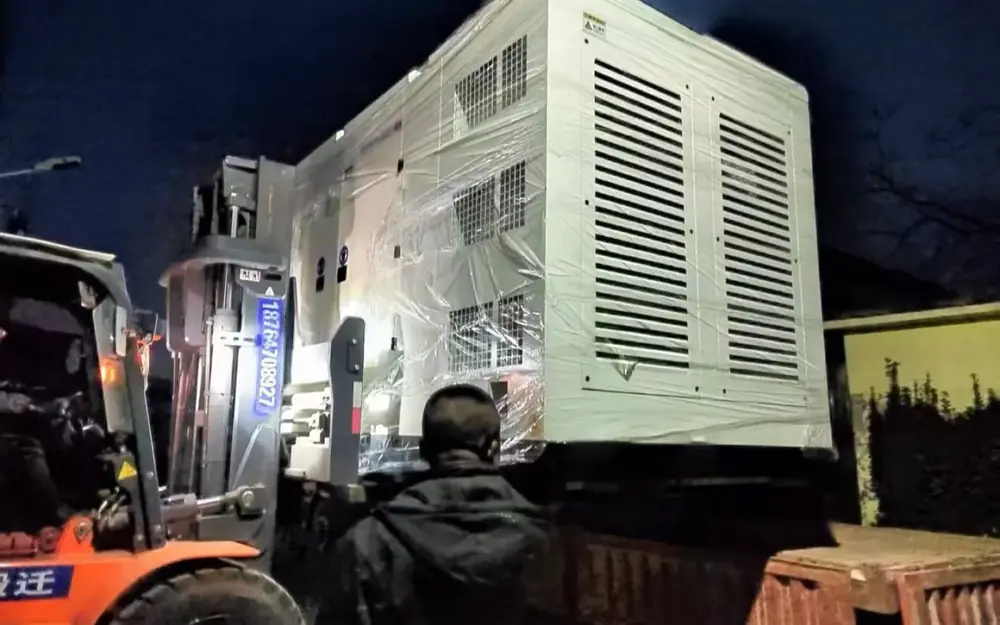
This page is for buyers comparing quotations around 160kVA who want to understand what the rating delivers, where it stops being adequate, and which specification lines separate one quotation from another.
What 160kVA delivers, and what it does not
A 160kVA set delivers 128 kW at a power factor of 0.8. Everything a buyer plans should be counted against that number rather than against the kVA, because the loads on a Nigerian site — pumps, compressors, air conditioners, refrigeration — are usually specified in kW or in horsepower.
The figure is also a ceiling, not a target. A set run continuously at its declared limit has no margin for ambient derating, for load power factor below 0.8, or for the next piece of equipment the site buys. Most well-planned installations sit somewhere below the declared output at their normal peak.
This is where the 160kVA decision usually goes wrong. Buyers count the connected load, find it fits inside 128 kW, and stop. The connected load is not the running load, and the running load is not the worst moment of the day.
160, 165 and 200: what actually changes
These three ratings appear together in quotations more often than buyers expect, and the reason is that 160 and 165 are frequently the same machine class described on different rating conventions. The difference between them is small enough that the engine and alternator specification matters more than the number.
The step from either of them to 200 is a real step: 128 kW against 160 kW, roughly a quarter more usable output, and usually a different engine frame and a heavier enclosure. That is the step that buys headroom for motor starting and for growth.
The practical way to decide is to ask for the declared output at site ambient for each option, then compare those figures against the worst-case running load. If the answer is within a few kW of the declared output, the smaller rating is not really adequate — it is merely adequate on the day it is commissioned.
| Rating | Output at 0.8 PF | What the step actually buys | Where it still falls short |
|---|---|---|---|
| 160kVA | 128 kW | A whole mixed commercial building, or an estate with pumps and lighting | A single large direct-on-line motor added to that load. |
| 165kVA | 132 kW | Usually the same machine class as 160 on a different rating basis | Nothing structural — it is not a different size class. |
| 200kVA | 160 kW | Headroom for motor starting, for growth, and for ambient derating | Two large motors starting together without sequencing. |
Anyone comparing 160 against 165 should ask directly whether the two are the same set on different paper. If they are, the decision is about documentation and rating basis, not about capacity.
Where 160kVA is the right answer
The rating suits facilities that need whole-building backup but whose peak load arrives gradually rather than in one surge.
An estate with borehole pumps, street lighting and common buildings is a good fit, provided the pump controllers are sequenced after an outage. A cold room or a small processing unit fits when refrigeration is staged and compressors do not restart simultaneously.
A school block or a mixed commercial building fits when the peak is cooling load rather than motor load. A production unit fits when the largest motor is modest or started gently.
In each case, the qualifier is doing the work. The set is adequate because of how the loads behave, not because of the total on the schedule.
| Site | Typical load | Condition that must hold |
|---|---|---|
| Estate with pumps | Borehole pumps, lighting, common buildings | Pumps start in sequence, not together after an outage. |
| Cold room or food processing | Refrigeration, compressors, lighting | Compressors are staged and not all restart at once. |
| School or campus block | Classroom cooling, ICT, pumping, lighting | Peak cooling load is the driver, not motor inrush. |
| Mixed commercial building | HVAC, lifts, lighting, tenant loads | Lift and HVAC starts do not coincide. |
| Mid-sized production unit | Machines, compressors, extraction, lighting | Largest motor is started by star-delta, soft start or drive. |
The largest motor decides more than the total load
When a motor accelerates it draws several times its running current, and the generator must supply that surge without dropping voltage far enough to trip contactors or disturb other equipment. As a rule of thumb, a direct-on-line start is the harshest of the common methods, star-delta reduces the surge substantially, and a soft starter or drive reduces it further.
On a 160kVA set, this is the calculation that most often changes the answer. The running load may sit comfortably inside 128 kW while one motor's starting surge is enough to make the next rating the honest choice.
There are three ways to resolve it: increase the rating, change the starting method, or sequence the loads so the large motor starts before the rest of the building is reconnected. All three are legitimate; the third is the cheapest and the most often overlooked.
Engine and alternator pairing at this rating
At 160kVA the engine is typically a six-cylinder industrial unit, and the pairing with the alternator is where specification quality shows. An engine with adequate torque reserve behind a lightly rated alternator will still sag on a motor start, because the alternator is what the transient current passes through.
Ask for the alternator's rating at the same ambient as the engine's, and for the insulation class. A set that is assembled to hit a price often pairs a well-known engine with an alternator that has no margin left.
On the engine side, the choice between Cummins, Perkins and Yuchai usually comes down to what the buyer's maintenance organisation already supports and what is stocked within reach. At this rating, both mechanical and electronic fuel systems are common, and the difference in behaviour on site fuel is worth asking about explicitly.
Silent or open at 160kVA
A 160kVA set rejects enough heat that the enclosure is a thermal decision as much as an acoustic one. A silent canopy with inadequate airflow will cost more in derating than it saves in noise.
Estates and urban commercial sites usually need the silent version because the set sits close to occupied buildings. Factories with a plant room often choose open, then discover that the room needs acoustic treatment and ventilation of its own.
Whichever is chosen, confirm the acoustic target the canopy is built to and the clearance the installation needs around it. A canopy specified without those two numbers is a canopy that will be judged by ear after commissioning.
ATS and changeover scope
At this rating, an automatic transfer switch normally covers the main distribution board, and its rating has to suit the load rather than the generator. A switch rated below the site's peak will become the weak point in an otherwise adequate installation.
Confirm whether the switch is included in the quotation, whether it switches the neutral, and whether the generator controller has the output to drive it. Those three questions resolve most of the confusion between a quotation that includes changeover and one that leaves it to the electrician.
Where the site has a critical subset — a cold room, an ICT room, a diagnostic machine — a partial changeover to a dedicated board is often more useful than switching everything and hoping the set carries it.
Installation conditions that change the rating
The set will not deliver its declared output in a hot room with restricted airflow, and Nigerian installations frequently place generators in exactly that kind of room.
Combustion air and radiator discharge are two separate requirements. If the discharge duct is short and the intake is close to it, hot air recirculates and the set runs progressively hotter without any single obvious fault.
The base matters too. A level, drained plinth with correctly rated anti-vibration mounts prevents the slow misalignment that later appears as vibration and exhaust leaks. On a set this size, that is cheap insurance.
- Radiator discharge ducted away from the intake, not back into it.
- Combustion air sized for the engine, independent of general room ventilation.
- Plinth level and drained, with mounts rated for the set weight.
- Exhaust short, insulated and terminated away from windows and boundaries.
- Service access on the sides the technician needs, not just the front.
- Fuel tank bunded with isolation and a water separator at the engine.
Acceptance and documents
Acceptance should include a load test at stated steps, with voltage, frequency, coolant temperature and oil pressure recorded. That record is the reference point for every later conversation about performance.
Confirm the engine, alternator and controller nameplates against the approved datasheet at acceptance. Where a quotation was won on a specification, the nameplate is the only evidence that the specification was delivered.
- Load test record with steps and readings.
- Nameplate photographs for the three main components.
- Controller settings sheet as commissioned.
- Wiring diagram matching the build.
- Consumables list with part numbers.
- Packing list and loading photographs for consolidated shipments.
Comparing the quotations
Two quotations at 160kVA can differ for reasons that have nothing to do with the rating: alternator grade, controller tier, canopy construction, cooling package, electrical scope and delivery basis. Forcing both onto the same list is faster than negotiating on the total.
| Line | What a complete answer looks like |
|---|---|
| Declared output | Prime and standby, each with the ambient condition. |
| Engine | Model, displacement, fuel system. |
| Alternator | Make, model, insulation class, kW match. |
| Controller | Model, inputs, ATS output. |
| Canopy | Type, gauge, acoustic target, access. |
| Cooling | Radiator spec and design ambient. |
| Electrical | Breaker, ATS, cabling boundary, earthing. |
| Delivery | FOB or CIF, port named. |
If one supplier cannot fill a line, treat it as excluded until it is written down. That discipline resolves most of the apparent price differences at this rating.
Get a written quotation
Three fields. We reply with the rating, the engine option and the delivery basis.
FAQ
How many kW is a 160kVA generator?
A 160kVA set delivers 128 kW at a power factor of 0.8. The usable figure is lower if the load power factor is below 0.8 or if site ambient temperature is above the condition the rating was declared at.
Is 160kVA the same as 165kVA?
Often they are the same machine class described on different rating conventions. Ask each supplier whether the two figures come from the same set and on which rating basis before treating them as different sizes.
Should I choose 160kVA or 200kVA?
It depends on the worst moment rather than the running total. If the running load sits close to 128 kW, or if one large motor starts direct on line on top of that load, the 200kVA option is usually the honest choice.
Can 160kVA run a factory?
It can run a mid-sized production unit where the largest motor is started gently or where loads are sequenced. It is not a good fit where several large motors start together or where the process load runs near the declared output all day.
Does 160kVA need a silent canopy?
If the set will sit near occupied buildings, an estate or a boundary, a silent canopy is usually necessary — provided it is ventilated properly. A canopy without adequate airflow derates the set, which costs more than it saves.
Is ATS included in a 160kVA quotation?
Often not, unless it is requested. Ask explicitly whether the ATS, its rating and the cabling boundary are inside the price, because a changeover quoted separately can change the comparison between two offers.
What should be tested before accepting a 160kVA set?
A load test at stated steps recording voltage, frequency, coolant temperature and oil pressure, plus nameplate photographs matching the approved datasheet, a controller settings sheet, a wiring diagram and the consumables list.
