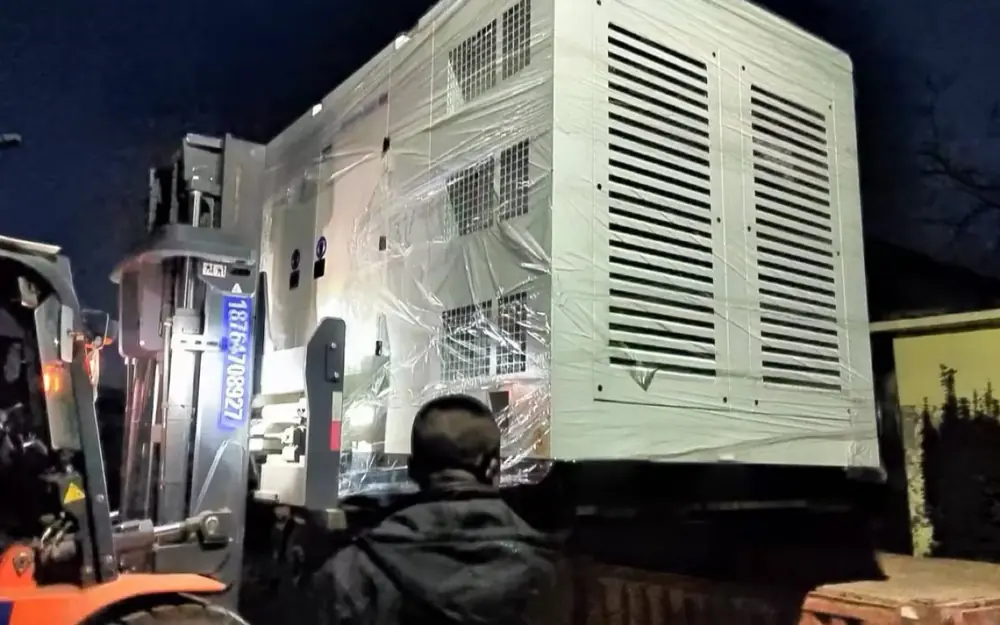
Size the standby set against what solar and batteries cannot carry, not against the whole site. Motor starting, consecutive low-yield days and 24-hour process loads set the rating far more than the total connected load does.
Why a solar-first site still needs a source that can start a motor
A battery bank and an inverter deliver a steady amount of power very well. What they do not do naturally is deliver a large current for a short time into a magnetic load that is not yet turning. An induction motor at standstill presents very little impedance, so the current it draws in the first moments after contact is a multiple of its running current, and the inverter has to supply that multiple or refuse the start.
This is the single most common reason a site that looks fully solar on paper keeps a generator. The building may run all day on photovoltaic output, the lights and air conditioners may never touch the set, and the set still earns its place because the lift, the borehole pump or the cold-room compressor has to start on demand rather than when the sun is agreeable.
A rotating machine solves this differently. The alternator has thermal mass and the engine has torque, so a start that would trip an inverter is simply a load step the set absorbs while its governor responds. That is why the standby set on a solar-first site is often smaller than the old whole-building set and yet more specifically chosen: it exists for the starts, not for the running.
The practical consequence is that the site needs two different calculations. One decides the solar and battery capacity, and it is driven by daily energy. The other decides the standby rating, and it is driven by the worst single start the site can produce plus whatever else must run at the same moment. Mixing the two is how sites end up with a set that is too large for its running load and still fails on the lift.
The loads solar and batteries usually cannot carry
Not every load is equally awkward for an inverter. Resistive loads such as heaters and incandescent lighting are easy. Electronic loads are easy in power terms but sensitive to transfer behaviour. The difficult group is the one that combines a high starting current with a mechanical duty, and it is worth naming the members because they recur on almost every Nigerian commercial site.
Lifts and hoists draw heavily at the moment of acceleration and can regenerate power back into the system when they descend with a load. Cold-room and chiller compressors start against refrigerant pressure, so they draw their heaviest current immediately and then cycle repeatedly through the day. Welding sets present an intermittent, badly behaved load with a poor power factor. Large borehole and process pumps combine a long acceleration time with a start that happens whenever the tank calls for water, which is rarely at a convenient moment.
There is a second group that is not about starting at all but about duration. A cold room must hold temperature overnight and through a run of cloudy days. A server room, a telecom cabinet or a security system must not lose supply because the battery reached its depth-of-discharge limit at four in the morning. A production line that runs a night shift needs energy, not just power, and the battery bank that carries a daytime office will not carry it.
Both groups point the same way. The set is being asked to cover events that are either short and violent or long and boring, and the two requirements rarely produce the same rating. The job is to find which of them dominates on this particular site, and to size for that one rather than averaging the two.
Reading your inverter's generator-input and pass-through limits
Almost every hybrid inverter sold into this market has an alternating-current input intended for a generator, and almost none of them will accept an unlimited one. The manual states a maximum input current, a maximum input power, an acceptable voltage and frequency window, and a charging current the inverter will draw from that input. Those four numbers, not the generator datasheet, decide which set can be connected.
The charging current deserves particular attention because it is easy to overlook. When a generator is connected to an inverter, the inverter typically does two things at once: it passes power through to the loads, and it uses surplus capacity to charge the battery. The total draw is the sum of the two. A set that looks correctly sized for the site load can be overloaded within minutes simply because the inverter was configured to charge hard at the same time.
The voltage and frequency window matters for a different reason. A set with a mechanical governor will drift in frequency as load changes, and a sensitive inverter may reject the supply or repeatedly connect and disconnect. This shows up as flickering, as a charger that never settles, or as a set that appears to run but never actually takes load. It is a settings and specification problem, not a fault in either device, and it is solved before delivery rather than after.
There is also a control question. Some installations want the inverter to start the generator automatically when the battery reaches a set point: that requires a dry contact or a communication link the set's controller can accept. Others want a manual changeover and no automation at all. Deciding this early changes both the controller specification and the wiring, so it belongs in the enquiry rather than in a site visit after delivery.
Sizing the residual load instead of the whole site
The residual load is what remains when everything solar and batteries reliably carry has been subtracted from the site. Reliably is the operative word. A load that the array carries at noon but not at six in the evening is not carried, it is borrowed, and it belongs on the set's side of the calculation.
Build the list in three columns. The first holds loads that never need the set: daytime lighting, office equipment, air conditioning that runs while the sun is up. The second holds loads that need the set only when the battery is low: the same air conditioning at night, general power outlets, refrigeration that can tolerate a short gap. The third holds loads that need the set whenever they run, because starting them from the battery is not realistic: lifts, large pumps, welding, heavy compressors.
Then apply the site's own operating pattern. A single-shift office discharges its third column almost never, so the set may run a few hours a month and the rating can be set by the single worst start. A cold store discharges it every night, so the same rating must also survive continuous running for long stretches. Two sites with identical connected load can therefore need very different sets, which is why a quotation built from a total-kVA figure alone is not a sizing exercise.
The residual figure should be recorded with the same discipline as the solar calculation: which loads, how many run together, which one starts last and largest, and how long the site expects to run on the set when the weather refuses to cooperate. That record is the input to the quotation, and it is also the only way to check afterwards whether the set that arrived matches the duty it was bought for.
The table answers the question a solar-first buyer asks next: once the battery is carrying the base load, what does adding a standby set actually change?
| Decision point | Battery-only site | Battery plus standby set |
|---|---|---|
| Starting a large motor | Limited by the inverter surge rating | The set absorbs the start as a load step |
| Several low-yield days in a row | The reserve must cover the whole gap | The set covers the gap on demand |
| A load that runs all night | Bank sized for the full night, every night | Set carries the residual, bank recharges |
| Recovery after a fault or a deep discharge | Waits for recharge before the site is normal | Set runs the site while the bank recovers |
What changes when the set has to run alongside an inverter
A set that runs a building on its own is judged on voltage and frequency stability. A set that runs alongside an inverter is judged on how gracefully the two share the work, and that is a different standard. The most common complaint is not that the set is too small but that it never settles: the inverter accepts the supply, loads the set, the frequency sags, the inverter backs off, and the cycle repeats.
Two settings prevent most of this. The first is the inverter's input current limit, which should be set below the set's continuous capability with a margin for the load step. The second is the charging current, which should be reduced so that the combined draw stays inside that limit. Neither is a hardware change, and both require the person commissioning the system to understand what the set can actually hold.
The set's own control also matters. Variable-speed sets behave differently from fixed-speed sets when lightly loaded, and a set that spends its life at a small fraction of its rating will not run cleanly for long. If the residual load is genuinely small, the honest answer may be a smaller set rather than a large one idling, and possibly a different starting arrangement for the lift. This is the point at which the specification is worth challenging rather than accepting.
Finally, the interface between the two systems has to be documented. Who commands the changeover, what happens when the set is already running and the grid returns, whether the inverter can accept both sources, and what the site does if the set fails while the battery is also low. None of these are exotic, but each one changes the wiring and the controller, and each one is cheaper to decide in the quotation than on site.
Two configurations for a Lagos office: battery-only versus battery plus set
Consider a mid-size office building of the kind that has moved its daytime load onto solar: lighting, workstations, servers, split air conditioning, a lift and a borehole pump. The array and the bank are sized for the working day with a margin. The question is whether a set is needed at all, and the honest answer depends on two things the energy calculation does not capture.
The first is the lift. If the building has one, the inverter must supply a start that is significantly larger than anything else on site, and the bank must be able to deliver it without being pulled below its depth-of-discharge limit. A battery-only design can do this, but it is sized by the start rather than by the daily energy, and that is usually an expensive way to buy capacity that sits idle for most of the day.
The second is the bad week. A run of overcast days with dust in the air reduces array output for longer than a single day, and an office that closes because the battery is flat has lost more than the fuel would have cost. The set converts an energy uncertainty into a fuel purchase, and that is the real product being bought.
The battery-plus-set configuration is not simply the battery-only design with a generator bolted on. It usually allows a smaller bank, because the reserve no longer has to cover every adverse run, and a smaller set, because the lift start is the dominant event and everything else can be sequenced. The saving on storage often funds the set, and the site ends up with two independent ways of keeping the lift working.
What to put in the RFQ so both systems are quoted together
The failure mode in hybrid procurement is that the solar supplier quotes a battery system and the generator supplier quotes a set, and nobody quotes the interface. The site then discovers at commissioning that the inverter will not accept the set, or that the set cannot charge the bank at the rate the inverter expects, and the argument about who pays starts after the equipment has landed.
Send one enquiry covering both. State the inverter make and model and attach the page of the manual that gives the generator-input limits. State the residual load list and which item starts largest. State whether the set should start automatically at a battery set point or whether changeover is manual. State the site's expectation for a bad week: does the set carry the whole site, or only the residual list.
Ask for the two systems to be quoted as one scope with the interface explicitly included: who supplies the changeover, who configures the inverter input limits, who commissions the pair together, and who is responsible if they do not talk to each other. A quotation that leaves the interface out is not cheaper, it is incomplete.
It is also worth asking what the set's rating is at the site's ambient temperature and whether the figure is standby or prime. A set rated for intermittent standby duty and then asked to carry a cold store through a bad week is being used outside its rating, and the fuel consumption and wear will show it. For the wider method behind the load list, the generator sizing guide sets out the sequence, and the running cost comparison covers the monthly arithmetic once both systems are in place. Brand and platform options are compared in diesel generator brands, and the current range is listed on the price list.
Request a standby rating for the residual load
Send the inverter make and model, the loads that will stay on the set, and which of them starts largest. The quotation will then carry a rating for the residual duty and a statement of how the set is meant to work alongside the inverter, rather than a single kVA figure chosen from the total connected load.
Get a written quotation
Three fields. We reply with the rating, the engine option and the delivery basis.
Solar and standby sizing questions
Can a solar and battery system replace a generator completely in Nigeria?
For a load profile that is entirely daytime and contains no large motor starts, it can. The limit is not the daily energy, it is the motor start and the run of low-yield days. Where either exists, the practical answer is usually a smaller set sized to the residual load rather than no set at all.
How do I know if my inverter can take a generator?
The manual states a maximum generator input current and power, a voltage and frequency window, and a maximum charging current. If those figures are not published, ask the manufacturer before buying a set. Connecting a set outside those limits can damage the inverter and will usually void its warranty.
Should the generator charge the batteries or only carry the loads?
Both are possible and the choice is a design decision. Charging as well as passing power through means the total draw is higher than the site load, so the set has to be sized for the sum. Many sites set a modest charging current to keep the set inside its rating and let the array do the bulk charging.
Is a variable-speed generator better for a solar-first site?
It can be, where the residual load is small and variable, because the set can run efficiently at part load. Where the dominant event is a single large motor start, a fixed-speed set with a well-matched alternator is often simpler to specify and to service.
What is the residual load in one sentence?
It is everything the site needs that solar and batteries do not reliably supply, counted at the moment it all runs together, with the largest motor start included as a step rather than as an average.
How much diesel does the standby set still burn per month after solar is installed?
It is the running hours multiplied by the engine's consumption at the load the set actually carries, and that consumption per kWh is higher at light load than near rating. Count the hours the battery cannot cover, note the load band the set runs in, apply the published consumption curve for that model, and sum it by month. No figure is given here, because the answer depends entirely on the site's own hours and band.
