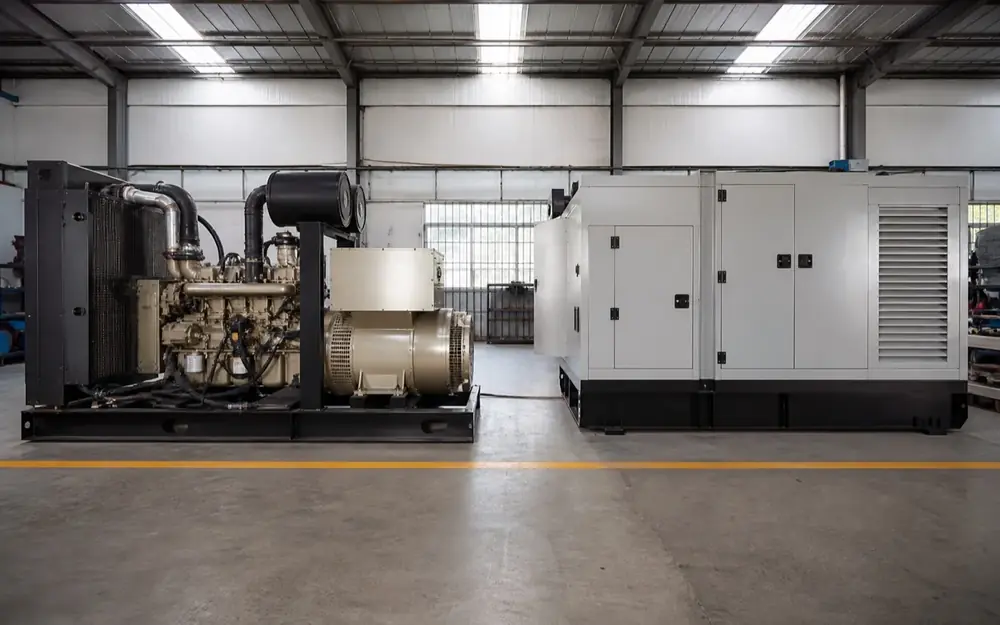
Engine brand choice affects three buyer outcomes: the upfront price position, the availability of spare parts over the life of the set, and the confidence a tender committee places in the submission.
Fix the conditions before comparing anything
A comparison of two engine platforms is only meaningful at a fixed kVA, a fixed duty and a fixed configuration. Change any one of those and the difference you measure belongs to the change, not to the engine.
The three conditions should therefore be written down first and applied to both offers. Rating must include the power factor. Duty must state whether it is prime or standby and the daily hours assumed. Configuration must state open, sound-attenuated or containerized.
With those fixed, the remaining differences are the ones worth examining: the engine model offered, the alternator paired with it, the controller and protection scope, and the service and parts route. Those are the lines that decide what the set costs to own rather than what it costs to buy.
The three outcomes that actually differ
The first is the price position. Engine platforms sit at different points on the budget scale, and that difference is real rather than a reflection of quality alone.
The second is parts availability. What matters after commissioning is how consumables and wear items reach the buyer's city: filters, belts, hoses, injectors, gaskets and sensors, and specifically the items the offered model uses. Two platforms at the same rating can use different service parts, and the difference appears in the second year rather than on the invoice.
The third is buyer confidence, which in tenders is a documented matter rather than a feeling. A submission is easier to evaluate when the engine origin and the after-sales parts route are stated in writing and backed by the offered model identification.
Platforms commonly considered
Cummins and Perkins are the two platforms most often named in Nigerian tender documents, and this site quotes generator sets configured with available options from either, subject to written quotation and model availability. Weichai and Yuchai options are also quoted where the specification allows a broader field.
Neither this page nor a quotation from this website claims authorised distributorship of any engine brand, and no warehouse stock claim is made. Those are separate commercial matters that a buyer should verify in writing before payment.
What can be compared objectively is the offered engine model, whether that model is confirmed for the requested delivery window, and how the spare parts route is described. A comparison built on those points survives an audit; a comparison built on brand preference does not.
For platform-specific pages, see the Cummins-powered generator guide, the Perkins-powered generator guide and the Yuchai generator page.
What tender documentation usually requires
Tender submissions tend to be judged on the completeness of the technical offer rather than on the headline figure alone. The items that recur are the engine and alternator identification, the rating basis with the power factor, the controller and protection scope, the enclosure specification and the delivery term.
Alongside those, evaluation often looks for the evidence that will accompany the machine: the test arrangement, the packing standard and the documentation that travels with the shipment. Agreeing these before production is easier than assembling them afterwards.
It also helps to state what is not claimed. A submission that is clear about the boundary of its own scope, including who handles clearance, inland transport, installation and commissioning, is easier to accept than one that leaves those questions open.
The factory acceptance test guide and the pre-shipment inspection guide cover the evidence side of a submission.
Asking for a comparison you can evaluate
Ask for the same specification priced on each platform you are considering, with the engine model named in each case and the parts route described. A single number per platform, without the model, cannot be evaluated against a tender requirement.
The Cummins versus Perkins comparison page sets out the buyer-facing differences, and the 100kVA quotation checklist shows how the surrounding lines are usually structured.
Request a platform comparison
Send the rating or load list, the duty and daily hours, the configuration and the platforms you want compared, and state which documentation the submission needs to contain.
Get a written quotation
Three fields. We reply with the rating, the engine option and the delivery basis.
Engine platform comparison questions
Is one engine platform better than another?
They differ in price position, parts availability and the documentation they support. Which matters most depends on the project, so the useful comparison fixes the rating, duty and configuration first and examines the remaining differences.
What has to be fixed before comparing two platforms?
The kVA rating with its power factor, the duty basis with daily running hours, and the configuration, whether open, sound-attenuated or containerized. Without those three fixed, the comparison is not like-for-like.
Do you claim authorised distributorship?
No. Generator sets are quoted with available engine options from the named platforms, and no authorised distributorship or warehouse stock claim is made. Buyers should verify engine model, serial or nameplate evidence, warranty route and supplier identity in writing.
Why does parts availability matter more than the badge?
Because it shows up after commissioning. Two platforms at the same rating can use different filters, belts, injectors and sensors, so the service route should be described in writing before the order rather than assumed from the brand.
What does a tender usually expect to see?
Engine and alternator identification, rating basis with power factor, controller and protection scope, enclosure specification, delivery term, and the test and packing evidence that will accompany the machine.
Can several platforms be quoted on one specification?
Yes, and it is the clearest way to compare. Ask for the same rating, duty and configuration priced per platform with the engine model named in each case.
