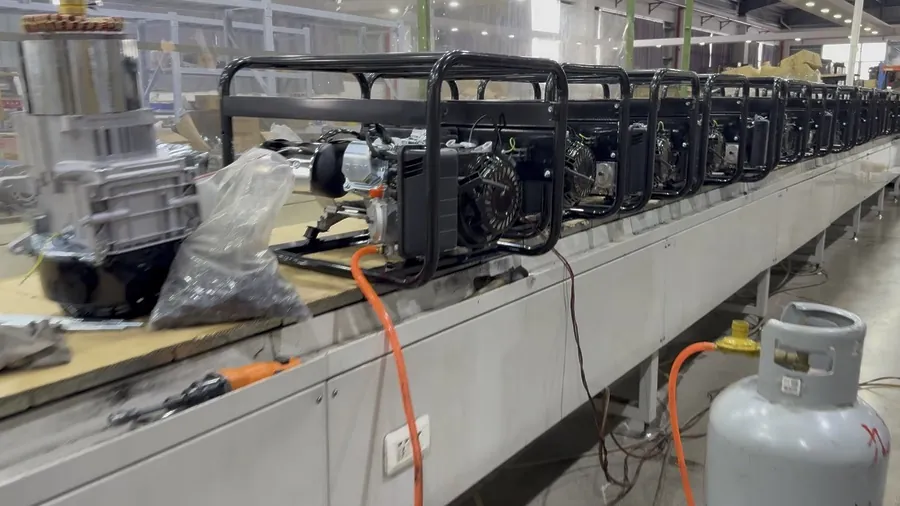
Under about two hours a day at light load, petrol is usually the simpler buy. From a working shift upward, or for anything overnight, diesel wins on engine life, fuel storage safety and running cost per hour worked.
Duty cycle decides, not the fuel name
Ask two buyers in the same street whether diesel or petrol is better and you will get two confident, opposite answers, both based on a single purchase each. The disagreement is not about fuel; it is about duty. One is running a set for two hours in the evening to keep lights and a television on. The other is running a freezer, a pump and a shop for a full working day, and sometimes into the night.
Those two duty patterns put completely different demands on an engine. Short, light, intermittent running suits a small air-cooled petrol set: it is cheap to buy, easy to start, and it is idle most of its life anyway. Long, loaded running suits a water-cooled diesel: it is built to sit at a working load for hours, and its fuel system is designed for that life.
So the first number to write down is not the budget or the brand. It is hours per day, and the share of the rating the set will actually carry during those hours. Everything else in this comparison follows from those two numbers.
| Duty pattern | Typical use | What the engine experiences | Where it points |
|---|---|---|---|
| One to two hours, light load | Home evening backup, small shop, security lighting | Frequent cold starts, low load, long idle between runs | Small petrol set is usually adequate |
| Four to eight hours at moderate load | Shop with freezer, small office, workshop | Steady running at a working load | Diesel, and the choice becomes clear |
| Overnight or continuous | Cold room, clinic cold chain, telecom, bakery production | Long hours, high load factor, unattended | Diesel, without much debate |
| Intermittent heavy bursts | Site work, welding, pumps | Repeated large steps and recoveries | Diesel with attention to starting current |
| Mixed, unpredictable | Growing business, several load types | Neither pattern consistently | Diesel for capacity, or a two-set arrangement |
Why long hours punish a petrol engine
Small petrol generator engines in this market are usually derived from light-duty designs: air-cooled, high-revving, and intended for intermittent work. That is not a criticism, it is a design brief. Run one at a high share of its rating for hours on end and several things happen at once. The cylinder head runs hotter than it would in intermittent service, the oil thins and its film weakens, and the clearances that the engine was built with start to close.
The fuel system has its own problem with continuous duty. A carburettor is a precise but delicate device that depends on clean passages and a stable float level; heat soak after a long run can percolate fuel and make hot restarts difficult. Petrol itself is volatile, and a tank that is warm and half empty breathes vapour for hours.
None of this means a petrol set will fail on its first long day. It means the engine is being used outside the duty it was designed for, and the cost appears as shorter intervals between overhauls, more frequent oil changes, and a machine that becomes unreliable in exactly the season it is needed most.
Load factor, and why it changes the answer
Both engine types are least efficient at the extremes. A set running at a small fraction of its rating burns fuel mostly to keep itself turning; a set running near its ceiling has little margin for the next load that switches on. The comfortable band for a diesel set is usually described as somewhere in the middle of its range, and the same idea applies to petrol, though the petrol engine has less headroom to give.
The practical difference is what happens when the load grows. A business that starts with lights and a fan and adds a freezer, then a pump, then air conditioning, will outgrow a small petrol set quickly. The diesel set bought for the eventual load will run at a lower fraction for a while and then settle into its band. The petrol set bought for today's load will spend its life at its ceiling and be replaced.
This is why the useful question is not what the load is now but what it will be in two years. A buyer who answers the second question honestly usually ends up with a different machine from the one they first considered.
Running cost depends on a price you do not set
The textbook comparison says diesel costs less per hour because the engine is more efficient and the fuel carries more energy per litre. That is true, and it is not the whole story in Nigeria, because the retail relationship between the two fuels has not been stable. There have been periods when diesel was the expensive option and periods when it was not, and buyers who made a decision years ago on the old relationship have found their reasoning no longer holds.
The honest method is to compare litres per hour at the same output, then multiply by the price each fuel actually costs where the buyer is. That gives a running cost per hour for each option which can be re-checked when prices move. What it does not capture is the rest of the cost: the petrol set will be cheaper to buy and more expensive to keep running for long hours, and it will have a shorter working life at high load.
Where the buyer expects a few hundred hours a year, the purchase price dominates and petrol often wins. Where the buyer expects thousands of hours, the running cost and the replacement interval dominate, and diesel wins by a margin that a fuel price movement rarely overturns.
Storage is where the argument is usually settled
This is the part buyers underweight and it is the part with the highest consequence. Diesel has a high flash point: a lit match dropped into a bucket of diesel will usually go out. Petrol has a low flash point and produces vapour at ordinary ambient temperatures, which is why a petrol store is a different proposition entirely, especially in a hot climate and especially indoors.
In practice, a business running long hours needs a tank, and a tank of petrol is a serious undertaking: venting, bunding, earthing, distance from ignition sources, and rules that staff will actually follow. A diesel tank in the same place is ordinary equipment. That asymmetry, more than any efficiency argument, is why cold rooms, clinics, telecom sites and factories do not run petrol sets.
For a household using a small set in the evening, a five-litre can refuelled carefully is manageable and common. The problem starts when the same habit is scaled to a business that needs a hundred litres a week and stores it in the back room.
Starting, and whether the set can run unattended
A petrol set is usually started by hand or by a small electric starter, and it is expected to be attended while running. A diesel set in a commercial installation is normally started by a controller, optionally by an automatic transfer switch, and is expected to run with nobody in the room. That difference matters because it decides whether the set can protect a load that fails at three in the morning.
Carburettor engines are also more sensitive to being left: fuel in the bowl evaporates and leaves deposits, and a set that sits for weeks may need attention before it starts. Diesel fuel systems tolerate sitting better, though they have their own enemies, which are water and dirt rather than evaporation.
Where the load is critical and the owner is not always present, the requirement for automatic start effectively selects diesel before any efficiency comparison is made.
Service, parts and who can fix it
A petrol set asks for spark plugs, a carburettor clean, an air filter and oil. Those are cheap and widely available, and most mechanics in any Nigerian town can work on them. That is a genuine advantage for a small business that cannot afford downtime while a part comes from Lagos.
A diesel set asks for fuel filters, a water separator, injectors and a high-pressure pump, and those are specialist items. In exchange, the intervals are longer and the engine is designed for the duty. The trade is between frequent small maintenance with easy parts, and less frequent maintenance with parts that must be sourced properly.
The deciding factor is usually proximity: whether there is a competent diesel technician within reach, and whether the supplier can support injector and pump work rather than only filters. That question is worth asking before the purchase, not after the first hard start.
Matching the fuel to the job
Set out side by side, the common Nigerian use cases fall into a pattern. The point of the table is not to remove judgement but to show where the answer is genuinely close and where it is not.
| Use case | Duty | Usual answer | The reason that decides it |
|---|---|---|---|
| Home evening backup | One to three hours, light | Petrol | Low hours, small tank, simple starting |
| Small shop with a freezer | Four to eight hours | Diesel, or a larger petrol if hours are short | Freezer compressor starts and longer hours |
| Cold room or frozen food | Continuous | Diesel | Overnight load and unattended operation |
| Clinic or diagnostic centre | Long hours, critical | Diesel | Automatic start and cold chain protection |
| Construction site | Shift work, heavy bursts | Diesel | Motor starting current and dust tolerance |
| Telecom site | Continuous, remote | Diesel | Unattended operation and fuel logistics |
| Market stall or kiosk | Two to four hours | Petrol | Price and simplicity outweigh efficiency |
When two sets make more sense than one
There is a third answer that buyers rarely consider and often should. A business with a small overnight load and a large daytime load can run a small set at night and a larger one during the day, rather than making one machine do both jobs badly. The small set runs in its efficient band at night; the large set runs in its band during production.
The arrangement costs more up front and less in fuel, and it has a resilience benefit that is easy to overlook: if one set fails, the business is degraded rather than stopped. For a cold room or a clinic, that is worth more than the efficiency saving.
The decision is arithmetic, not philosophy: measure the night load and the day load separately, and see whether one set can sit in a sensible band across both. If it cannot, two sets usually can.
Where the rules of thumb stop
This page avoids quoting a fixed efficiency difference between the two fuels on purpose, because the honest number depends on the specific engines being compared and on the load they carry. Where a rule of thumb is used — that a diesel set is comfortable somewhere in the middle of its rating, or that a petrol engine is a light-duty design in this class — it is a starting point for a conversation, not a specification.
Engine life at high load depends on cooling, oil quality, ambient temperature and how well the set is maintained, so two identical machines can have very different lives. Fuel prices move, and a comparison built on today's prices may be wrong next year. Petrol consumption at part load is especially sensitive to carburation condition.
The defensible method is to compare litres per hour at the actual expected load for each candidate set, apply the prices the buyer actually pays, and add the maintenance and replacement expectations. Where that data is not available, the duty cycle still gives the right answer in most cases, because duty selects the engine type before cost selects the model.
Get a written quotation
Three fields. We reply with the rating, the engine option and the delivery basis.
FAQ
Is diesel or petrol better for a generator in Nigeria?
It depends on duty cycle. A few hours a day at light load suits a small petrol set; a working shift or overnight running at a real load suits diesel. Diesel wins on engine life at sustained load, fuel storage safety and running cost per hour worked.
How many hours a day can a petrol generator run?
Small petrol sets in this class are light-duty designs intended for intermittent work. They can run longer, but at a high share of their rating the engine runs hotter, oil degrades faster and the interval between overhauls shortens. Where the pattern is a full working day, a diesel set is the better fit.
Is diesel cheaper than petrol to run?
Per hour of work, usually, because a diesel engine is more efficient and diesel carries more energy per litre. But the retail gap between the two fuels has moved in Nigeria, so the comparison should be rebuilt from litres per hour at the buyer's actual load and the prices they actually pay.
Why is petrol harder to store than diesel?
Petrol has a low flash point and gives off vapour at ordinary temperatures, so a petrol store needs venting, earthing and distance from ignition sources, and a large petrol tank is a serious undertaking. Diesel has a high flash point, which is why businesses that need a tank choose diesel.
Can a petrol generator run a freezer or a cold room?
It can start a small freezer, but a cold room runs continuously and unattended, and that is the pattern diesel is designed for. Compressor starting current is also harder on a small petrol set than on a diesel with more headroom.
Do petrol generators need more maintenance?
They need different maintenance, more often: spark plugs, carburettor cleaning, air filters and oil. The parts are cheap and widely available, which is a real advantage where a diesel technician is far away.
What should I tell a supplier before choosing between the two?
Daily hours, the typical load and what it consists of, whether the set must start automatically, and where and how much fuel can be stored. Those four answers select the engine type before any model comparison begins.
