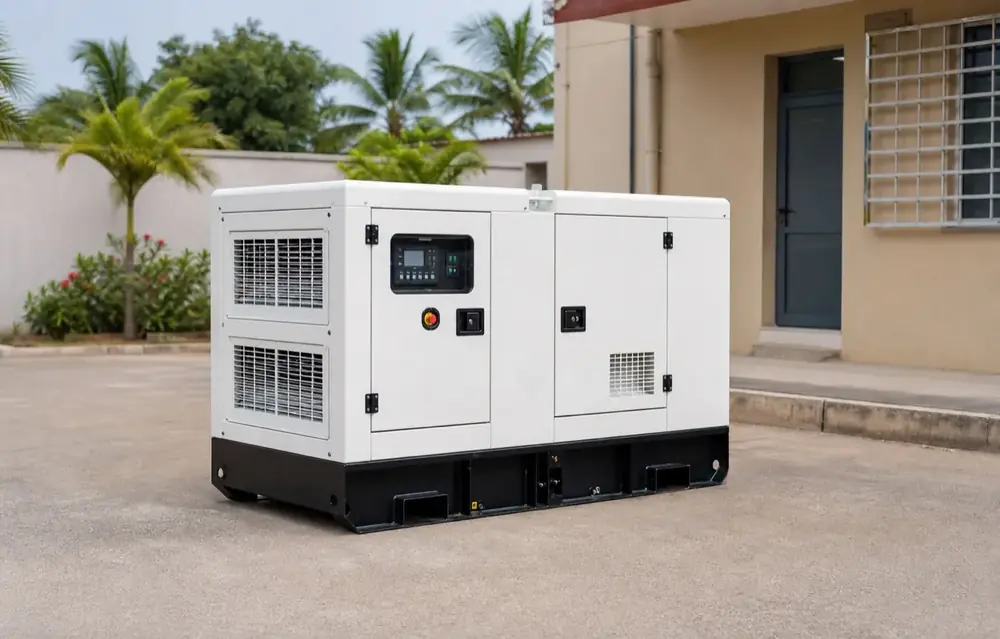
This page is for buyers quoting around 30kVA who want to know whether the rating fits, why the offers differ, and which lines in the quotation actually decide the outcome.
What 24kW carries
A 30kVA set gives 24kW at a planning power factor of 0.8. For a commercial building that is enough for lighting, a set of air conditioners, a cold room compressor, an office and a water pump, as long as they are not all starting together.
It is also enough to be dangerous in the wrong hands. Twenty-four kilowatts sounds like a lot, and buyers routinely assume it covers a building that it does not, because the cooling load alone can absorb most of it by mid-afternoon.
The number should be checked against a list of what runs simultaneously at the worst hour, plus the largest start. That is a short conversation, and it is the one buyers most often skip at this rating.
The phase cliff
Around 30kVA the single-phase and three-phase worlds meet. Below this rating, many installations are comfortably single-phase. Above it, three-phase equipment becomes normal — air conditioners, pumps, workshop machines.
The trap is a three-phase set wired to a board that is mostly single-phase. Load concentrates on one phase, the set reaches its limit while the total looks fine, and the diagnosis is confusing because nothing is overloaded on paper.
Before ordering, have the board checked for phase balance and list any three-phase equipment separately. If the site has none and will not add any, a three-phase set is still the usual choice at this size for resale value and flexibility — but the board must be balanced for it.
Four site patterns that behave differently
The same 30kVA set is asked to do quite different jobs depending on the building. The pattern matters because it determines when the peak arrives and how long it lasts.
| Site | When the peak arrives | The load that decides the rating |
|---|---|---|
| Guest house | Evening, when rooms, kitchen and laundry overlap | Room air conditioners restarting together after an outage |
| Church | Service hours, in a short and heavy block | Cooling for the hall plus the sound system on one switch-on |
| Small school | Mid-morning to early afternoon | Classroom cooling, pumps and the ICT room together |
| Workshop | Through the working day, with sharp spikes | The largest machine or compressor start |
A church is the clearest example of why averages mislead: the load is negligible six days a week and heavy for a few hours, and the set must survive the few hours.
Why this size is bought on price
At 30kVA, the difference between offers is small enough to look like negotiation and large enough to change the equipment. That is why this rating attracts price-first buying more than any other.
A lower offer at the same kVA usually contains one of a short list of substitutions: a lighter alternator, a basic controller, a thinner canopy, a smaller radiator, a tank listed as optional, or an electrical scope left to the electrician. None of them appear as a line item, which is why the comparison feels opaque.
The productive response is not to negotiate harder on the total. It is to make both suppliers fill in the same specification list, then decide which differences are worth paying for.
30, 40 and 45 on paper
The next two ratings up are frequently quoted alongside 30kVA, and the arithmetic suggests a smooth progression of 24, 32 and 36kW. The hardware does not always follow that suggestion.
Some suppliers declare 30 and 40 as different rating points on the same engine family, and 40 and 45 as the same machine on different rating conventions. The buyer who chooses on the label may be paying for a number rather than for capability.
The question to ask is what prime output is declared at site ambient, and what engine and alternator sit behind it. Where those match across two offers, the rating label is marketing rather than engineering.
Changeover and who operates it
At this rating the changeover decision is about people as much as equipment. A guest house has staff on duty; a church does not; a workshop has someone who knows the building.
An automatic transfer switch removes the dependency, and is what most commercial sites choose. A manual changeover is acceptable where someone competent is always present, and it is cheaper.
Whatever the choice, confirm the rating against the site peak, whether the neutral is switched, and which circuits are actually covered. An ATS that covers the whole board on a 30kVA set will reproduce the trip that the load plan was meant to prevent.
Comparing the offers
The list below is the minimum for a fair comparison at this rating. A line that cannot be filled should be treated as excluded until it is written down.
| Line | What a complete answer looks like |
|---|---|
| Declared output | kW and kVA, with the ambient condition the rating assumes |
| Phase configuration | Three-phase or single-phase, and the voltage arrangement |
| Engine | Model, displacement and fuel system |
| Alternator | Make, model, insulation class and the kW it is matched to |
| Controller | Model, inputs, and whether it can drive a changeover |
| Canopy | Type, acoustic target, treatment and required clearance |
| Electrical | Breaker, ATS scope, cabling boundary, earthing |
| Delivery | FOB or CIF, with the port named |
Acceptance should follow the usual pattern: a load test at stated steps with voltage, frequency and temperatures recorded, nameplates photographed against the approved datasheet, and the controller settings handed over as commissioned.
Get a written quotation
Three fields. We reply with the rating, the engine option and the delivery basis.
FAQ
Is 30kVA enough for a small hotel or guest house?
It suits a small guest house where room cooling, kitchen and laundry do not all peak in the same hour. Where they do, or where a borehole pump starts while the building is loaded, the set will be at its limit.
Should I choose silent or open type at 30kVA?
Silent for guest houses, churches and urban commercial sites, because the set usually stands close to people. Open is only sensible where a plant space exists with its own ventilation and acoustic treatment.
Can ATS be quoted with a 30kVA generator?
Yes, and it should be requested at the quotation stage so the electrical scope is clear. Confirm the ATS rating against the site peak, whether it switches neutral, and which circuits it covers.
How many kW does a 30kVA generator produce?
About 24kW at a power factor of 0.8. Usable output falls if the load power factor is lower than that, or if the site is hotter than the condition the rating was declared at.
Is 30kVA the same as 40kVA or 45kVA?
Sometimes the figures come from the same engine family declared at different rating points. Ask what prime output each supplier declares at site ambient, and compare the engine and alternator behind the number.
Why is there no fixed 30kVA price on this page?
Because the specification determines the offer: alternator, controller, canopy, radiator, tank, electrical scope and delivery basis all change what is being quoted. A single figure would describe none of them.
What should I send for a 30kVA quotation?
The site type, the running load, the largest motor or compressor and its starting method, whether the board is single or three phase, whether an ATS is needed, and whether you want FOB China or CIF Lagos.
