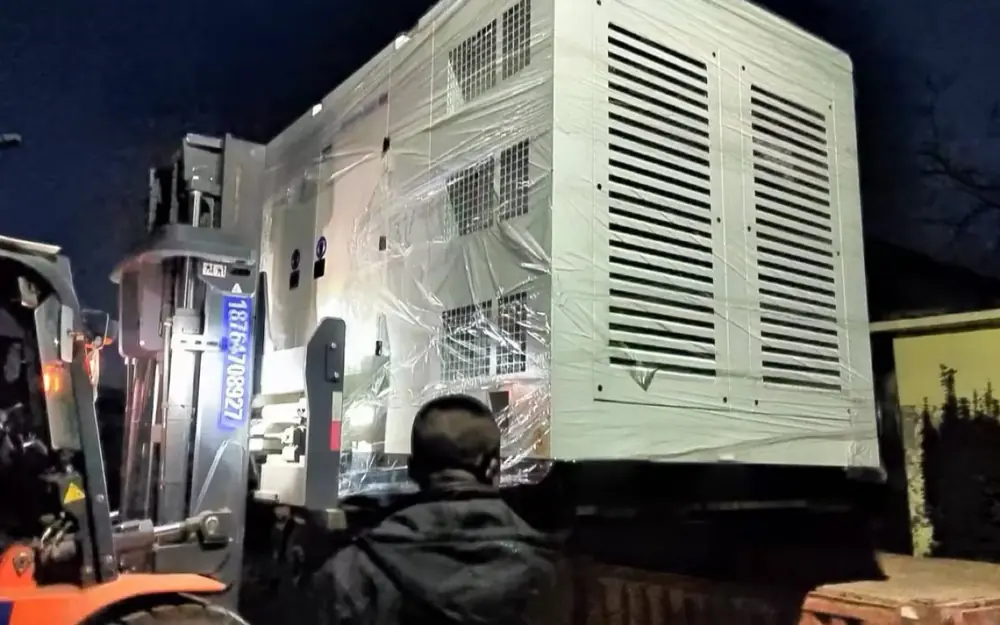
One hundred and twenty-five kVA is about 100kW at a 0.8 power factor. At this size the useful question is not whether the set can run the building, but whether it can hold the building through the worst start of the day.
Where this size is usually reviewed
Clinics with laundry, sterilisation and refrigeration, schools with ICT rooms and water pumps, small hotels with kitchens, and light industrial units with a compressor and a workshop drive. The common thread is a site with several distinct load groups and one or two that are heavy.
Because the set is often positioned near occupied space, the enclosure question arrives earlier at this size than at lower ratings. A plant room needs designed ventilation and noise is easier to manage at design stage than afterwards.
Changeover also becomes a real decision rather than a convenience. If the site must transfer automatically, that belongs in the specification from the start rather than as a later addition.
Checklist before you request the price
The more of this list you can answer, the more the quotation becomes a specification.
| Item to record | Detail that helps |
|---|---|
| Load groups | Which parts of the site exist and roughly when each is busiest. |
| Largest motor | Rating, driven equipment and the starting method used. |
| Voltage and phase | The supply the site actually distributes. |
| Siting | Indoor plant room or outdoor position, and how far from occupied space. |
| Changeover | Manual or automatic, and what the panel is expected to control. |
| Fuel storage | Base tank capacity or separate storage arrangement. |
| Delivery term | Which shipping and clearance responsibilities you want quoted. |
Using the quotation as a decision tool
Ask for the enclosure type, the changeover scope and the fuel arrangement on every offer. Those three lines routinely account for a large part of the spread between two prices at this rating, and they are the lines most often left implicit.
If the site is being built or refurbished, share the drawings or at least the intended position. Cabling routes, ventilation openings and the exhaust path cost far less to plan now than to correct after the set is on the plinth.
Related: 100kVA generator guide, 150kVA generator guide, ATS selection guide.
Get a written quotation
Three fields. We reply with the rating, the engine option and the delivery basis.
Diversity: why the sum of the nameplates is not the demand
The number that decides this size is not the total of everything installed. It is the total of everything that runs at the same moment, and those are rarely the same figure. A site with three pumps, a compressor, two cold rooms and a workshop does not draw all of them together for long, because the cold rooms cycle, the compressor cuts out at pressure and the workshop is used in bursts. Adding the plates produces a number no hour of the day ever reaches.
Diversity is a judgement, not a formula, and it has to be made honestly. The correct question is which loads can be on simultaneously and which are mutually exclusive by design or by habit. A borehole pump and a workshop compressor may never run together because the same person operates both. Two cold rooms may cycle independently but both restart after an outage, which is the case that matters.
The failure mode runs in both directions. Ignoring diversity buys a set far larger than the site needs, which then runs at a low load for years and delivers poor efficiency for its whole life. Over-applying diversity buys a set that trips whenever the coincidence happens, and the coincidence always happens eventually, usually on the hottest afternoon of the year.
Write the schedule as two columns: what can run together, and what cannot. The simultaneous column is the demand, and the largest start inside that column is the second number the quotation needs.
Where a set of this size is usually reviewed
Sites at this rating tend to share a shape: a steady base load that never stops, plus two or three heavy loads that arrive unpredictably. The table describes how that shape behaves in the four settings where this size is most often specified. It is a planning aid, not a load calculation.
| Site type | What the set actually sees |
|---|---|
| Small manufacturing | A steady motor base load with press or compressor starts on top. The start, not the base, sets the rating. |
| Commercial building | Air conditioning dominates by day and disappears at night, so the load swings widely across the day. |
| Hospital or clinic block | A base that must never drop, plus imaging and sterilisation loads that arrive without warning. |
| Water treatment or pumping | Long steady pumping interrupted by heavy starts. Pump starting method matters more than pump kW. |
| Estate or facility block | Many small loads with poor coincidence, plus a borehole pump that decides the sizing on its own. |
One set of this size, or two smaller ones in parallel
This is the last rating band where a single machine is almost always the simpler answer, and the first where the alternative becomes worth discussing. Two smaller sets in parallel can follow the load: one runs through the quiet hours, both run at peak. A single set cannot, and a single set that spends most of its life at a low load is an expensive way to make electricity.
The costs of the parallel arrangement are real. Two machines mean two services, two fuel connections, a synchronising panel and a control system that has to be understood by whoever operates the plant. It also means twice the number of things that can fail, though a failure then removes only part of the capacity instead of all of it.
The trade is worth making when the load profile is genuinely wide, when the site cannot tolerate a total outage, or when the load is expected to grow in clear steps. It is not worth making to chase efficiency on a site whose load is flat, because a single machine on a steady load is already in its efficient band and the extra panel is simply more to maintain.
The plant room and the foundation belong in the same budget
Buyers comparing offers at this size often compare machines and forget that the machine has to stand somewhere. A set at this rating needs a base that can carry it without settling, a room or compound with an air path sized for the radiator, an exhaust that discharges where it will not be drawn back in, and a fuel arrangement that can be filled without spilling into the bund.
The air path is the item most often got wrong. A room that is large enough for the set but has a small inlet will pull its own heated air back through the radiator, and the machine will derate slowly in a way that looks like a fuel or a load problem. The same happens with a canopy whose louvres are too small for the ambient at the site.
Foundations matter for a different reason: vibration transmitted into a slab travels into the building, and a set that is mechanically fine can still make a building unusable. An inertia base or anti-vibration mounts cost a fraction of the set and are difficult to add convincingly later.
None of this appears on a machine quotation, which is why the installed cost of two otherwise identical offers can differ substantially. The civil work is the buyer's scope in most cases, and it should be priced before the order rather than discovered during installation.
Service radius: who comes when it stops
At smaller ratings a set can be carried to a workshop. At this size it is fixed in place, and the maintenance has to come to it. That changes the calculation: the question is not only what the machine costs to own but who will attend it, how far they travel, and whether the parts they need are held locally or ordered from abroad.
A set that is technically excellent but two days of travel from the nearest competent technician is a worse asset than a plainer machine with a service arrangement behind it. The practical checks are simple. Ask who will do the first service and where they are based. Ask which filters are held in stock locally. Ask what happens to the controller if it fails, because a proprietary panel that must be shipped back is a different proposition from one a local technician can replace.
This is also the point at which the spares package earns its place. A filter set and a belt on the shelf are trivial next to the cost of a stopped site, and the same is true of a wiring diagram in a language the local electrician reads.
Why two quotations at this rating diverge
Two offers carrying the same rating can differ in every component behind the number, and at this size the differences are large enough to change what the site can do. The engine is the first: which design, which plant built it, and whether the parts network reaches Nigeria. The alternator is the second, because the difference between a unit rated for continuous duty and one that is not is the difference between holding the rating and being watched while approaching it.
The control and protection package is the third. A panel that starts and stops the set, and a panel that monitors and trips on pressure, temperature, speed and current, are different products with different consequences when something goes wrong at three in the morning. The enclosure is the fourth: open, canopy or container, with ventilation and acoustic treatment designed for the site rather than inherited from a catalogue photograph.
Fifth is the spares and documentation that come with the machine, from the filter set to the test record. Sixth is the commercial boundary: where the seller's responsibility ends, which port or which site, and who carries the risk of the leg in between. Those six lines are what a quotation actually says. A figure on its own says none of them, which is why an itemised written offer is the only thing worth comparing.
125kVA generator questions
How much is a 125kVA generator in Nigeria?
There is no single figure, because the offer depends on rating basis, available engine option, alternator and controller, enclosure, changeover scope, fuel storage and the delivery term. An incomplete offer is not a cheaper offer.
Is 125kVA suitable for a clinic or a school?
It commonly is, for a site with lighting, refrigeration, pumps, ICT equipment and limited air conditioning. Sites with imaging, sterilisation plants or heavy workshop machinery need the load schedule reviewed before the rating is fixed.
Does this size need an automatic changeover?
Not necessarily, but the decision should be made early. An automatic changeover changes the panel scope, the cabling and often the set's controller configuration, so it is cheaper to decide before the order than after delivery.
