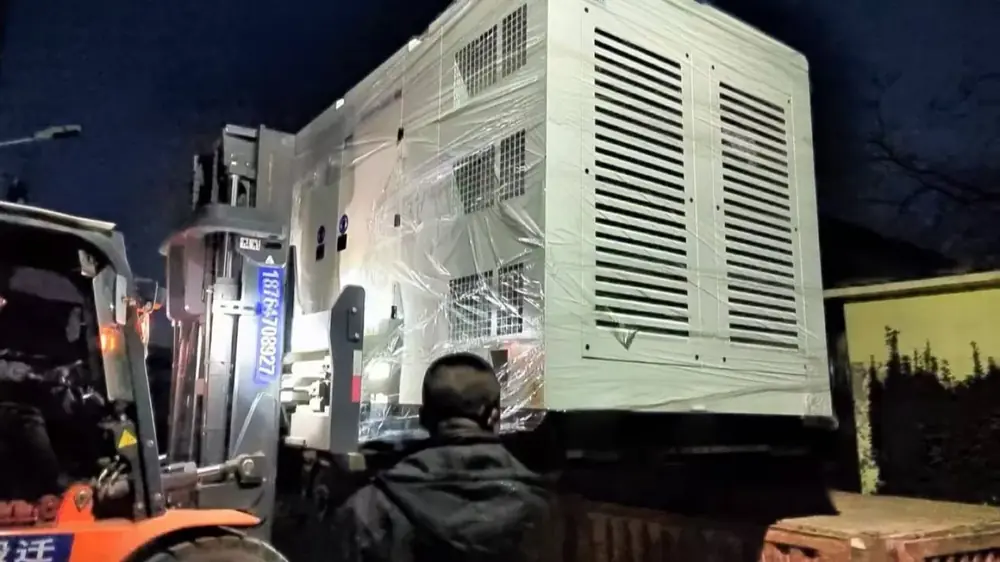
Sixty kVA is about 48kW at a 0.8 power factor. Inside a mid-size office or clinic that is generous for running load and tight only at start-up, which is why the largest motor belongs in the first message.
Why this size is the awkward middle
Below this band, loads are small and predictable. Above it, the site usually has engineering input and a real load schedule. At 60kVA the buyer is often a business owner with a sensible appliance list and no measured starting data.
That is the practical risk. A 60kVA set that is spec'd against a running total will carry the building happily and still trip on a hot afternoon when the largest air conditioner and the water pump start together.
The remedy costs nothing: write the list down with the largest motor marked, and say how many of the heavy loads can start at the same moment. The quotation can then be built on that combination.
The step down from this size is a common alternative and is looked at in the 50kVA quotation page.
Comparing 60kVA offers properly
A short list of questions separates a comparable offer from a rough one.
| Ask for | Why it matters at this size |
|---|---|
| Rating basis | Prime or standby, and the hours per day assumed. |
| Engine option | The available engine at this rating, named by model. |
| Alternator and AVR | Rating basis, frame and excitation arrangement. |
| Enclosure type | Indoor plant room or outdoor canopy, with ventilation consequences. |
| Changeover scope | Whether an ATS panel is supplied, and what it controls. |
| Fuel storage | Base tank or separate, and how it travels. |
| Delivery basis | FOB China or CIF Lagos, with each party's responsibility stated. |
Sending a request that gets a usable reply
Send the application, the load list, the largest motor with its starting method, the supply voltage and phase, the position the set will occupy, whether changeover is needed, and the delivery term. Add a note if a second phase of the project is planned.
If you are already comparing 45kVA, 60kVA and 80kVA, say so. It is more efficient to be quoted across the band on one specification than to run three separate conversations on three different ones.
Related: 45kVA generator guide, 80kVA generator guide, 100kVA generator guide.
Get a written quotation
Three fields. We reply with the rating, the engine option and the delivery basis.
48kW is a ceiling, not a budget
At a power factor of 0.8 the rating converts to 48kW, and that figure is the most the set should be asked for, not the figure a site should plan around. Two deductions come off it before anything is specified. The first is starting current: a motor of any size takes several times its running current while it accelerates, and the set has to carry that on top of whatever is already running. The second is margin for the load the site will add between delivery and the next two years, because a set ordered exactly to today's list has no room for the second air conditioner or the extra freezer.
The practical way to use the conversion is to compare it with the site's worst case rather than its average. A site that sits at half the rating for most of the day and touches the ceiling twice is a comfortable application. A site that touches the ceiling whenever the kitchen starts is already too small, and it will spend its life tripping breakers and glazing its bores.
How the reserve gets spent across a working day
The table describes the shape of a typical commercial day rather than a specific site. It is there to show that the same set can be comfortable in the morning and marginal in the evening, and that the rating is decided by the peak, not by the average.
| Period | What the set is doing |
|---|---|
| Early morning | Lighting, refrigeration and a pump. Light load, and the band where fuel is used least efficiently. |
| Office hours | Air conditioning, ICT and general sockets. The steady middle of the day, usually the design case. |
| Kitchen or production peak | Heavy motors starting on top of a warm load. This is the hour that decides whether the size holds. |
| Evening | Lighting returns while air conditioning cycles. Intermittent surges rather than a steady demand. |
| Restart after an outage | Everything tries to come back at once. The worst case, and the one most often left out of the brief. |
Almost every inquiry at this size is three-phase, and why
Above the small domestic band, the load mix changes character. A site that needs this much power usually has a three-phase distribution board, a three-phase pump, a compressor, or air conditioning split across phases to keep the supply balanced. Once any one of those is present, the single-phase build is no longer a candidate, because it cannot feed that load at all.
The consequence is that enquiries at this size should state the supply type at the top of the message. A buyer who asks for a quotation without saying whether the site is 230V single-phase or 415V three-phase will usually receive a question back, and the exchange costs a day. It also matters for phase balance: a three-phase set loaded heavily on one phase and lightly on the others will show a voltage imbalance that electronics and compressors both dislike, and the fix is a distribution decision made before the set is ordered rather than after.
A load that changes between morning and evening
The commercial sites that suit this band rarely draw a constant load. An office is air conditioning and computers by day and almost nothing at night. A small hotel is quiet in the afternoon and busy from evening, with kitchen motors, laundry and water heating arriving together. A clinic peaks when the theatre or the steriliser runs, not when the waiting room is full.
That pattern matters for two reasons. It decides the rating, because the peak is what the set must survive. It also decides the running cost, because a set idling through a quiet night at a small fraction of its rating delivers each unit of energy far less efficiently than the same set at a sensible load. Splitting the overnight base load onto a smaller source, or accepting a slightly larger set only where the peak genuinely demands it, is often the difference between a comfortable installation and one that drinks fuel for nothing.
What actually differs between two packages of this rating
A quotation for this band can describe a machine built to last a decade of daily work, or an assembly of parts chosen to reach the number. Six things separate them.
Which engine, and from which plant, is the first: the same displacement can come from a maker with a global parts network or from a builder whose spares have to be ordered by photograph. How the alternator is wound and excited is the second, because insulation class and temperature rise decide how much of the rating is usable continuously. What the control panel monitors, and what it actually trips on, is the third; protection that exists only on the drawing is not protection.
Fourth is the enclosure: open, canopy or container, and whether the canopy has been designed for the local ambient or simply wrapped around the machine. Fifth is the spares and documentation package, from filter sets to a wiring diagram a local electrician can read. Sixth is the trade term and where the seller's responsibility ends, since delivery to a port and delivery to a site are different scopes with different risk.
Ask for those six in writing. A reply that answers them can be compared with another reply; a reply that offers a single figure cannot.
When the answer is smaller, not larger
Buyers in this band usually ask whether they should move up. The more useful question is sometimes whether they should move down and add a second small source. A site whose overnight load is lighting and a fridge does not need this much capacity at three in the morning, and running a set that size for a handful of kilowatts is the least efficient thing a facility can do.
If the peak is real and short, keep the size and plan the load so the peak arrives in steps. If the peak is an artefact of everything restarting at once, a changeover sequence that brings loads back in order does more for reliability than another step up in rating, and it costs nothing in machinery.
60kVA generator questions
How many kW does 60kVA give?
About 48kW at a 0.8 power factor. Treat that as the set's ceiling, then subtract the effect of motor starting and any reserve the site wants to keep.
Is 60kVA enough for an office or a small hotel?
Usually yes for lighting, office equipment, refrigeration, a borehole pump and a limited number of air conditioners, provided the heavy loads do not all start together. Larger hotels with kitchens and laundry need a proper schedule.
Should I choose a silent set at 60kVA?
Choose the enclosure from the position, not from the size. A prepared plant room with designed ventilation can take an open set; anything near guests, patients, staff or a boundary is usually better served by an attenuated canopy.
